Teaching yourself to bake bread from one good book is often derailed by the overwhelming noise of conflicting internet forums and messy recipes. By following a singular, trusted guide, you will master the timing and texture needed for a perfect crust.
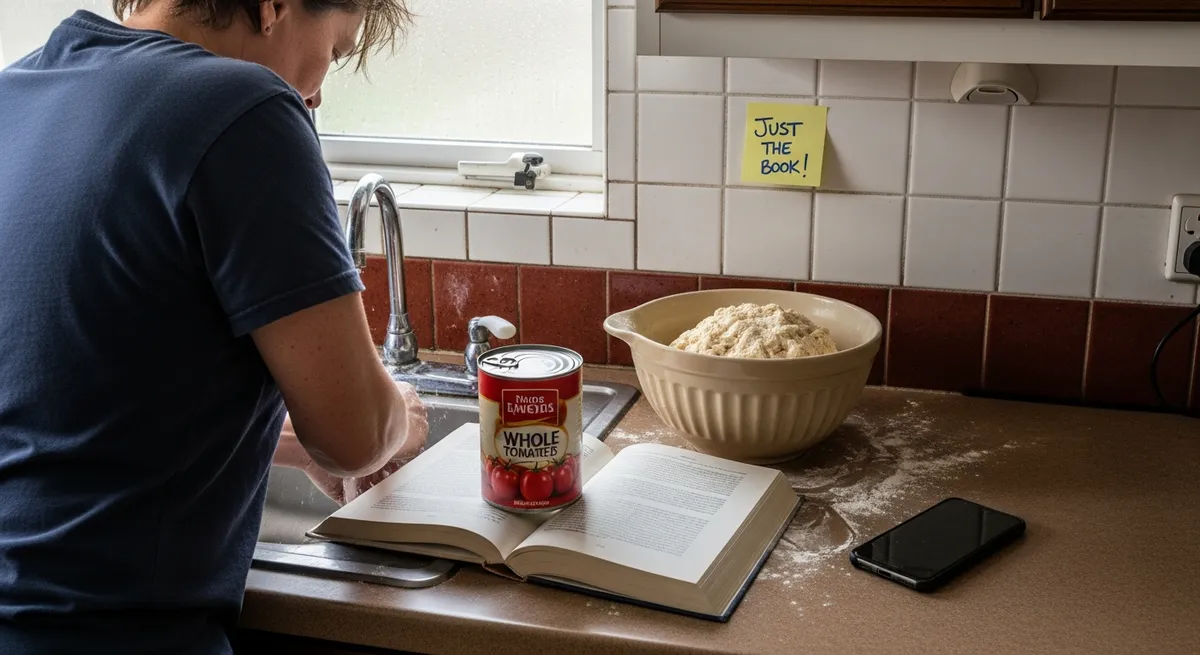
The dough sits in the bowl like something that has given up. I've three browser tabs still open on the counter - one says seventy-eight percent, one says sixty-five, one says it depends on your flour and your altitude and the mood of the room - and I've split the difference so many times there's no difference left. The bench scraper drags through it and it closes back over the blade like a slow gray mouth. My phone screen is smeared with something and the clock says 12:41 and the Post-it's still up there above the bowl - the one that says twice a day, a week, the book, just the book, in my own handwriting from four days ago. I don't throw the dough out.
The book says wet hands - so I run them under the cold tap and reach in, and the dough lifts in one piece, a long slow pull that doesn't tear. I press my index finger into the center and watch the crater fill in like sand after a wave, and I just stand there watching it, which I've never done before. The three browser tabs are still open on the counter and I don't close them and I don't look at them. At some point the Post-it falls off the cabinet and lands face-down on the floor and I leave it there.
The Midnight Mess on the Bench
The timer goes off while I'm putting on my jacket - and I silence it with my elbow. The dough goes into the banneton like a shirt I'm stuffing into a bag - fast, corners pressed in, lid down. Thirty-five minutes later I lift the Dutch oven lid and the smell is right but the color is wrong, and there's a crack running down the side that the book has no picture of, white and gluey where it split - like something that opened before it was ready to open. I press the bottom with my knuckle and it sounds like a door. The Post-it's still on the floor, face-down, and I don't pick it up.
The bowl is on the counter and I'm on the floor with my back against the cabinet and a novel open across my knees, and I can hear nothing from the dough, which is the first time I've noticed that it makes no sound. I read the same paragraph four times because I keep looking up at the bowl without meaning to - and eventually I stop trying not to. When I finally stand, the dough has pushed up against the plastic wrap and made a slow dome, and I peel the wrap back and lean in close, and the smell comes up warm and sour and faintly animal, like the inside of a barn after rain. The lame scores through in one pull - no dragging, no second pass, just a single clean mouth opening along the surface, and I set the lame down on the towel and don't pick it back up. The Dutch oven lid goes on with a small iron clang and I set the timer and then I sit back down on the floor and find my page.
What the Dough Finally Said
The ear catches the light and throws a shadow across the towel, a curved dark line I don't move to fix. I cut one slice with the bread knife my grandmother kept in the wooden block she got from a catalog - the one with the green handle, and the crust shatters just slightly at the edge and the crumb inside is open and uneven and nothing like the photographs. I set it on the upturned bowl and stand there a moment with flour still in the crease of my wrist. The book is open to the water-stain page, its spine finally cracked flat, and a small drift of white has settled into the groove my pencil made in the margin two years ago. I don't write anything new in the margin.
The heel of the loaf is still on the cutting board three days later, gone hard at the cut end - and I pick it up and knock it against the counter once the way my grandmother knocked melons at the market, listening. The book is open somewhere else now, a different page, flour in the binding from where I set it down open-faced to hold my place, and I haven't closed it once. I pull off a piece of the heel and it gives wrong - dense all the way through, no air, and I know without looking that I rushed the cold proof that time, jacket on, timer silenced with my elbow. I eat it anyway - standing over the sink, and it tastes like bread the way a drawing of a door looks like a door. The mixing bowl is already rinsed and waiting on the drying rack, chip on the lip catching the light, and I go to the cabinet for the flour.
The new loaf cools on the rack and I don't touch it for an hour, which is the longest I've ever left one alone - and when I finally press my palm flat against the bottom it's warm the way a forehead is warm, not hot, and something in my hand decides before I do that it's ready. Many home bakers find that their crumb structure initially fails to match professional photographs, often featuring uneven holes or large gaps beneath the crust known as 'tunneling'.and then I don't. The book is open on the counter with a smear of something dark on the page - olive oil or molasses, I can't tell, right across the paragraph about patience, and I leave the smear. My grandmother's mixing bowl is in the drying rack again and the chip on the lip is the same chip it has always been, and I set the book face-down next to it - spine cracked the rest of the way open now, and I go to bed without closing either one.
Disclaimer
This article is for general informational purposes only and doesn't constitute professional, financial, medical, or legal advice. Consult a qualified professional about your specific situation.