The list had fourteen names on it, written small on a Post-it because Donna did not believe in wasting a full sheet of paper on something she already knew by heart. She typed what time should we expect you and set the phone face-up on the counter next to the celery. The thumbs-up came back in eleven seconds. No time, no question about what to bring. She put the phone in her pocket, picked up the knife, the good one with the black handle she'd had since before Carol's first wedding, and started on the onions.
Gary came through the door at noon with his jacket still on and aimed himself at the couch like a man who had somewhere to be. Ted cracked his Modelo on the kitchen doorframe, on the spot where the paint had been chipping for three years from exactly that, and drifted toward the television. From the good armchair, the wingback with the taped leg, her mother raised her voice over the football to ask whether Donna had used the French's this time, the crispy kind, the right kind. Donna slid the casserole dish an inch further back on the counter so her mother couldn't see the label, and said yes, Ma, the crispy kind.
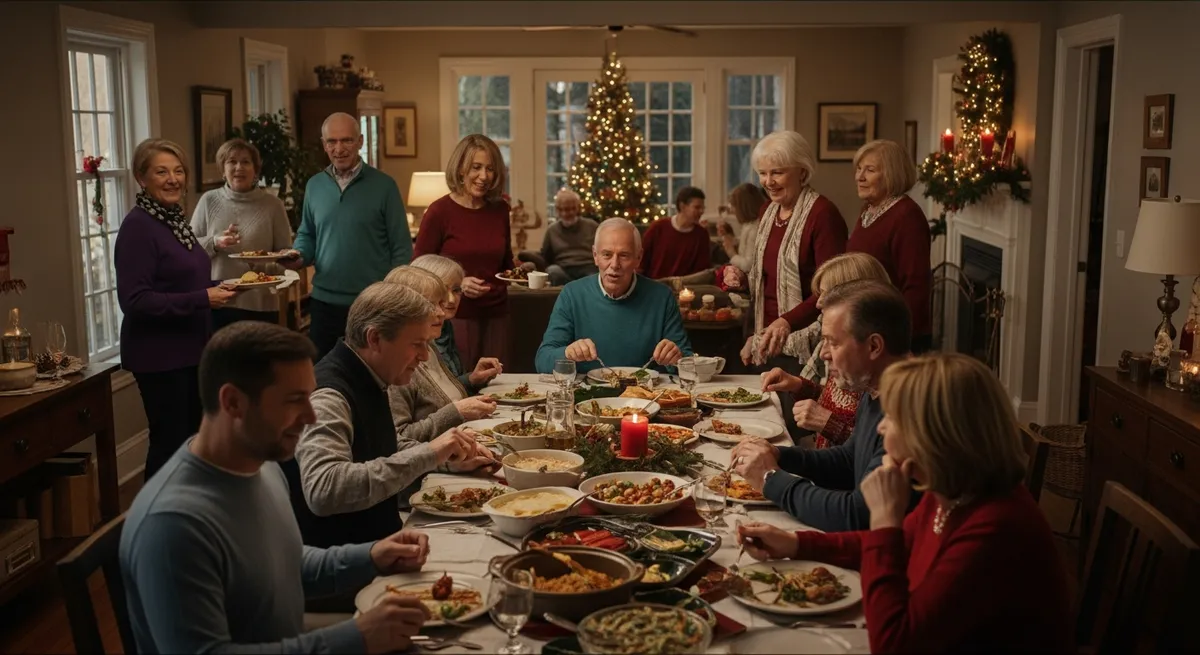
Nobody had assigned her the table. There had never been a meeting. It had simply become hers somewhere between her twenties and now, the way the taped armchair had become her mother's, and every year the fourteen names arrived assuming the table would be there, set and steaming, the way weather assumes a valley.
The water ran too hot at the sink and she didn't turn it down. In the window's reflection she could see Gary's sock feet up on the ottoman she had reupholstered herself, the one with the nail heads along the bottom, and Carol laughing at something on Ted's phone, head tipped back the way it went when she hadn't done any of the dishes. Twenty-two, Donna thought. Twenty-two years since anyone else had washed the plate with the blue rim, the one that had belonged to her mother's mother, the one nobody else would think to hold with two hands. She set it in the rack and reached for the next one.
Her daughter Maya had the good plastic wrap, the kind that actually clung, and was pressing it tight over the green bean dish, smoothing the bubbles out with her thumb the way Donna had shown her when she was nine. "Mom, you should just tell people to bring more stuff," she said, without looking up, the roll still spinning in her hand. "I know, I know," Donna said. She picked up the dish towel with the faded roosters on it and folded it into thirds, the long way first, then across, the same fold she had made every night of her adult life, and hung it on the oven handle. It was a fair point, and it was also beside the point. You could hand off the green beans. The table was a different kind of thing.
That night she smoothed the Post-it flat against the counter before folding it, the names still legible under the crease, and slid it into the drawer next to the Szechuan Garden menu and a magnet shaped like a lobster from somewhere coastal, Maine or Maryland, she could never remember which trip. The drawer stuck at the end and she shut it with her hip. The light over the stove, the one with the bulb she kept meaning to replace, threw its yellow cone onto the rooster towel. She turned it off and stood a moment in the dark kitchen, listening to the house tick, before she went upstairs.
In the morning the calendar was lying on the counter, December page up, a covered bridge in Vermont, and someone had written your house? in pencil in the square for the twenty-fifth. Carol's handwriting, big and slanted, the same as third grade. Donna stood on the cold tile in her socks and looked at it. Your house. As if there were a question mark anywhere in this family that ever expected an answer other than yes. She got the blue pen with the chewed cap out of the drawer and wrote heavy cream in the margin where there was room, then extra chairs. Then she tore a corner off the paper towel roll, wrote call rental place on it, and stuck it to the cabinet door with the lobster magnet.
The extra leaf for the table had been standing behind the coat closet door since last January. She carried it through with both arms, and the edge caught the hallway wallpaper at the same place it always caught, the little scrape she kept meaning to touch up with paint she no longer had the color of. On her knees under the table she found the brass bracket, the one that had to be turned with a coin because the slot had stripped years ago, fished a dime out of her pocket, and it worked, the way it always worked. The leaf went in with a sound like a door closing. She stood and looked at the longer table in the quiet room.
The cloth came down from the top shelf of the linen closet in its plastic bag, the good white one with the drawn-thread border her mother had used, and her mother's mother before that, smoothed and put away last January by Donna's own hands, waiting all year the way it had waited all the years before. She laid it down the center and smoothed it toward the far end with both palms until the border hung even on both sides. Then she went back for napkins and stood looking at the shelf. Twelve cloth ones. There had never been more than twelve, in three generations. She found the paper ones from the party store, autumn leaves printed on the sleeve, and counted chairs in her head, six at the table, four from the kitchen, the folding ones behind the coats, and got to fourteen, and then to fifteen, because of Maya's boyfriend.
She went back to the drawer for the pen and added Maya's boyfriend under extra chairs on the paper towel square, pressing hard because the cabinet door was soft. She tore off a second square, wrote napkins (more), and stuck it beside the first one under the lobster magnet. Two small flags on a cabinet door, the entire visible archive of a job nobody had ever given her and nobody could take away. She stepped back and looked at them for a moment, the way a foreman looks at a site. Then she turned and went to set the table with what she had, which was, as it had been for twenty-two years, enough.