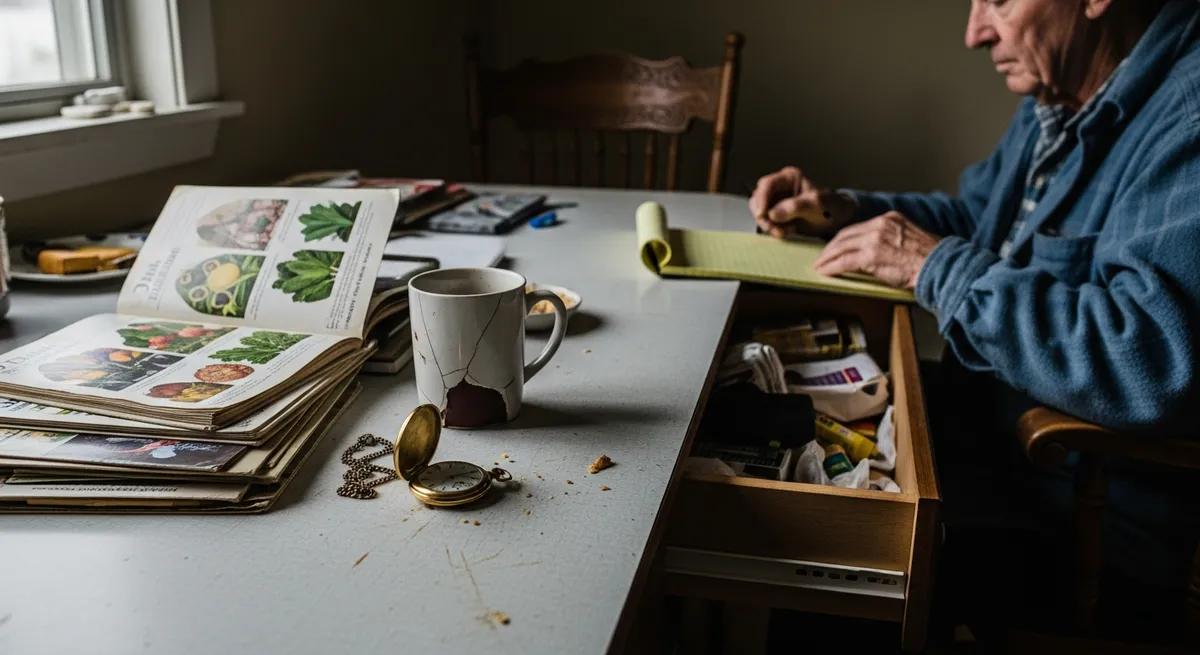
My father kept the pocket watch in the left breast pocket of his good coat, the charcoal one he wore to funerals and job interviews and once, memorably, to a Sears to dispute a water-heater charge. The watch was brass, older than anyone still living could say for certain. The chain had a kink in it, third link from the clasp, from something that happened before any of us. He never explained the kink, and we learned early that asking got you the Sears story instead.
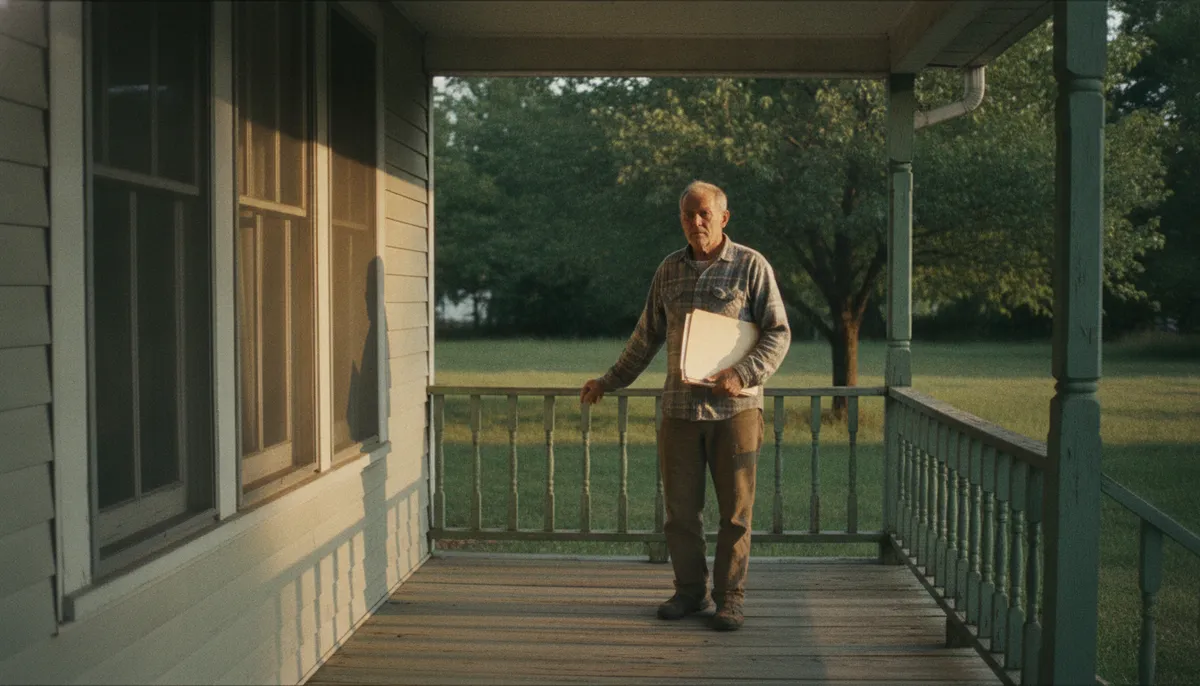
The last time I visited the house, he walked me out to the car and handed me a sandwich bag, the zipper kind, with the watch inside pressing against the plastic like something trying to see out. His spare keys were in there too, on a Meineke fob so old the logo had worn to a smear. Keep this at your place for a while, he said. He didn't say why, and he had already turned back toward the porch by the time I thought to ask.
The drive home was forty minutes of radio I didn't hear. I sat in my own driveway with the engine off and started a message to my brother. Dad gave me the watch to hold. I watched the cursor blink after the period, deleted to hold, tried for some reason, deleted the whole thing, and sat there until the neighbor's porch light clicked on and laid a stripe of orange across the hood.
The bag went into my kitchen drawer, the one with the takeout menus, because I couldn't think of a spot that wouldn't turn it into a shrine. Some mornings I opened that drawer for a pen, saw the brass through the plastic, and closed it again without taking the pen.
He called on a Sunday, which was unusual for him, and said he needed me to write something down. The nearest thing to a pen was a burnt sienna crayon, flat on one side from somebody's old school project, and the nearest paper was the back of an electric bill. He said my name. He said our sister's name. Then he left a pause I could hear him breathing through, and he said, the watch goes to Marcus. He gave the reason in one sentence, and I have that sentence memorized, and I am not going to repeat it here. The crayon made a soft, waxy line. I wrote down every word anyway.
Marcus called three days later. I could hear his dog clicking across hardwood somewhere behind him, and he asked if Dad had seemed okay to me lately. I said yes, fine, because the only other answer involved reading him the electric bill, and that was Dad's to read whenever he decided to. Marcus talked about his gutters for a while. I said gutters back at the right moments. The bill sat four feet from my elbow the whole call, folded behind the menus, the crayon letters showing faintly through the paper where the lamp hit it.
I had taken a box of kitchen things home from the house that winter too, back when he was closing off rooms he no longer used. In it was a dish towel that had been yellow once, with roosters on it, the roosters gone the color of old mustard. He had folded it in quarters, short edge to short edge, the way nobody else in the family ever thought to do. I set it on my counter next to the pepper mill and let it stay there for an afternoon, still folded, and watched the light from the window move across the roosters. Then I hung it on the oven handle, where my mother would have hung it.
My sister came for Thanksgiving and helped me clear the table. When she pulled the drawer open looking for a rubber band, her hand stopped over the sandwich bag. She looked at the watch inside it, then at me. I told her I was keeping it there until I found a better place, which was true if you didn't lean on it too hard. She didn't touch the bag. She found a rubber band at the back, the thick kind that comes on broccoli, doubled it around the bread bag, and we talked about her drive home and the weather coming in off the lake. Neither of us said the word watch again all night, though I noticed she kept her coffee cup on the counter nearest that drawer and turned it in small half-circles with her thumb.
Here is the one time I ever saw him wind it. I was fourteen. It was the Saturday before Christmas, and he stood at the sink in his undershirt and held the watch up to the window light the way you'd candle an egg. The second hand made three full circles while he watched. Then he lowered his arm and pressed the watch flat against his sternum with his palm and just held it there, against the cotton, his eyes on the backyard. He didn't know I was in the doorway. I found that scene written on the back of the electric bill too, below his sentence, in my handwriting, and I don't remember writing it.
He called again in February, a Tuesday. I was at the table with a cup of tea gone cold, and he asked whether I'd found a box for it yet, a proper one. I said I was looking, which was a lie you could hold in one hand. He told me there was a tin in his coat closet, a blue one, on the shelf above the scarves. It had held throat lozenges once, he said, and it was empty now and the right size. I wrote blue tin, coat closet in the margin of a crossword I'd been ignoring for a week, in pen, pressing hard. I didn't tell him I already knew about the tin. Two Sundays earlier I had lifted it down, shaken it, heard nothing shift, and put it back exactly as he kept it, the small dent in the lid facing the wall.
I drove the watch over to Marcus's in March, the blue tin riding in the cupholder like a passenger. He met me in the driveway with the dog circling both of us, and I handed the tin across and watched him work the lid off with his thumbs. He stood there a minute without saying anything. Then he asked what Dad had said, that day on the phone, and I told him the sentence, once, in his driveway, with the dog leaning against my leg. It belongs to him now. He held the watch up and then pressed it flat against his chest with his palm, the same gesture I'd watched from a doorway at fourteen, and if Marcus had ever seen Dad do that, it was news to me.
The electric bill stayed in my kitchen drawer. That part, nobody assigned.