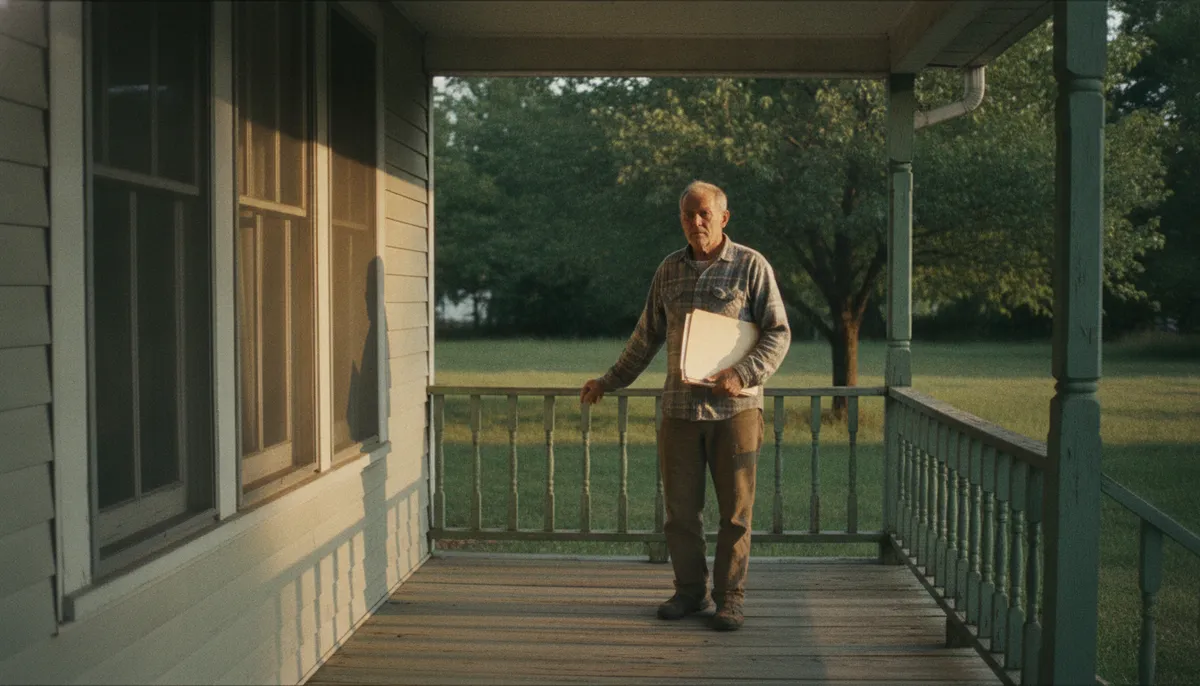
My grandfather packed the clay around the roots with the heel of his hand, firm and unhurried, the way a man tamps tobacco. He folded the burlap square and set it on the lip of the hole like a small surrendered flag. I was eight, sitting on the back steps with a popsicle going soft, orange dripping onto the concrete between my sneakers, and without looking up he said it would be a good twenty years before that tree gave anything worth eating. I remember deciding that twenty years was not a number that applied to me. I remember it because I was wrong in a way that took decades to finish being wrong.
Forty-one steps out, thirty-nine back
He watered the sapling with a five-gallon bucket that left a wet crescent on the patio every time he set it down to rest his back. Once I counted his steps to the spigot: forty-one going out, thirty-nine coming back, because the empty bucket let him walk faster. He staked the little tree with a length of my grandmother's old pantyhose, the color of a Band-Aid, knotted twice with the same two-handed knot he used on his boots. Pantyhose, he told me, because wire cuts bark and a tree remembers every cut. All that first summer the sapling stayed thinner than the mailbox post, and the stocking looked like it was doing most of the living for both of them. He checked the knot every evening whether anything had changed or not, pressing the bark lightly with one thumb, the way a person tests a peach.
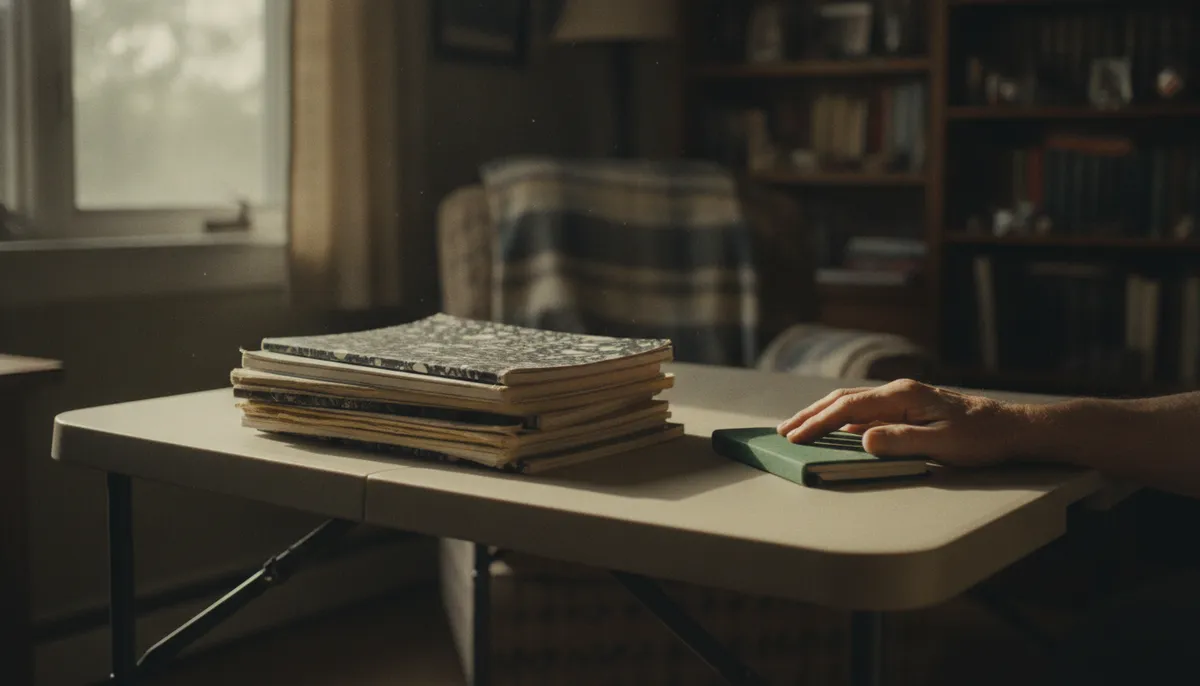
The peaches came, eventually, though I was grown and gone by the time the tree hit its stride. What I have instead of those harvests is a later picture: my grandfather at his kitchen table in the last year, the oxygen concentrator ticking in the corner, its clear tubing tucked under the chair leg so nobody would trip. On the table, a fruit catalog with coffee rings on the cover and the spine bent back so far it had given up resisting. He circled a Reliance peach with three slow loops of the ballpoint, licking the pen once when it skipped, and then wrote a year in the margin in the handwriting he saved for important things, capital letters, pen pressed down hard. The year was five years out. Outside the window, the tree he had planted when I was eight was throwing shade across half the fence line. He did not look at it. He did not need to.
He did not get the five years. Nobody in the family said anything wise at the funeral about the catalog, because nobody knew about it yet. I found it in the truck, warped from the heat, the corner of the cover lifting like a page that wanted turning, with a seed packet of cherries tucked inside, unopened, the fruit on the photograph so red it looked painted. I put both on my kitchen counter and left them there and went to bed, and they stayed on that counter for the better part of a year, the catalog opening itself a little every time the corner lifted.
The girl under the branches
Last spring I drove past the old house. I do this maybe twice a year, slowing without stopping, the way you check on something you no longer have any right to check on. The tree had gone up and out in a way I was not prepared for, thicker through the trunk than my arm, and under it, in the grass, sat a teenage girl with a yellow highlighter behind one ear and a notebook open on her knees. While I watched from the curb with the engine off, a petal came loose and drifted down and landed on her page, and she did not brush it away. She turned the page and the petal went with it, pressed between whatever she was reading and whatever came next. The shade lay across her knee and her notebook and the grass beyond her, and my hands were resting at ten and two on the wheel, which is where his hands always rode, and I noticed that the way you notice a word spelled wrong. I put my hand on the door handle. Then I took it off and drove home.
What got me was not grief, or not only. It was arithmetic. He was younger than I am now when he dug that hole. He knew the timeline out loud, said it to a child eating a popsicle, and then he picked up the bucket anyway, forty-one steps out and thirty-nine back, all summer, for strangers. The girl with the highlighter has no idea he existed. That is not the sad part. That is the whole point of the transaction, and it took me until my fifties and a parked car to understand it.
That week I went to the hardware store and stood in front of a bin of wooden stakes longer than a person should stand in front of stakes. I bought four, which was three more than I needed. At the nursery there was a row of bare-root peach trees against the back wall, roots wrapped in damp newspaper the color of old snow, and when the kid in the apron asked if I needed help I said no, which was not entirely true. I bought a Reliance. I carried it to the car with both arms, the way you carry something asleep.
I planted the cherry from his seed packet too, in April, in a wire cage against the rabbits. It is still shorter than the fence post beside it. I step over the soaker hose every morning to check it, even in the cold, even though a seed-grown cherry may take longer than I have and may never come true to that painted photograph at all. The peach went in beside it. For the stake tie I cut a strip from a pair of pantyhose I had not worn since his funeral and knotted it twice, two-handed, a knot I have no memory of being taught. The stake went into the ground harder than I expected, and the sound it made was the sound a door makes when it finally closes all the way.
The catalog lives on my counter still, corner lifting. His three loops around the Reliance have gone brown at the edges the way ink does. Underneath the year he wrote, I have written a year of my own, same margin, same capital letters, pen pressed down. Mine is twenty years out. I did the math before I wrote it, and the math does not favor me sitting under either of those trees with a peach in my hand, and I wrote it anyway. Some mornings I press the cherry's thin bark with one thumb, lightly, testing, and nothing has changed, and I press it again the next morning. Twenty years is not a number that applies to me. It applies to somebody, though. Somebody with a notebook, maybe, and no idea.