Most reading nooks die in the planning folder. The corner gets measured four times, the swatches get photographed in morning light and again at two o'clock, sixteen chairs get saved to the phone, and a year later there is still nowhere to sit because no real chair ever looks as good as the one in the catalog, which lives in a room where nobody has ever spilled anything. The project stalls at decorating, when it was never a decorating project. A nook that actually gets used is built around three unglamorous things: your back, your knees, and the eyes you have now.
The good news is that this makes the job smaller, cheaper, and finishable in a weekend. Here is the order the decisions should happen in, with the honest trade-offs at each step.
Choose the corner before you buy anything
Walk the house at the hours you actually read, because a corner that glows at ten in the morning can be a cave by four. You are looking for a spot that clears a few practical hurdles:
- About 30 inches of clear width at minimum, so a chair fits without your elbows brushing wall on one side and bookcase on the other. A snug corner feels cozy; a cramped one keeps your shoulders up around your ears.
- An outlet within reach of a lamp cord. This is not negotiable. An extension cord run across the floor to a reading corner is a trip hazard you will cross at night, half asleep, in socks.
- Out of the traffic pattern. If the corner sits between the kitchen and the back door, every reading session will be interrupted by legitimate household business, and no cushion fixes that.
- Near a window if you can, but at an angle to it. Facing the glass means glare on the page in the afternoon; putting your back flat against it means your own shadow lands exactly where the words are.
- Check what is under and above the spot: a heating vent that roasts your ankles or a ceiling fan that flutters pages will quietly ruin the location no matter how good it looks.
Forty-odd inches of wall between a window and a radiator is plenty. Small corners are actually easier to make good, because one chair and one lamp can fill them completely.
Buy the chair with your knees, not your catalog eye
This is where most of the budget should go, and where the showroom photograph is least trustworthy. Test any candidate in person the way you will really use it: sit for ten minutes, holding something roughly the weight of a hardcover book.
Seat height matters more with every year past fifty. A seat 17 to 18 inches off the floor, about the height of a dining chair, lets your feet rest flat and your knees sit level with your hips, and it lets you stand back up with one push instead of a rocking start. The deep, low, bucket-style lounge chairs that photograph so well are exactly the ones that trap you. If getting out of a chair requires strategy, you will unconsciously stop getting into it.
Look for firm arms at a height that supports your forearms while you hold a book, because a heavy hardcover held unsupported for forty minutes is a shoulder ache with a plot. A seat that is firm rather than marshmallow-soft supports your lower back over an hour far better than something you sink into. If the chair you love is a touch too deep, a small cushion behind your lower back fixes it; a footstool fixes almost everything else and costs little. Secondhand shops are full of well-made armchairs at these dimensions for a fraction of new prices, and a worn armrest should not disqualify anything. Wear is evidence the chair works.
Light it for the eyes you have now
The single dim, warm bulb that looks so atmospheric in photographs is the most common reason a finished nook goes unused. Reading in weak light does not damage your eyes, but it makes them work harder, and the result after half an hour is fatigue, headache, and a nap you didn't choose. This gets more pronounced with age: the National Institute on Aging lists needing more light and more time adjusting to changing light among the normal changes of the aging eye, and notes that improved lighting is one of the simplest corrections available.
The practical setup is two layers. First, some general room light, so the page is not a bright island in a dark room, which is its own kind of strain. Second, and more important, a dedicated task lamp with an adjustable arm, positioned beside and slightly behind your shoulder so light falls onto the page from the side instead of bouncing off the paper into your eyes. Put a standard bright bulb in it, in the range of an ordinary 800-lumen household bulb or brighter, and pick a shade that sits below eye level when you are seated, so the bulb itself never shines at you. A decent adjustable task lamp costs around $50, and it is the difference between reading for ten minutes and reading for an hour. If you wear progressive lenses, the adjustable arm earns its keep twice, since you can bring the light to where your reading zone actually points.
If your nook time includes a tablet or e-reader, the same corner works, with one addition: screens invite longer unblinking stretches than paper, so borrow the habit the American Academy of Ophthalmology recommends for digital eye strain and look up at something distant for a few moments every twenty minutes or so.
Add the small things that decide whether you use it
A surface within arm's reach for the mug, even if it is a stack of two crates. A blanket that lives on the chair, because a nook you have to provision like an expedition gets skipped. A shelf or basket holding the next two or three books only, so the choice of what to read next is already made. And a standing rule that the phone charges in another room, or at minimum face-down out of reach, because the chair cannot compete with a screen that lights up and should not have to.
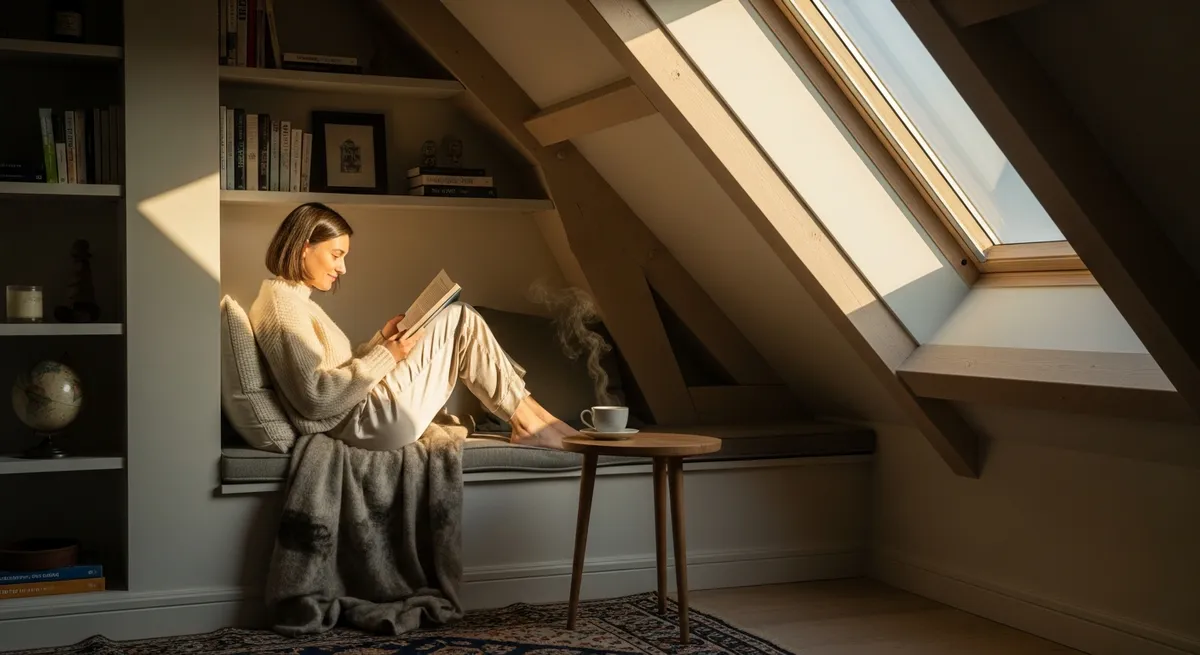
Then stop adding. The candle you will never light, the throw pillows that have to be relocated before you can sit, the rug that cost more than the chair: these are furnishings for the photograph of the nook, and the photograph is the old failed project wearing new clothes. A ring mark on the shelf and a flattened seat cushion are what success looks like here.
Where the money goes, honestly
If the budget is a few hundred dollars: most of it to the chair, around $50 to the lamp, and the remainder to a footstool and whatever surface holds the mug. If the budget is tighter than that, buy the lamp new and everything else secondhand, in that order of priority. Lighting is the one component where quality is cheap and the payoff is immediate, and a good chair under a bad lamp still goes unused. There is no version of this project that requires new furniture to work.
The part that matters more, later
A reading corner sounds like a small domestic luxury, and it is, but it is also infrastructure for a habit, and habits carry more weight as we get older. The National Institute on Aging reports that older adults who spend time on hobbies and activities they find meaningful tend to be happier and healthier than those who don't, and reading is among the most durable of those activities: it costs nearly nothing, it survives bad knees and bad weather, and the library keeps it supplied forever. What a dedicated corner does is remove the daily friction. The chair is already right, the light is already right, the book is already waiting. All that is left to decide is when.