The larger case had a name tag she'd filled out in three different pens, crossing out addresses. The zipper pull had bent itself into a question mark sometime in the night. She stepped over the wheel of the smaller case to reach the light switch, and her shin found it instead. The brass key caught the porch light coming through the sidelite, one clean yellow rectangle on the table, and she looked at it the way you look at the one thing you remembered.
The case caught the lip of the second step and she had to set it down - both hands on the handle, her good shoulder already burning in the socket the way it had in Edinburgh and before that in Porto. Three people moved past her in the time it took - a man with a canvas roll tucked under one arm, a woman in a linen shirt with a single strap crossing her chest, someone's teenager with nothing but a rain jacket tied at the waist. The pigeons on the overhead wire didn't move. She got the case to the platform and stood with it, breathing - her hair across her face, while the departure board clicked over to a new name and a new track number she had to read twice.
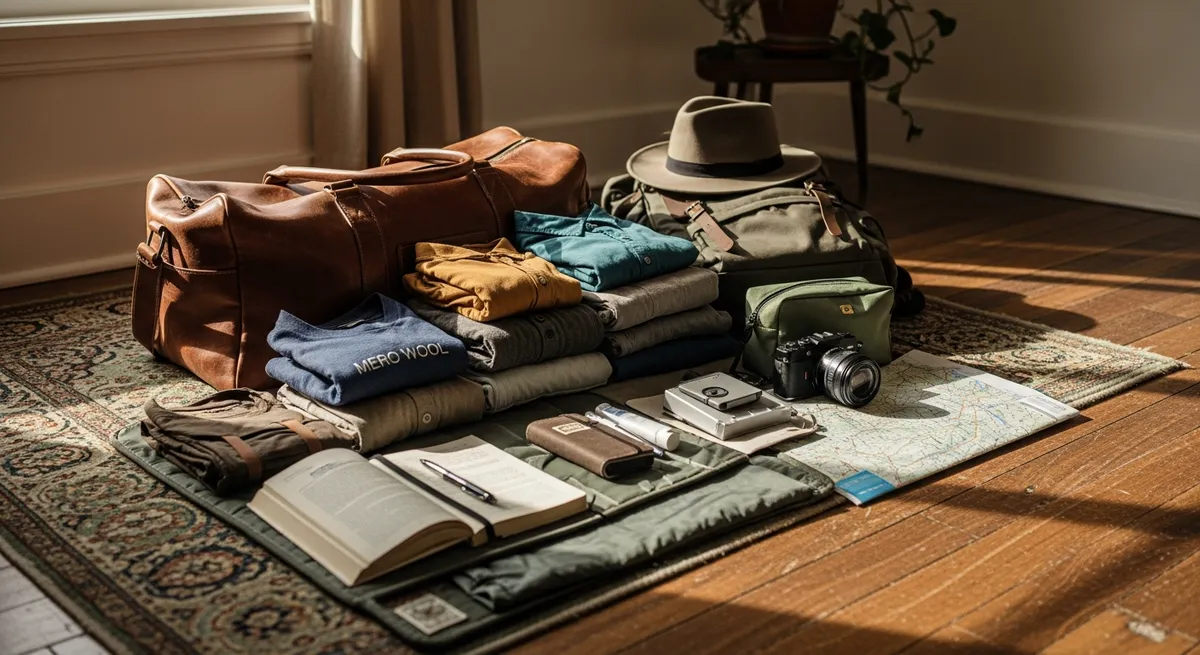
The bed took all of it: four grey cardigans in a row like a family photograph, each one a slightly different shade of nothing. The travel umbrella still had the plastic sleeve on, the little cardboard tag that said *compact* in four languages. Two books, both unread - both about a city she'd left two cities ago. The yellow light made everything the same color, the cardigans and the pillowcase and the backs of her hands. She stood at the foot of the bed and counted the cardigans without meaning to.
The Zipper That Already Knew
The clerk stapled the receipt to a yellow carbon copy and slid it under the glass without looking up. Through the narrow window in the back door she could see the case standing upright on a metal shelf between two boxes wrapped in brown paper, its question-mark zipper facing out. She had paid in cash, three bills and coins she counted twice on the counter, more than she'd spent on the case itself at the shop on Marchmont Street - the one with the dog tied outside. The cobblestones held a thin slick of morning rain and she stood on them until the back-room door swung shut and the case was gone, which took about four seconds. In her hand was the receipt and on it was a tracking number and she folded it into her jacket pocket next to the brass key, which she was still carrying.
The path had turned to loose plates of shale just below the terraced vines, and the old man's stick went sideways before the rest of him did, one arm out - his hat already gone. She caught his coat at the elbow, both her hands free, no strap across her chest, nothing pulling her back down the hill. He smelled like tobacco and warm wool and he said something in Portuguese that she didn't understand and then laughed, which she did. They stood together for a moment looking out at the river far below - copper-colored in the afternoon, while his hat settled in the scrub a few feet off the path. She retrieved it, handed it back, and he held it to his chest with both hands the way people hold things they almost lost.
The hostel room had a single bulb and a window that opened onto a wall. She set the bag on the chair - the one chair, wooden - the paint gone at the armrests - and unzipped the front pocket with two fingers. The key went in next to a folded bus ticket, both of them weightless against the canvas, and the zipper closed on the first try without her having to press anything flat. She stood at the window and looked at the wall, which was close enough to touch, the old mortar between the stones worn smooth and grey as river water. Her hands hung at her sides with nothing in them - which was the same as everything.
What the Cobblestones Charged
The postcard rack at the tabacaria spun one slow quarter-turn and stopped, and she bought two cards she wouldn't send and a pen that dried out on the third word. At the long table in the square she watched a man lift his pack onto the bench to find something at the bottom, then lift it again to find the thing he'd moved while looking for the first thing, the canvas sides gone dark at the straps from weeks of contact. Her own shoulder, the good one - had stopped being the good one somewhere around Tuesday. She touched the soreness through her shirt the way you touch a bruise to confirm it, one finger, checking. The pen lay on the table between the two blank cards and the afternoon light moved across all three of them while she sat with her hands open and wrote nothing.
The woman at the stall folded the scarf in thirds and held it out, and she took it with both hands, a thing she hadn't planned - terracotta-colored, the weight of it almost nothing. She stood in the narrow street for a moment trying to think what she'd left room for, which drawer, which corner, and then remembered that there was no drawer - no corner, only the single bag sitting back in the room with its zipper already pulled tight. The dry pen was still in her pocket. She carried the scarf folded over her forearm all the way back to the hostel and sat on the edge of the wooden chair and held it in her lap and didn't open the bag. On the wall across the alley someone had painted a door the color of the scarf, the exact same terracotta, and she sat looking at it through the window until the light changed.
The morning train left at six and she was on the platform at five-forty with the single bag at her feet and the scarf around her neck, the terracotta warm against the cold - and when she lifted the bag to the overhead rack her shoulder made a sound she felt in her back teeth. Across the aisle a woman her age was doing the same with a case the size of a small refrigerator, both arms shaking, a man in the next seat watching without standing. She sat down and looked at her hands, the knuckles pale from the handle, and flexed them once in her lap. Out the window the platform was emptying - a porter moving a trolley stacked with three identical navy cases banded together with yellow straps, and she watched them go until the train began to move and the cases and the porter and the yellow strap all became one smear of colour and then nothing. In the seat pocket in front of her was someone's folded map, a city she wasn't going to, and she left it there.
Disclaimer
This article is for general informational purposes only and doesn't constitute professional, financial - medical, or legal advice. Consult a qualified professional about your specific situation.