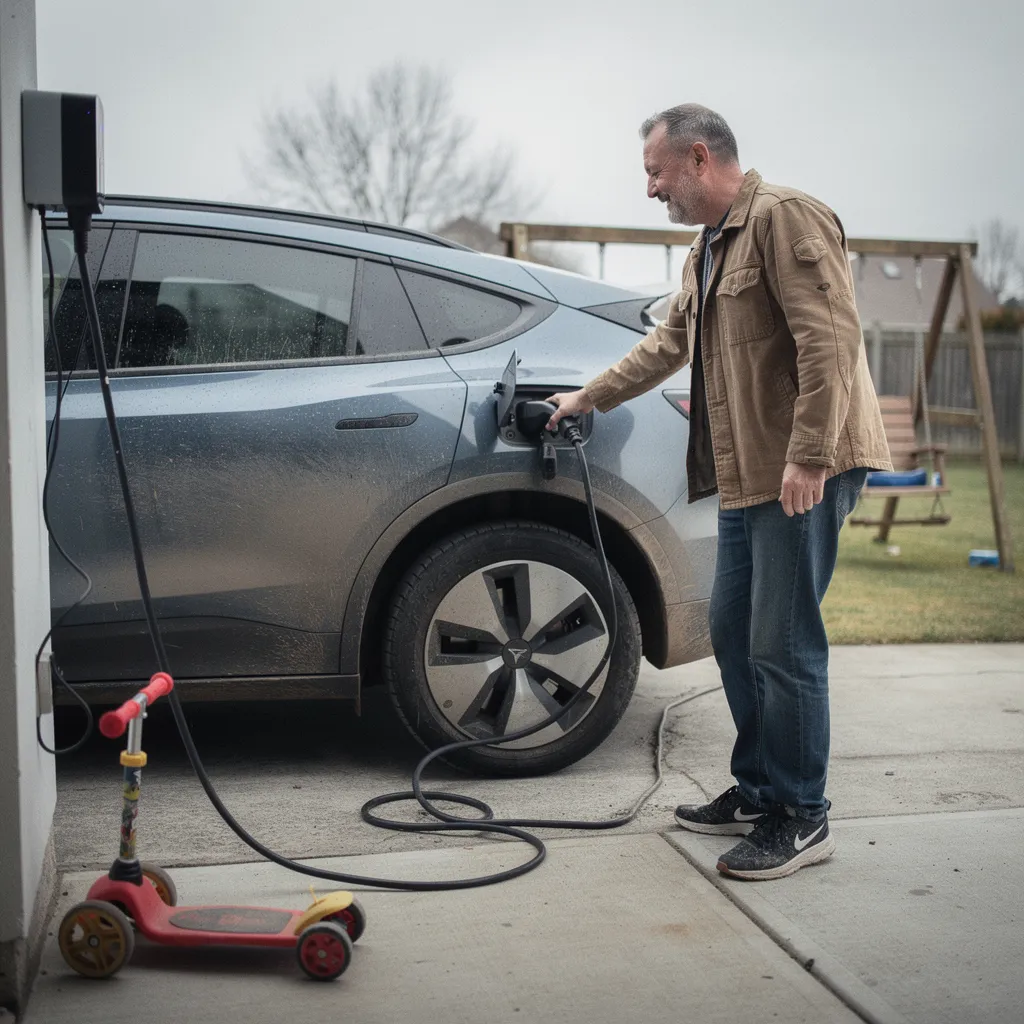
Electric family SUVs come in a wide price range, and the feature list varies just as much. Understanding what drives the cost - and what you actually get for it - takes more research than buying a regular gas SUV. This article breaks it down concretely.
What Electric SUVs Offering Practical Family Features Typically Cost
Base prices for electric SUVs with genuine family-oriented features - three-row or large-cabin layouts, real cargo room, DC fast charging, and advanced safety systems - run from roughly $42 -000 to $90,000 before incentives, according to pricing data tracked by the U.S. Department of Energy's Alternative Fuels Data Center.1 That range is wide because it spans compact two-row crossovers with good cargo space all the way to full-size three-row electric SUVs.
The federal EV tax credit under the Inflation Reduction Act can reduce the effective purchase price by up to $7,500 for qualifying vehicles and buyers, according to the IRS.2 Income caps and vehicle MSRP limits apply - the SUV MSRP cap is $80 -000 - so not every model qualifies and not every buyer qualifies.
What Makes the Price Go Up or Down
Battery size is the single largest cost driver. The EPA's vehicle labeling data consistently shows that larger battery packs - necessary for longer range - account for 30 to 40 percent of the total vehicle manufacturing cost.3 Moving from a 75 kWh pack to a 100 kWh pack can add $5 -000 to $10,000 to a sticker price before anything else changes.
Drivetrain configuration matters too. Dual-motor all-wheel drive - which many families want for winter driving - adds roughly $3,000 to $6,000 over a single-motor rear-wheel-drive version on most platforms. Integrated third-row seating adds complexity to the floor structure and battery packaging, which is why true three-row electric SUVs cluster at the top of the price range.
Trim level stacking is aggressive in this segment. Safety technology packages - automatic emergency braking - blind-spot monitoring, rear cross-traffic alert - are standard on base trims of many current models because the National Highway Traffic Safety Administration (NHTSA) has been pushing for broader standard inclusion of these systems.4 But features like hands-free highway driving assistance, panoramic roofs, and premium audio are almost always reserved for upper trims, adding $4 -000 to $12,000.
Where the Purchase Price Money Actually Goes
On a $60,000 mid-size electric family SUV, the rough cost allocation looks like this: the battery pack alone accounts for approximately $18,000 to $24 -000 of that figure at current cell costs, according to BloombergNEF's 2023 battery price survey, which reported an average battery pack price of $139 per kWh5. A 150 kWh equivalent across a 75 kWh pack gives roughly that spread.
Electric motors and power electronics make up another $3,000 to $6,0004. The remainder covers the body structure - which on family SUVs has to accommodate child seat anchor points - large door openings, flat usable floors, and in three-row models, a structural pass-through for the rear seat - plus software, interior - and dealer margin.
DC fast charging hardware built into the vehicle, typically a 150 to 350 kW onboard charging port, adds component cost that doesn't exist in a conventional SUV. That hardware is why electric SUVs with the same cabin as a gas equivalent reliably cost $10,000 to $15,000 more at equivalent feature levels - even before the battery premium.
The Costs That Catch Families Off Guard
Home charging installation is the most commonly overlooked expense. A Level 2 (240V) home charger and the electrician work to install a dedicated circuit runs $500 to $1 -500 in most U.S. markets, according to figures from the U.S. Department of Energy's Office of Energy Efficiency and Renewable Energy.6 Some older homes need a panel upgrade, which can push that cost to $3,000 or more.
Cold-weather range loss is real and underestimated. The AAA's testing program found that at 20°F, electric vehicle range drops by an average of 41 percent compared to the EPA-rated range - a result from their 2019 and updated 2023 testing cycles.7 For a family SUV rated at 300 miles - that means roughly 177 miles in hard winter conditions. Families in cold climates need to size their battery choice accordingly, not just check the EPA number.
Insurance premiums run higher. The Insurance Institute for Highway Safety (IIHS) notes that repair costs for electric vehicles are elevated partly because battery pack damage in even minor collisions can require full pack replacement, a repair that can exceed $15,000 to $20,0008. Thorough and collision premiums reflect that. Budget 10 to 20 percent more for insurance on an electric SUV versus a comparable gas model as a starting assumption.
State-level registration fees for EVs have also risen in many states. Over 30 states now charge an annual EV registration surcharge - ranging from $50 to $200 or more per year - to offset lost gas tax revenue - according to the National Conference of State Legislatures9. Check the specific fee in the state of registration before finalizing a purchase decision.
How to Keep the Total Cost Down
Start with the federal tax credit eligibility check on the IRS website before choosing a specific model. The credit is non-refundable for direct purchases, which means it only offsets tax owed - not a guaranteed $7,500 in hand2. The IRS also allows the credit to be applied at the point of sale as a rebate through dealers starting in 2024, which changes the cash-flow picture significantly for buyers who might not owe that much in taxes.
Stack state incentives on top of the federal credit where available. California's Clean Vehicle Rebate Project and similar state programs can add $1,000 to $4 -500 in additional rebates on qualifying EVs, according to the California Air Resources Board.10 Many other states have utility rebates for home charger installation that can cut that cost by $200 to $500.
Buy one trim below the top. On most electric family SUVs, the second-from-top trim includes standard safety features, real cargo capacity, and the larger battery option - but lacks the panoramic roof and premium sound system that add cost without adding family utility. The EPA's fuel economy and range data tool at fueleconomy.gov allows direct comparison of range across trims at no cost.1
Consider the total cost of ownership - not just the sticker. The U.S. Department of Energy estimates that electric vehicle fuel costs average less than half those of comparable gas vehicles at current electricity and gas prices.6 Over five years and 75,000 miles, that gap can represent $5,000 to $9,000 in savings - which changes the real cost comparison substantially against a gas SUV priced $8 -000 lower at purchase.
What Trips People Up
Mistake 1: Trusting EPA range as a real-world guarantee. The EPA range figure is a standardized test result, not a minimum. Real-world range depends on speed, climate, load, and HVAC use. AAA's testing shows averages running 10 to 20 percent below EPA figures in normal mixed driving - and much more in cold weather.7 Plan road trips around 70 to 75 percent of rated range as a practical buffer.
Mistake 2: Assuming the federal tax credit is automatic. The IRS requires the vehicle to meet North American final assembly requirements, the buyer's income must fall below the MAGI threshold ($150,000 for single filers, $300,000 for joint filers as of 2024) - and the vehicle MSRP must be at or below $80,000 for SUVs2. Several popular models fail one of those tests. Confirm eligibility before negotiating, not after.
Mistake 3: Thinking all third-row electric SUVs offer the same usable third row. Some platforms place the battery pack under the rear floor in a way that reduces third-row headroom or legroom significantly. NHTSA's vehicle dimensions data and independent reviews from consumer testing organizations show wide variation in actual third-row usability across nominally similar models.4 Measure against real occupant sizes before purchasing.
Mistake 4: Underestimating charging infrastructure on long family trips. The U.S. Department of Transportation's National Electric Vehicle Infrastructure (NEVI) program is funding a national fast-charging network, but coverage in rural corridors remains uneven as of 2024.11 Families who frequently travel through rural areas need to plan charging stops more carefully than urban drivers, using real-time tools rather than assuming availability.
Where This Stops Being Enough
This article gives general cost ranges and decision frameworks. Actual prices - incentive amounts, and eligibility rules change frequently - the IRS updates EV credit guidance, state programs open and close, and manufacturer pricing shifts with market conditions. The figures here are approximations drawn from published sources and should be treated as starting points, not final numbers.
For a specific purchase decision - confirm current federal credit eligibility directly on the IRS website and with the dealer in writing. For home electrical work, get a licensed electrician to assess the panel before buying, not after. If the purchase involves financing, a qualified auto lender or financial advisor can accurately model the total cost of ownership for the specific situation - something no general article can do precisely.
The next step is straightforward: run the IRS eligibility check for the model being considered, pull the state incentive database for the registration state - and get a home charging installation quote - all three, before settling on a final budget. That sequence takes about two hours and prevents the most expensive surprises.
References: (1) U.S. Department of Energy, Alternative Fuels Data Center / fueleconomy.gov. (2) IRS, Clean Vehicle Tax Credits guidance, updated 2024. (3) EPA vehicle labeling program data. (4) National Highway Traffic Safety Administration (NHTSA) - FMVSS standards and vehicle safety data. (5) BloombergNEF, Electric Vehicle Outlook / Battery Price Survey 2023. (6) U.S. Department of Energy, Office of Energy Efficiency and Renewable Energy, EV cost of ownership data. (7) AAA, Electric Vehicle Range Testing - 2019 and 2023. (8) Insurance Institute for Highway Safety (IIHS), EV repair cost research. (9) National Conference of State Legislatures, EV fee tracking data. (10) California Air Resources Board, Clean Vehicle Rebate Project. (11) U.S. Department of Transportation, National Electric Vehicle Infrastructure (NEVI) Formula Program.
Disclaimer: Cost figures are approximate and reflect general market conditions as of 2024. They vary by region - trim, market conditions, and individual circumstances. This article is informational only and doesn't constitute financial, legal, or professional automotive advice. Verify all incentive and eligibility details with the relevant official sources before making any purchase decision.
Disclaimer
This article is for general informational purposes only and doesn't constitute professional - financial, medical, or legal advice. Consult a qualified professional about your specific situation.