The man had a hat on, the kind with a short brim, and he was squinting into whatever light was behind me. The car had a running board and a hood ornament shaped like something I couldn't make out. I typed the words and closed the laptop and then opened it again and looked at what I'd written. *Unknown relative. * The cursor blinked.
She picked it up without looking at me and held it at arm's length the way she holds menus, and said *Dariusz* with the soft z that I'd never learned to make, and then she said Warszawa and set the photograph down on the edge of my laptop like she was closing a door. I had typed *unknown* right there on the screen where she could see it. She didn't say anything about the word - but she moved the photograph so it covered it.
The paragraph had four sentences in it and then three and then one, and the one said *she worked nights* and stopped there like a fence. I could see my aunt's handwriting on the card she'd sent me at Christmas, the way she pressed hard enough to leave grooves in the envelope, and I thought about those grooves while I looked at the word *nights. * The cannery had a name - I knew the name, I had it written on an index card under my coffee mug - but I typed around it the way a tongue moves around a sore tooth. I saved the file and the little spinning wheel turned and I thought about the overtime - how my aunt still calls it *the stealing* even now, even at dinner, even with the good dishes out.
The Shoebox That Corrected Me
The pages had a staple in the corner and she'd bent it back when she turned the first one, and I watched her thumbnail go white against it. She read slowly, her lips not moving but her chin tipping down with each line the way it does when she's doing the crossword. When she got to the middle of the third page she stopped and looked at the wall above the radiator - where the paint has gone the color of old tape, and she stayed like that long enough for my uncle to refill his glass and come back and sit down again. The stapled corner was bent all the way flat now, I could see it from the couch. She didn't turn the page.
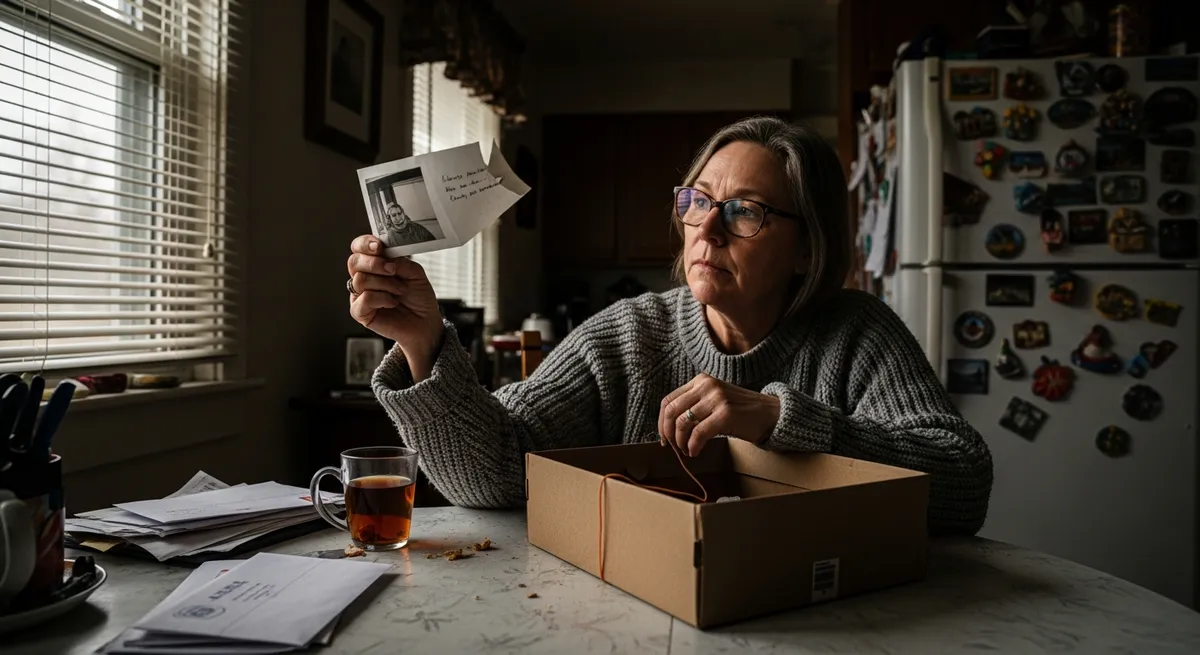
The envelope had no stamp. I turned it over and the flap was still sealed, gummed shut, the paper gone amber at the edges the way old things go when they've waited too long. Her handwriting on the front said *Dariusz* in the soft way - the z I'd never learned, and inside, when I finally worked the flap open with a butter knife, she had written about the floor drains and the way the brine smell stayed in her hair and a man named Szymański who docked their pay if they looked up from the line. I stood under the kitchen light reading it twice and then a third time, the butter knife still in my hand - and the whole time I kept thinking about the third page she hadn't turned, and how she'd had this in a shoebox for forty years, and how we'd all of us been sitting in the same rooms together, eating off the same good dishes, and none of us had ever once asked her why she pressed so hard when she wrote.
The Letter She Addressed to No One Living
The stamp is a bird - a wren maybe, and she pressed it crooked so one wing dips below the line. I set the shoebox beside the manuscript and for a second they were the same height, the same thickness, almost, and I noticed that and then looked away. The manuscript has my name on the spine in the font I chose for twelve minutes on a Tuesday - and the shoebox has nothing on it except a water ring from a glass someone set down years before I was born. I slide them apart so they aren't touching.
My cousin called on a Tuesday while I was eating cereal and said she'd seen the manuscript listed somewhere, some local press thing, and had I written about the cannery, and I said yes, some of it - and she said *which part* in the way that meant she already knew which part and was asking me to say it first. I looked at my spoon. The milk had gone pink from the berries and I watched it for a second before I said *the overtime, the way Babcia called it the stealing,* and my cousin was quiet long enough that I heard her set something down on a counter, something ceramic, a mug maybe - and when she came back she said *that's not the word she used with us* in a voice that had no weather in it at all. I had the index card right there under the coffee mug, the one with the cannery name on it in my own handwriting, the ink a little smeared on the S where I'd written it fast. I didn't tell her about the index card.
My aunt sent a photograph in a padded envelope two weeks later, no note, just the photograph and a yellow sticky on the back that said *before* in her pressed-down handwriting. The woman in it's standing at a long metal table - her hair pinned up, wearing an apron that goes past her knees, and her hands are blurred the way hands go when they won't stop moving. I held it next to the page I'd written, the one with *she worked nights* sitting there at the end like a period someone else put down, and the apron in the photograph has a dark stain along the hem that I hadn't known about and couldn't have known about and hadn't put there. I turned the photograph over and on the back - under my aunt's sticky, was a stamp from a developing place, a Fotomat address I didn't recognize, and a date that put her at the table three years before she told us she'd started. I put the photograph face-down on the manuscript and left it there and went to do something else, the way you leave a stove burner on low when you're not sure yet what you're making.
Disclaimer
This article is for general informational purposes only and doesn't constitute professional - financial, medical, or legal advice. Consult a qualified professional about your specific situation.