The Soup She Makes Every Fall provides a way to handle the heavy, seasonal grief that returns as the leaves begin to drop.1 This guide shows how a simple barley recipe can anchor you when memory feels too big.2
Her thumb ran the length of the barley bag's paper seam and she tipped it over the pot before the sound of pouring stopped - like she'd already counted in her sleep. I was eight, sitting on the counter with my heels knocking the cabinet door, watching her wrists. She tore the celery with both hands, not looking down, and the pieces were all the same length. I didn't ask how she knew.
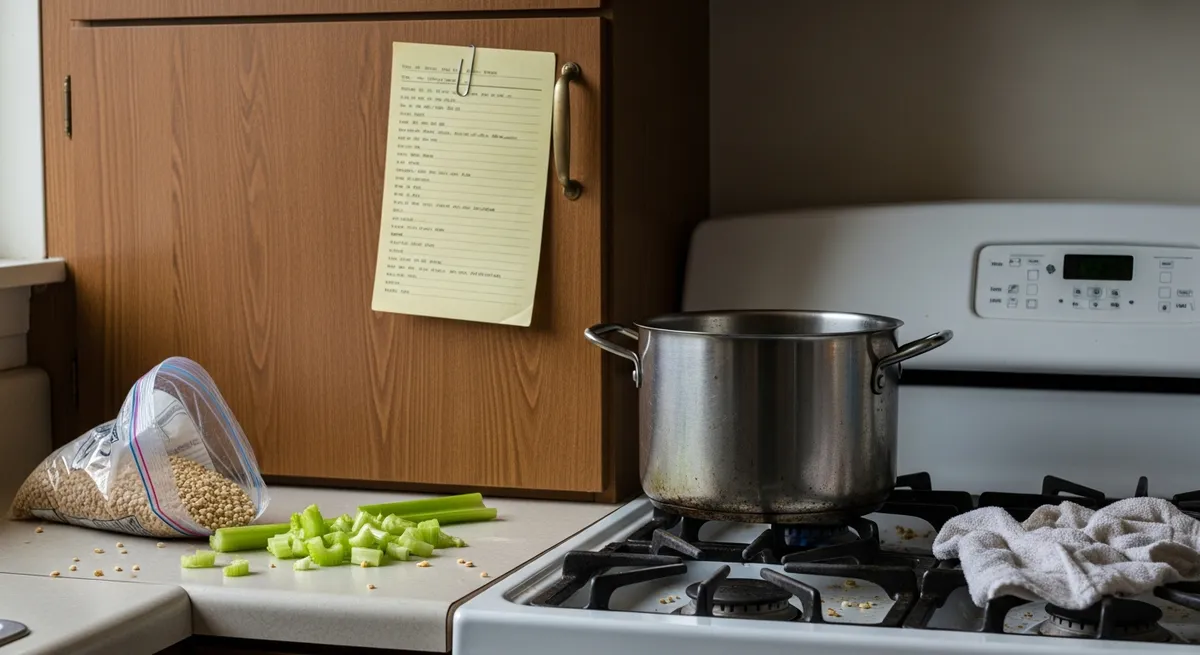
The dent above the left handle catches the light the same way every time - and I always look at it first, before anything else. The recipe is paper-clipped to the cabinet door at eye level, four pages I typed out in November of the year she died, and the word I'd written at the top - unwashed, underlined twice - is almost gray now from the sun. I don't look at it. The spoon - the one with the crack running up through the bowl like a river on an old map, I lay out on the counter before I even fill the pot, because that's the order.
The broth ran off the spoon too fast, watery, nothing catching. She tipped the spoon sideways over the pot and a thin ribbon fell back in and that was all. She stood there with steam coming up around her wrist and her mouth still closed around nothing - and then she set the cracked spoon down on the dish towel and put both hands flat on the counter and looked out the window at the folded white paper she hadn't thrown away.
She pulled the chair out with her foot and sat down without turning on the overhead light. The bowl had a hairline crack along the rim that she touched with her thumbnail before she picked up the spoon. Outside, the maple dropped one more leaf flat against the glass and held there a second, then went.3 She ate slowly, with the window going black in front of her, and the steam rising into nothing.
She lifted the cracked spoon out of the water last and held it under the faucet until the stream ran clear off the handle. The dish towel was already damp from the bowl and the pot lid but she used the dry corner for the spoon - turning it once, twice, the crack catching dark for a second before the towel moved past it. She opened the drawer with her hip. She set the spoon on top of the spatulas and the whisk and the slotted spoon and the other things, on top of all of it, and closed the drawer with her hip again - and that was the end.
The barley bag she folded flat and put in the drawer with the twist ties, though there wasn't enough left in it to cook again. The white paper from the windowsill she carried to the trash can in both hands, walking slowly, like it was full of something. She stood at the can with the lid lifted and then set the paper on the counter instead, still folded into its square - and smoothed it once with her palm. The overhead light she left off.
The barley bag she folded flat and put in the drawer with the twist ties, though there wasn't enough left in it to cook again. The white paper from the windowsill she carried to the trash can in both hands, walking slowly, like it was full of something. She stood at the can with the lid lifted and then set the paper on the counter instead, still folded into its square - and smoothed it once with her palm. The overhead light she left off.
The recipe pages are still paper-clipped to the cabinet door, but the clip itself has left a rust shadow on the top sheet, a brown comma just above the word - unwashed -. She touched it once with her fingernail, not to move it, just to feel the raised edge. The folded white paper is still on the counter - and in the morning she will put it back on the windowsill, and in the evening she will carry it to the trash can again, and set it down again, smoothing it with her palm. The drawer she opened once more before bed for no reason she could have named, just stood there in the dark with her hand on the handle - and then closed it again.
Disclaimer: This article provides general information and narrative storytelling regarding traditions and memory. It doesn't constitute professional medical or psychological advice. Consult a healthcare provider for mental health concerns.