Marcus had been explaining things to people for twenty-two years. That was the job, whatever the business cards said: territory, quota, relationships, and a folder on his desktop labeled "reps" that held 214 files, the oldest named 02-14 in a font size he didn't use anymore. Then the industry moved, the territory shrank two years running, and somewhere past fifty he decided he would rather learn a new trade than spend his last working decade defending a smaller and smaller version of the old one.
The pads
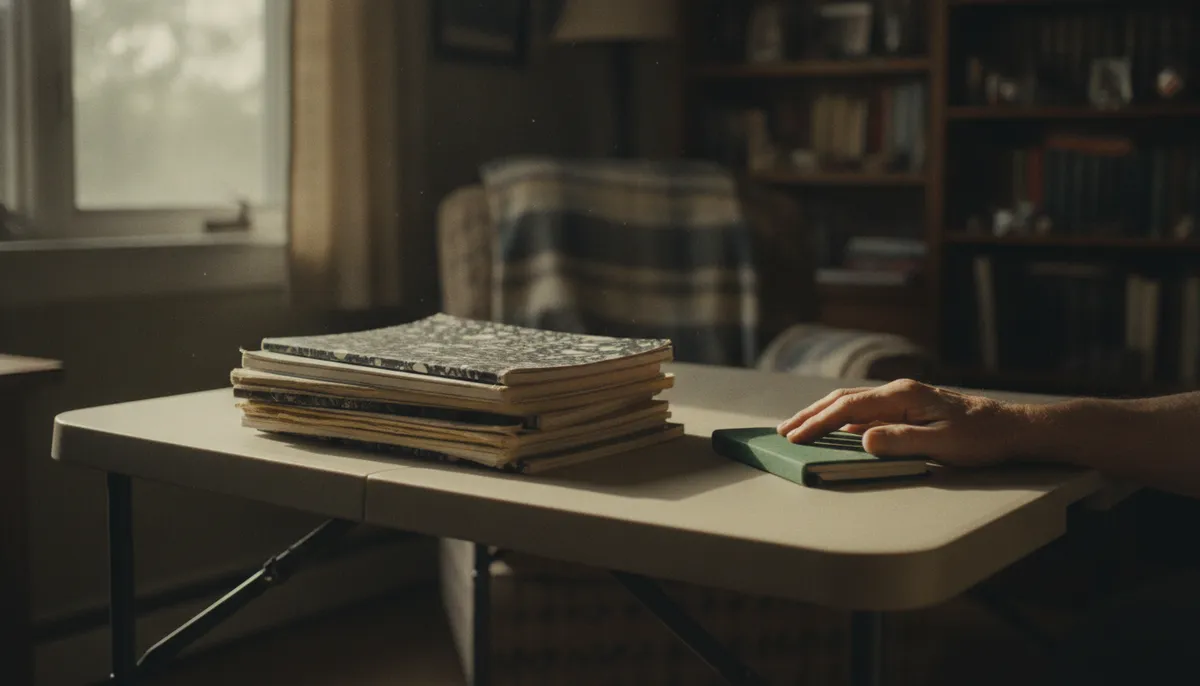
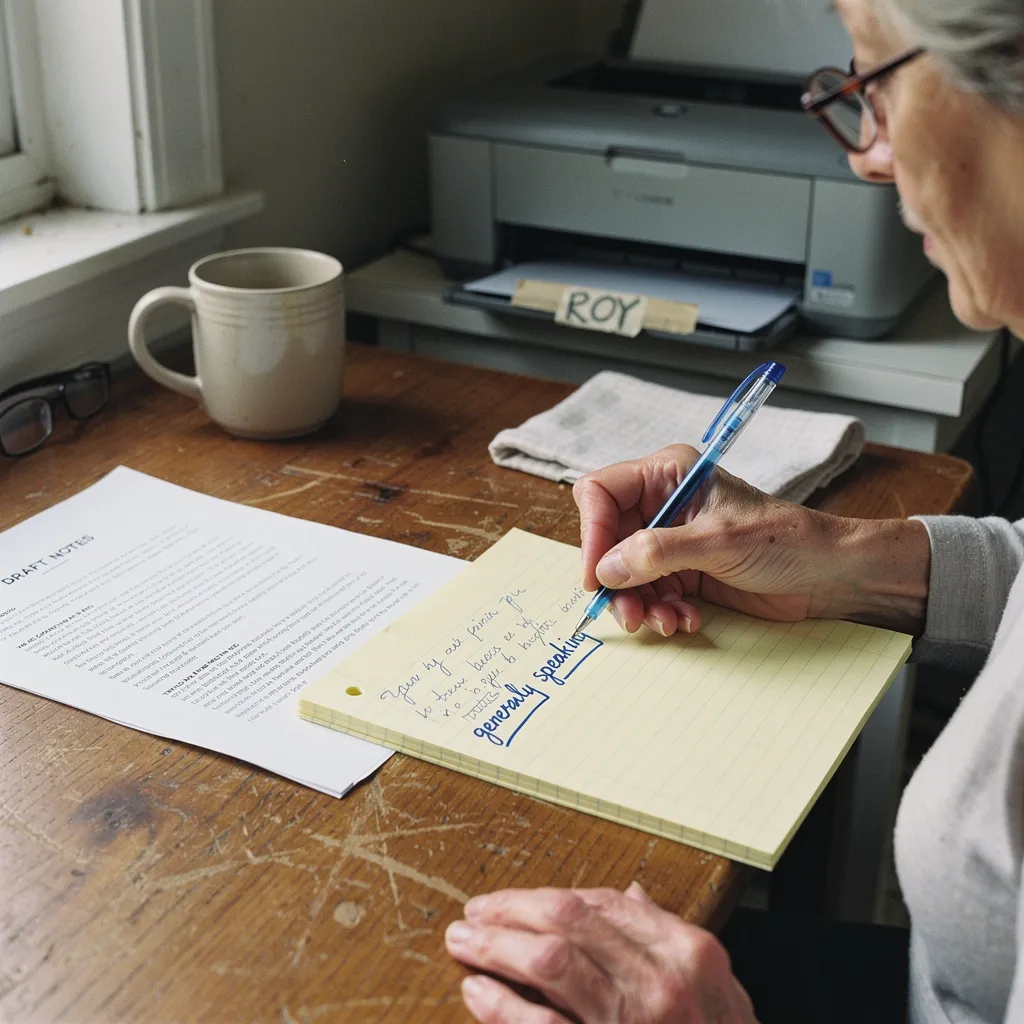
The legal pads came first. The handwriting on the oldest pages had gone gray where steam from the kettle reached it, because he studied at the kitchen table, nearest the stove, after everyone else had gone up. By the third pad he had switched to a finer pen, having noticed his letters getting smaller, as if the material itself were teaching him precision. On one page, near the bottom, he had crossed out "get faster at pivot tables" and written "get less afraid of pivot tables," with a small star beside it in the margin. In two years of notes he never wrote anything truer.
He was no natural. The videos he watched at lunch assumed a comfort with the numbers that he had to build brick by brick, and twice he paid for a month of an online course he abandoned by the second week. What kept him going was smaller than ambition. It was the star in the margin, and the knowledge that at his age the alternative to learning was pretending, and he had watched men he liked choose pretending.
The library book on negotiation had a due-date slip from March tucked behind the front cover. He renewed it twice without finishing the last chapter, then finished it on a Tuesday in November, on the train, standing up. His flash cards wore a rubber band so old it had stained the top card orange at the corners; when it snapped one morning he looped a new one around twice and set the deck back on the corner of his desk, next to the good pen. A highlighter died mid-word on page forty-one of a printout, a pale stripe thinning to nothing across the middle of "collaborative," and he finished the line in ballpoint. Small failures of equipment. He replaced nothing until it quit.
Six forty-seven
At work he started standing in the back of the conference room with his arms crossed, watching the analyst draw a box around a number on the whiteboard and circle it twice, the marker squeaking on the downstroke. He wasn't there for the number. He was there to learn what people look like when they own the numbers and are sure.
At his desk an hour later he built three versions of the same model in three tabs, each one wrong in a different direction, the third off by a factor of ten because he had anchored to the wrong cell. The fourth one balanced. He saved it at 6:47 in the evening and sat looking at it for a full minute before he shut the laptop and went home. On the train he did not open the flash cards. Some nights you let a win sit.
The job posting asked for three years of experience he did not quite have and a list of tools he now quietly did. At the interview they slid a sheet across the table with a staple hole in the upper left corner and a coffee ring on the back that bled through just enough to shadow the third column of figures. He read it twice without picking it up, then picked it up. The hiring partner's pen was uncapped, though she hadn't written anything yet, and he noticed that with the same trained eye that caught the wrong cell, the off-by-ten, the bad anchor. He said a number. She wrote it down.
Two hundred fourteen files
He got back to his desk before anyone looked up and sat down without taking his coat off. The reps folder was still there in the corner of the screen, 214 files, a dozen years of a person. He didn't delete it. He didn't open it either. He closed the laptop, and the good pen was where it always was, cap on, beside the flash cards.
On his last afternoon he right-clicked the folder, chose rename, and sat with the cursor blinking in the little box. Then he pressed escape. The folder kept its name, and he carried the plant and the pen and the cards down to the parking garage in a box that was lighter than he expected.
The legal pad hit the new desk corner-first and skidded into the paper cup, and he caught the cup before it tipped. He turned past the pages with the gray handwriting to a clean one, the spiral pulling at the heel of his hand, and wrote seven words, crossed out two, wrote one back in. The cup had no coffee in it yet. There would be time for that.