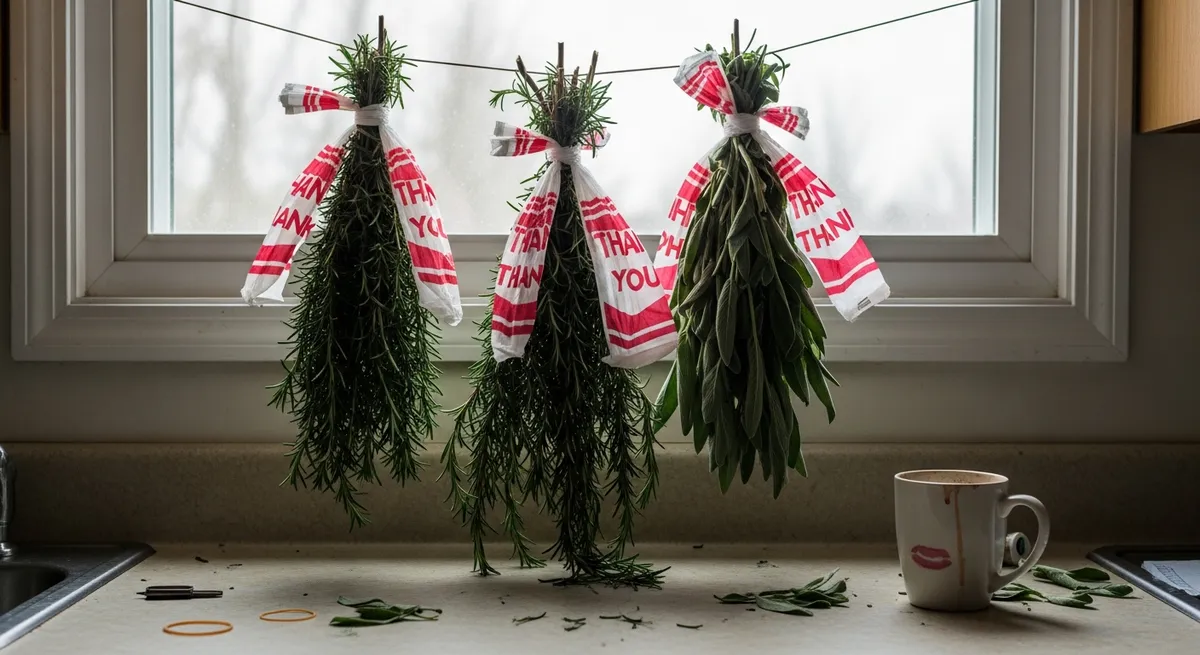
Drying herbs in the kitchen window often leaves you with dusty, flavorless piles of grey leaves that fail to season your cooking. You can easily fix this by applying traditional techniques that lock in essential oils while preventing the moisture buildup that ruins your harvest.
The plastic strips were white with faint red lettering, the word THANK and then YOU and then HAVE, torn into long ribbons my grandmother wound twice around each stem before knotting them tight. Three bundles - fat as the handle of a broom, and she pushed them close together on the rod so they touched at the shoulders. The window faced east and the morning light came through the leaves outside and made everything smell like something about to happen. I watched her press her thumb into the center of one bundle, checking for something, and her thumb came away darker than the rest of her hand.
Mine hung in the south window, the one that got the full afternoon - and when I touched a sprig two weeks later the whole thing came apart in my fingers like something that had already forgotten what it was. The color had gone out of it, that particular grey-green of old newspaper left in a car. I pinched a leaf between my nails and held it up to my nose and got nothing, not even the ghost of something. The stems were light as paper straws. I stood there with the dust of it on my fingers and thought about the east window, and the plastic ribbons, and my grandmother's thumb coming away dark.
The rosemary had sent up a thin column of purple - each flower the size of a baby tooth, and I stood over the pot with the scissors open in my hand and didn't close them. I cut four stems from the lower part where the flowers hadn't reached yet and laid them on the cutting board and told myself the rest could wait. A week later the whole plant had gone to purple, every tip of it, which I photographed and sent to no one. I cut what was left and tied it with a rubber band, flowers and all - and hung it in the same south window where the grey-green dust bundle had been, because I hadn't yet learned to stop making the same decision twice.
The Curtain Rod Method
The jar had a red lid I'd bought at a farmers market and never used for anything that deserved it. I pressed my thumb against the metal and the seal gave with a sound like a knuckle popping, and the smell that came up wasn't rosemary but something closer to the floor of a barn after rain. I tipped the jar over the trash can and the leaves came out in one slow pour, still holding the shape of the jar, and they landed against the black liner with a sound so quiet I had to check that they'd actually fallen. The jar sat empty on the counter next to the roast - which was waiting. I put the lid back on the empty jar and set it in the cabinet, because I had paid two dollars for it at a table next to a woman selling honey, and some things are harder to throw away than others.
The bundle came down in my hands heavier than it should have, heavier than dried anything ought to be, and when I pulled the plastic ribbon loose the outer leaves fell against my palm with a sound like shuffling cards. I spread the stems apart with two fingers and the center ones were black - soft where they should have been rigid, threaded through with white like something living had been working in there all winter. I held the ruined part up to the window, the same east window, and the light came through the good outer leaves the same pale green it had come through them the summer before. My grandmother's thumb came back to me then, the way it had pressed in and come away darker - checking for exactly this, before she ever tied the knot. I set the crisp outer stems on the windowsill and dropped the black center into the bin under the sink, and I stood there smelling my fingers, which smelled, finally - like rosemary.
I realized then that drying herbs in the kitchen window isn't merely about suspension; it's about the physics of air. If you pack your bundles too tight, you create a micro-environment where moisture can't escape. This leads to mold, specifically in the dense heart of the bunch where you can't see it. According to the National Center for Home Food Preservation, moisture is the primary enemy of any long term storage effort.1 They recommend small bundles to ensure that every leaf has a fighting chance at evaporation. My grandmother knew this instinctively. She checked the centers because the centers are where the story ends if you aren't careful.
What the Black Center Knew
The four stems sat across my open palm, lighter than they had any right to be - and when I tilted my hand one leaf let go and landed on the counter beside the cutting board without a sound. I pinched a sprig between my thumb and forefinger and rolled it once and the leaves crumbled away clean, and the smell came up sharp and bright and immediate, the way a word comes back to you in the middle of the night after you've stopped trying to remember it. I pressed my nose against what was left on my fingers and stayed there a moment. The empty jar with the red lid was still in the cabinet. I got it down.
The thyme came up in March between two paving stones, unbothered, and I pinched a sprig between my thumbnail and forefinger and the smell came off it clean and fast - like a door opening. I pulled six stems before the first bud showed, laid them flat on the wooden cutting board in a single layer, not touching, the way my grandmother had once laid fish on newspaper to drain. They sat there three days in the north kitchen air and on the fourth morning I tried one between my fingers and it crumbled into pieces, each piece sharp - each piece still itself. I swept the whole cutting board into the jar with the red lid, the good one, and pressed the lid down and it sealed on the first try. I didn't photograph it.
The oregano went to flower while I was away for four days, the blossoms so small and pale I almost missed them against the grey of the pot, and when I rubbed a leaf between my fingers the smell that came up was thin and green and wrong - like something that had been asked to do too much. I cut the whole plant back anyway, down to where the stems were still woody, and laid the cuttings on the cutting board beside what was left of the thyme jar, and the two smells in that north kitchen air were nothing like each other. The oregano dried in five days but when I crumbled a leaf it bent first before it broke, and the smell that came off my fingers was faint in the way that voices are faint through a wall - present but not useful. I put it in a different jar, a short one with a yellow lid I didn't care about, and set it toward the back of the shelf where it wouldn't embarrass the red one.
Managing Light Exposure for Potency
The sun is a paradox in your kitchen. While it provides the warmth necessary for growth, the ultraviolet rays act as a solvent for the volatile oils that give rosemary its resinous bite and thyme its earthy sweetness. Most people place their bundles in direct south-facing light because it feels efficient. It's actually a mistake. Research from the University of Illinois Extension suggests that while heat is your friend, direct sunlight is your enemy.2 You want the ambient temperature of the room to pull the moisture out - not the radiation from the sun to bleach the chlorophyll out of the cells. When you see that grey-green newspaper color, you're looking at a leaf that has been chemically stripped of its soul.
You want your herbs to stay as green as the day you cut them. This is why my grandmother chose the east window, where the sun visited only for a few hours in the cool of the morning. By afternoon, when the house began to bake under the peak summer heat, her herbs were in the shade. They were warm - yes, but they were protected. The light was a visitor, not a permanent resident. If you have a kitchen that only faces south, you need to move your herbs back from the glass. Hang them on a wall that catches the warmth but avoids the direct beam. You will notice the difference in the first pinch of leaves you roll between your palms.
The Science of Air Circulation
Air is the invisible worker in your kitchen. Without movement, the moisture leaving the herb stems just hangs there - creating a humid envelope that invites decay. My grandmother used to leave the window cracked just a hair, even on days when the air felt like a wet wool blanket. It wasn't about cooling the room. It was about displacement. You need the air to carry the water away. If you're drying herbs in the kitchen window, you likely have a ceiling fan or a vent nearby to improve air circulation. Use it. You don't need a gale, just a whisper of movement to keep the environment from stagnating.
Think about the surface area of your bundles. A bunch of rosemary the size of a baseball will never dry correctly in the center because the air can't penetrate the outer layers. I've seen enthusiasts tie massive bouquets of lavender and wonder why the middle smells like a damp basement three weeks later. The Colorado State University Extension notes that air circulation is as important as temperature for preserving the chemical profile of the plant.3 You should aim for bundles no thicker than your thumb. Tie them loosely. If you can see through the bundle when you hold it up to the light, you have done it correctly. If it looks like a solid mass - start over. Your future self, the one trying to cook a decent meal in November, will thank you.
Identifying the Point of Perfection
There's a specific sound that a perfectly dried herb makes. It's not the soft rustle of paper, but the sharp snap of a dry twig. If the stem bends at all, you're not finished. You can't rush this. I once tried to jar some sage that felt dry to the touch but still had a slight give in the mid-rib of the leaf. Three days later - the inside of the jar was clouded with condensation. You're looking for a state of total brittleness. When you press a leaf, it should shatter, not fold. This is the moment when the water activity has dropped low enough to prevent microbial growth.
Timing varies by the humidity in your home. In a dry climate, you might reach this point in four days. In a humid coastal town, it might take two weeks. You have to be the judge. Don't rely on a calendar; rely on your senses. Smell the bundle every day. If the scent starts to change from bright and herbal to musty or hay-like - you have a problem with your airflow. My grandmother would walk by her bundles and give them a little flick with her finger. She was listening for the sound of the dry leaves hitting each other. It’s a rhythmic, metallic clatter. When you hear it, the harvest is ready to be moved into the dark.
Storing the Harvest for Longevity
The jar with the red lid was just the beginning. Once your herbs are dry, they need to live in a place that mimics a tomb: cool, dark - and dry. Clear glass jars are beautiful on a shelf, but they're a death sentence for flavor if they sit in the light. If you must use glass, keep the jars in a closed cabinet. Better yet, use amber glass or ceramic crocks that block all light. The volatile oils that you worked so hard to preserve are still susceptible to light damage even after the water is gone. You're protecting an investment of time and labor. Don't let a pretty countertop display ruin it.
You should also avoid pre-crushing your herbs. Keep the leaves whole until the exact second you need them. Every time you break a leaf, you expose more surface area to the air - and more of those precious oils evaporate into the room instead of into your soup. I keep my rosemary in long needles and my thyme on the tiny stems. When it's time to cook, I take out what I need and crush it in a mortar and pestle or between my palms. The scent that hits the air at that moment is the proof of your success. It should be as powerful as the day you cut it from the garden. You didn't just dry some plants; you captured a season.
Quick Takeaways
Frequently Asked Questions
Can I dry herbs in a microwave instead?
Mostly, no - at least not if you want quality. While you can technically zap moisture out of leaves in seconds - the high heat often cooks the oils rather than preserving them. Research suggests that air drying at room temperature is the gold standard for maintaining the chemical complexity of culinary herbs, whereas the microwave can leave them tasting like scorched grass.
How long do home-dried herbs actually last?
About a year, usually. If you store them whole in airtight, dark containers away from the stove's heat, they will retain their punch until the next growing season. After twelve months - the oils naturally begin to oxidize, and you’ll notice the flavor starts to fade into a generic