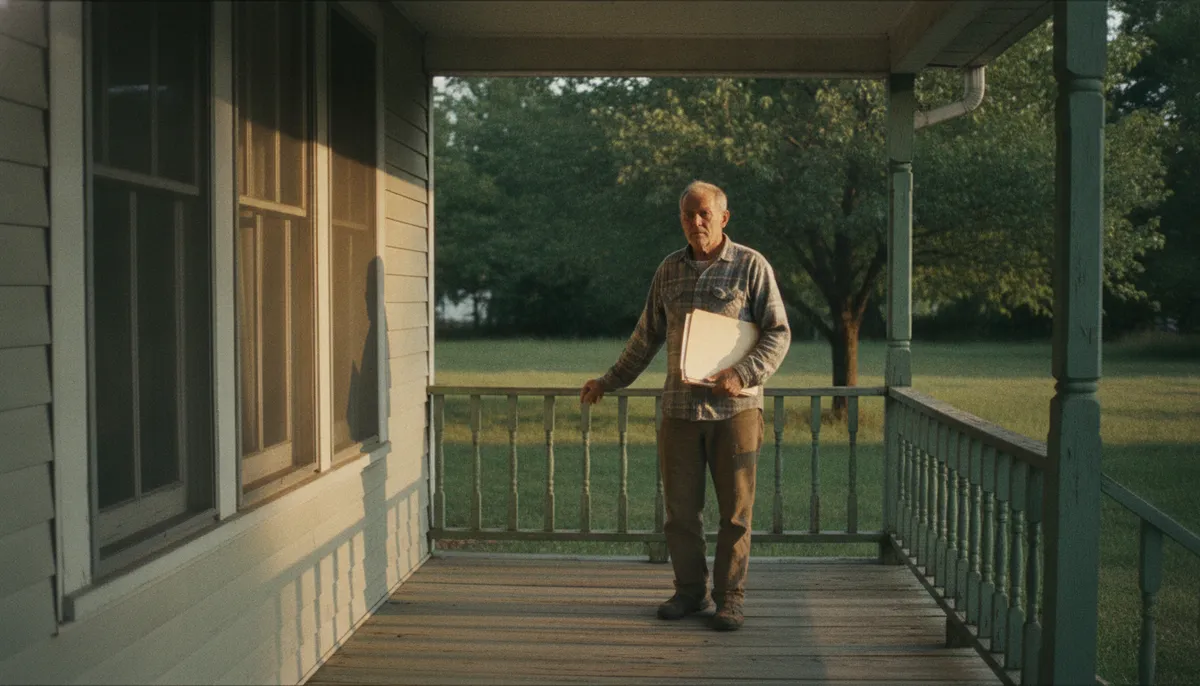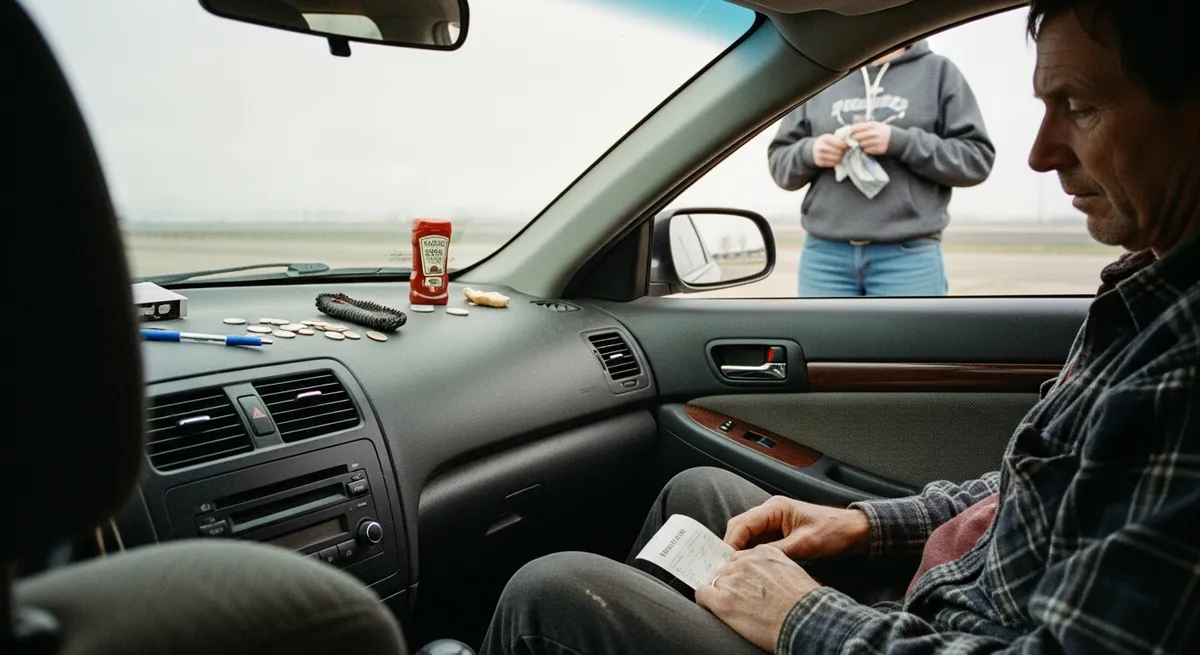
The curl of papers had fanned across his knee - three of them, cream gone yellow, each one a different car. He smoothed the top one flat with his thumb the way you'd press a wrinkle from a shirt. The corner had somebody's phone number on it in blue pen, a 919 area code, nothing else.
She came back out wiping her hands on her jeans and stopped when she saw the ketchup packet balanced on top of the tire gauge - its corner bitten off and resealed with age into something like leather. He held up the oil-change receipt without looking at her. The date was printed in the kind of faded dot-matrix ink that takes a second to read, and she read it, and he watched her read it. She took the packet from him and turned it over once, then set it in the trash bag herself.
He lined them up along the dash: the receipts, a ballpoint pen with its clip broken off - two quarters and a dime, a folded square of paper that turned out to be a grocery list in his mother's handwriting. She stood outside with her hand on the door handle and looked at the row of things through the glass the way you look at something in a museum case. The sun was low enough that the windshield threw a bar of light across his wrist. He straightened the grocery list so its fold ran parallel to the edge of the dash.
She slid in and pulled the door and the dome light came on and then went off. He turned the receipt over and read the number printed there in pencil, a mileage or a date or something, then set it face-down on his knee. The heater ticked. Fifty-four thousand, eight hundred and eighty-seven - he said, and she nodded at the windshield, and the grocery list sat between them on the console with its fold still straight.
She pulled it from under a wad of napkins, a AAA card the color of old cream, LINDA J. CARVER pressed into the surface in gold letters that had gone the color of old mustard. He took it from her without being asked. He held it in both hands the way you'd hold a photograph you weren't sure you wanted to see - his thumb moving once across the embossed letters, and then he set it at the end of the row on the dash, square with the edge, square with the others.
She swept the receipts and the pen and the quarters in with one pass of her forearm, the coins ringing against the ketchup packet at the bottom of the bag. He folded the AAA card once along its length and worked it into his shirt pocket with two fingers - the gold letters facing in. She pressed the glovebox door shut with the heel of her hand and it caught, clean, no second try. On the way home she kept both hands on the wheel and neither of them mentioned the click.
He found the grocery list on the console the next morning, still folded along its crease, because he'd left it there when they got out and neither of them had moved it. He carried it inside between two fingers and set it on the kitchen counter next to the pepper grinder - then moved it once so it wasn't touching anything. It stayed there four days before he put it in the drawer with the rubber bands, flat against the bottom, fold up.
He opened the drawer three weeks later looking for scissors and saw it there, the fold still up, and closed the drawer without the scissors. His daughter called that evening and he stood at the counter with the phone against his ear and his free hand resting on top of the drawer pull - not pressing down. She asked if he'd gone through Linda's things yet and he said he'd made a start, which was true, and looked at the pepper grinder.
He found a pen in the drawer when he finally went back for the scissors, a ballpoint with its cap still on, and uncapped it and wrote LINDA on the inside of his wrist the way she used to do with grocery lists - just to see if the ink still worked. It did. He recapped it and put it back in the drawer, to the left of the folded paper, where there was room.
He pulled her reading glasses from the basket on top of the refrigerator one morning when he was looking for the takeout menus, the frames still bent slightly to the left where she'd dropped them on the tile that one time. He set them on his own nose and the kitchen went soft and wrong, the pepper grinder a dark blur - the drawer pull a smear of brass. Through the left lens the window was sharp; through the right, nothing resolved. He took them off and put them back in the basket with the menus still unfound, the left arm hooked over the edge the same way she always left it.
He found her handwriting again on the back of an envelope tucked behind the toaster, a list of paint colors with small squares she'd drawn next to each name so she could fill them in at the store. The squares were empty. He set the envelope against the pepper grinder and stood there long enough that the coffee finished brewing, then propped it upright so the squares faced out.
He found her handwriting on the inside cover of the paperback on the nightstand - just her name in the bottom corner the way people do when they loan a book out, LINDA in the same blue ink as the wrist, and he didn't read the book but he moved it to her side of the bed with the cover face-down so the name was against the wood. The next morning he made two cups of coffee the same as always and stood at the counter with both hands around his own mug until the second one went cold. He poured it down the drain and rinsed the mug and put it back in the cabinet, handle out, the way she insisted - next to his.
He wore her cardigan to get the mail one morning, the green one with the loose button she'd meant to sew, because it was hanging on the hook by the door and his coat wasn't. The button swung against his ribs the whole way down the driveway and back. He hung it on the hook when he came in and smoothed the collar flat with both hands, the way she did, though she did it without thinking and he did it slowly.