Ray Kowalski wore a tape measure on his belt for thirty-one working years and saw no reason to take it off afterward. It was one of the fat yellow ones that snap back hard enough to catch a finger. He had measured his daughter's doorframe with it on every birthday until she turned eleven, and the distance from his recliner to the television, and once, for no reason he could ever give, the whole kitchen. He liked knowing how far things were from other things. It was a quiet religion, and in thirty-one years it had never once cost him money.
He bought the silver electric car on a Tuesday in November. The salesman shook his hand twice and talked about torque, and about never standing at a gas pump in January again, and somewhere in the folder of paperwork there was a brochure with a house on the cover and a woman in a fleece vest smiling at her phone. Nobody said one word about the garage.
That night Ray plugged the gray cord that came with the car into the outlet behind the shop-vac hook, the one with the scorch mark from 1987 that he had always meant to look at. The app on his phone showed a lightning bolt, and under it the number 38, and under that the word "hours." He read it three times. Then he stood in the garage in his socks for a while, looking at the car, then at the wall, then at the distance between them.
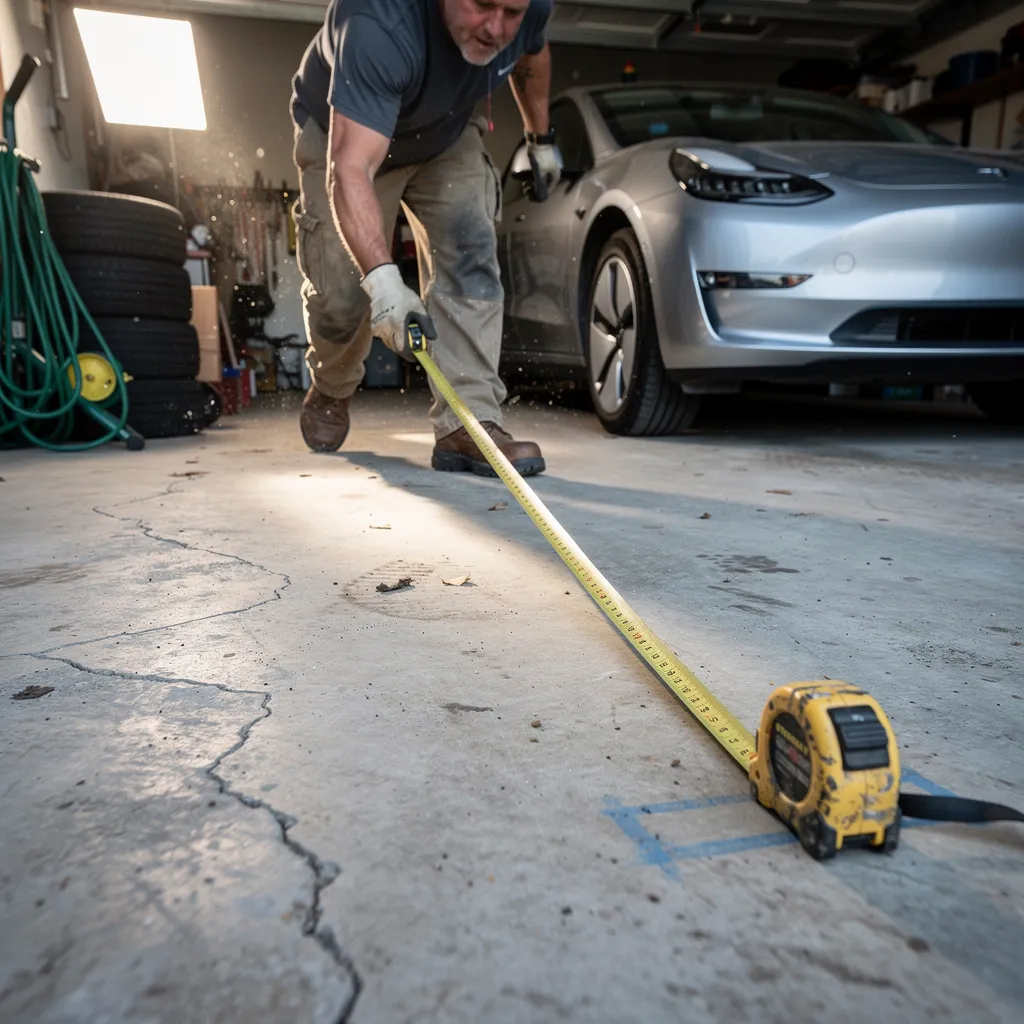
His brother-in-law knew an electrician. Dennis came out on a Saturday, set his coffee on the washing machine, and stood in front of the breaker panel with a pen light, counting the little black switches with the tip of his finger. He said "Huh" once, quietly, to himself. Then he pulled a stub of blue chalk from his shirt pocket, made a mark on the concrete block at knee height, and walked toward the garage door unspooling a yellow tape behind him. He made a second mark where the wall met the cold air coming in under the door. Forty feet, give or take, from the panel to the spot where the car's charging port sat. That was the number nobody at the dealership had said out loud. The car was the easy part. The forty feet were not.
The estimate had three sections separated by thin ruled lines, and Ray's eyes skipped all of them and landed on the figure at the bottom, which Dennis had circled in red pen and then, apparently reconsidering, crossed the circle out. Ray set the paper on the workbench. He picked a screw out of the coffee can and put it back. Through the side window the silver car sat in the gray light, still as an appliance when the power is out. He looked at the car, then at the estimate, then at the outlet with the scorch mark he had always meant to look at.
He signed where the penciled X was. The ballpoint skipped once on the waxy paper before it caught. Afterward he folded the yellow copy along its middle crease, slid it under the socket wrench on the lower shelf, and stood there a moment with the pen in one hand and the cap in the other, looking at the wall.
Dennis's work took most of a day. A new breaker, gray conduit running the length of the garage with a neat turn at the corner bracket, and the charger itself, about the size of a hardback dictionary and the same color as the drywall beside it. It made a sound Ray's wife described as "the freezer in the basement," which was accurate enough that within a week he stopped noticing it. The shop-vac now hung six inches left of where it had hung for nineteen years. There was a clean rectangle in the pegboard dust where it used to be, and Ray kept not wiping it away.
His daughter came by the following Sunday and ran her finger along the conduit the whole length of the wall, from the panel box to the charger, tracing it like a scar. She started to ask how much, and Ray told her before she finished, and she didn't say anything after that. She just looked at the clean rectangle in the dust. When she went inside she left her coffee mug on the workbench, and Ray set it on top of the folded yellow invoice under the socket wrench, where it left a ring.
Carl from two doors down stopped over in December with a bag of ice melt and stood in the driveway studying the conduit where it made its turn at the corner bracket. For a moment he said nothing. Then he asked, and Ray answered, and Carl repeated the number back the way a man repeats a phone number he isn't sure he heard right. Ray nodded. Carl picked the bag up again, held it with both arms against his chest, looked once more at the silver car and once more at the wall, and said he'd probably just get a hybrid.
The car itself was fine. Better than fine, most days. It left the driveway every morning full, which the old truck had never once managed, and Ray came to like the quiet of it, and the small chime when the cord seated. He kept a charging log in a spiral notebook, dates and kilowatts in pencil, because he was still a man who liked to know how far things were from other things, including how far a dollar went.
Six months later, hunting for the registration, he found the dealership brochure in the glovebox. House on the front, white garage door, the woman in the fleece vest smiling at her phone, a small green leaf in the corner. He turned it over. The back listed four charging options in a clean sans-serif font, and the last one said "consult a licensed electrician," and that was all it said about that. Ray read it in the driveway with the door open and the chime going. Then he put it back in the glovebox, under the tape measure, where it fit.