The clay came in a plastic bag with her supplier's logo on it, a red bull with one horn, and Dora had been ordering from the same place for thirty-one years. She carried it in from the car the way she carried all twenty-pound things, back straight, weight centered, and set it on the table at the front of the community center's craft room. Twelve strangers sat in folding chairs arranged in a horseshoe. Not one of them reached toward it. A man in the back row held his hands in his lap like someone waiting for a bus that was already twenty minutes late. The clay sat under the fluorescent light, sealed, enormous, patient as a stone.
She had volunteered for this because the flyer at the library said the senior center needed people willing to teach what they knew, and what Dora knew, after three decades at the wheel, was pots. It had seemed like the easiest yes of her retirement.
The Heel of the Hand
She pulled a lump loose, dropped it on the wheel, and opened her mouth to say something about the heel of the hand. By then the clay was already centered. It had taken maybe six seconds. Someone in the front row leaned forward and a chair scraped the concrete. Dora stopped and looked down at the smooth mound as if it had appeared while she was thinking of something else. She said, "The heel," and held up her right hand and looked at it. The hand explained nothing. It was a tool she had forgotten how to describe.
Priya was the one who stayed after the second class. She threw with her elbows pointed out like wings, and the walls of her pots kept folding in on themselves, small catastrophes of wet clay that she smoothed back into a mound and started again without looking up. The fourth time, she moved her arms in, just slightly, the way a person adjusts a chair in a dark room, by feel. The cylinder went up. Dora, who had been pretending to wipe her hands on a rag she had already wrung out twice, turned and found something interesting to look at on the far wall, because she had not told Priya to do that. Priya had found it herself. Whatever Dora had said out loud that afternoon had been, at best, in the vicinity.
That night she tried to throw a cylinder in her own garage with a notepad on the stool beside her, three bullet points in her own handwriting, the car parked outside for the first time in eleven years to make room. She wet her hands and watched herself work, and the clay went soft on one side, then the other, a slow lean she corrected before she caught herself correcting it. The second time it buckled she sat back and read the first bullet point under the work light. Heel. The word sat there, patient as a receipt for something already eaten. Thirty-one years of pots, and she could not narrate her own hands. Nobody warns you how much of a life gets automated. You find out when you try to watch yourself do it.
A Finger's Width
In week four Priya threw a bottle, maybe fourteen inches, the neck no wider than two fingers pressed together, and it stood on the slowing wheel the way a top slows, without falling. Dora watched with the rag between her hands. She had learned necks from a man in Tucson who had learned them from someone else, and the rule he gave her was four inches, maybe five, and she had written it in a spiral notebook she still owned. The notebook was in the car. Priya lifted her hands away and the bottle stayed. It was past four inches. It was past five. It was past whatever the notebook said, and the notebook had been wrong, or right only for the man in Tucson, and Dora had carried the rule for thirty-one years without once testing where it ended.
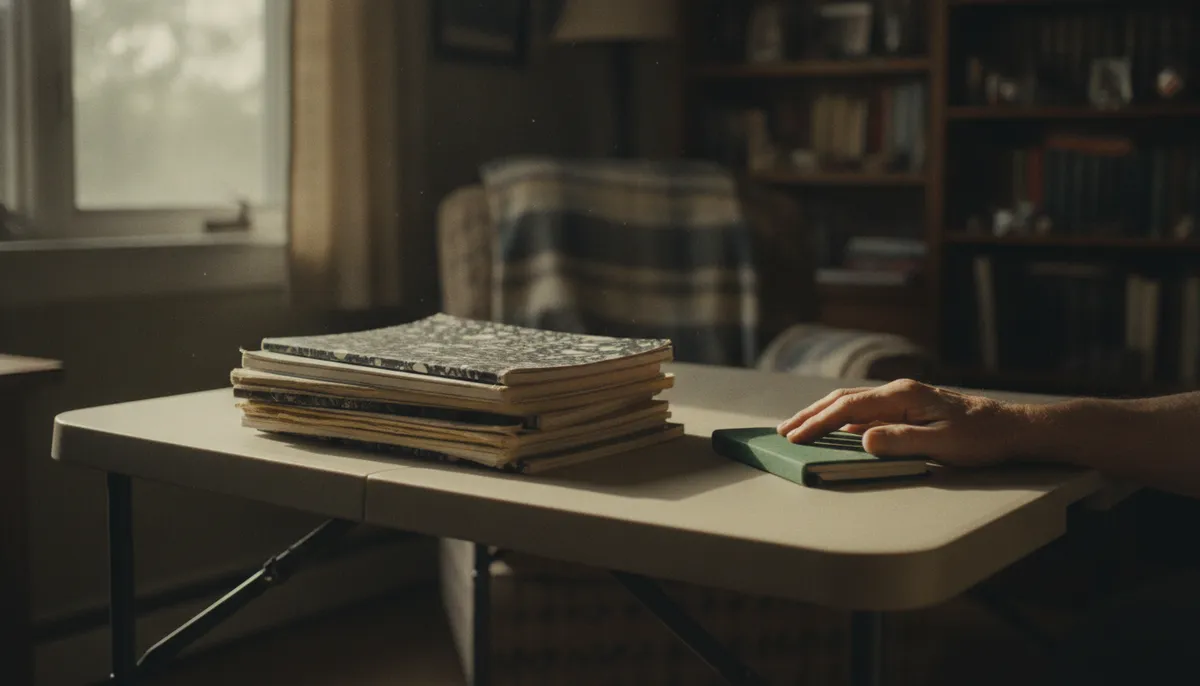
Later, while they covered the wedging table with plastic, Priya asked what the rule was for trimming a foot. "A finger's width," Dora said, and stopped, one hand still holding a corner of the sheeting. She looked at her own thumb. Her thumb was wide, had always been wide, and the man in Tucson had narrow hands, almost delicate, and she had never once considered the difference. She finished tucking the plastic down and said nothing else, and Priya wrote finger's width in a small green notebook without looking up, inheriting the same beautiful, unexamined error, fourth generation.
Dora went home and brought the spiral notebook inside for the first time in a decade. She sat at the kitchen table, opened it to the Tucson page, and under the old rule she wrote her own thumb's width in centimeters, a number she had to measure against a ruler from the junk drawer. It was smaller than she had thought. She wrote it down anyway and looked at it a long time, the way you look at a word until it stops being one. Every measurement she had ever taught herself turned out to be a measurement of somebody.
There is a cup on the shelf above her kiln now. It has a thumb dent in one side where Priya panicked and grabbed it, and the lip rolls outward the way a lip does when a beginner lets go too soon. Dora took it out of the scrap bucket herself and never glazed it. The shelf holds nothing else. Not the blue bottle from a workshop in 1987, not the test tiles. When the kiln is firing she can see the cup from across the room, its lopsided shadow against the warm brick, and it does the thing she apparently needs done: it reminds her what the beginning felt like, since her own beginning is forty years gone and her hands have eaten the evidence.
On the last Tuesday of the course, Priya brought her a mug, handle pulled and attached and everything, and set it on the wedging table without ceremony. The handle was thick where Dora's would have been thin, thumb-wide, matched to Priya's own hand, and it looked right. It looked like a mug someone would reach for in the morning. Dora turned it once and put it down, then went to the shelf where she kept her own mugs, the ones she had used as a private standard for thirty years, and held one next to Priya's for a while. Hers was correct. Priya's was true. She signed up to teach the spring session before she had fully decided to, the way her hands did most things, and drove home with the spiral notebook on the passenger seat, half its rules crossed out, the other half waiting for a student to break them.