Renata bought the legal pad on the way over, at the drugstore that still kept school supplies by the register, and she chose yellow because it looked official without looking like a lawyer. Her father had the coffee going when she arrived. Gus set her mug down without watching where it landed, and a little sloshed onto the Formica, and he let it sit. She squared the pad in front of her, uncapped the pen, and wrote Dad's wishes in the top margin, small, so it would not alarm him.
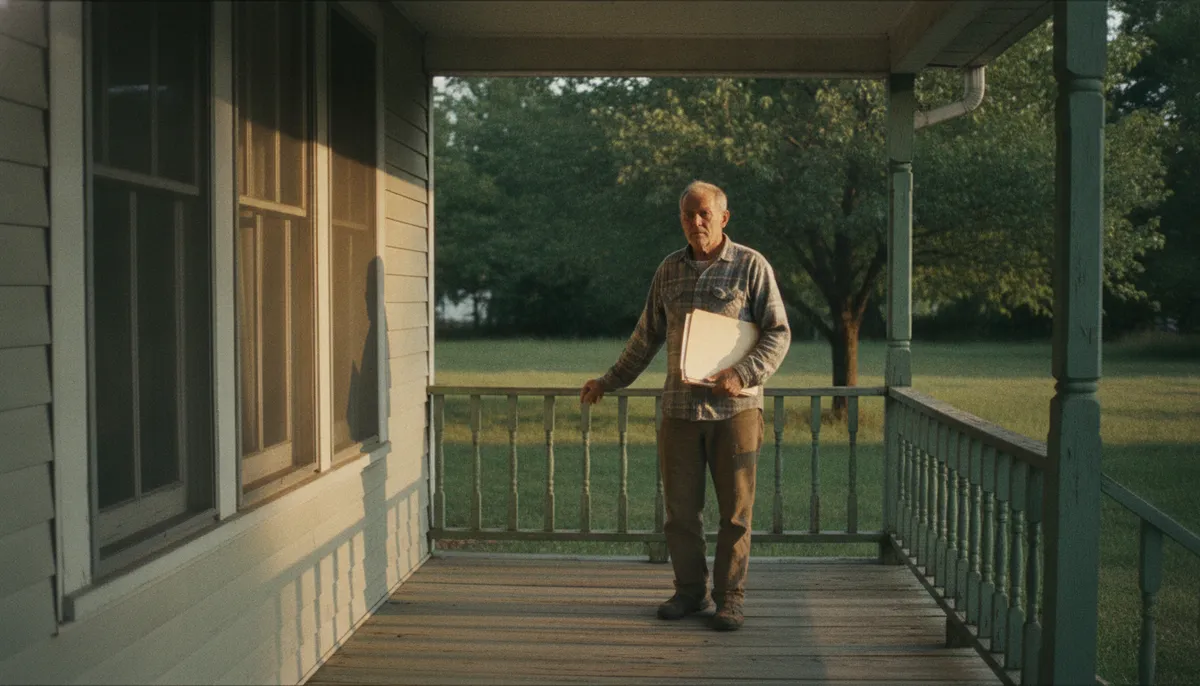
He was already talking about the porch. Eleven weekends it had taken him, maybe twelve, and he had used the level his father-in-law gave him, which he still had somewhere, he could put his hand on it if she gave him a minute. She said, Dad. He said the neighbor had gone with cedar, and cedar silvers out, give it three years and watch. She asked what he would want if a day came when he could not speak for himself, and he stood and topped off the coffee she had not touched and told her the thing about pine, how pine was cheaper for a reason. The pen rolled a half inch toward the coffee ring and stopped. After a while she capped it. The cap made a small click, and she laid the pen parallel to the pad the way her mother used to lay a knife beside a plate when a meal was over.
That was the whole conversation. It was a good afternoon otherwise. Driving home she told herself they had started, that was the word she used, started, and the pad rode along in the passenger seat with its one line filled in. It lived in the car for a week, then on the kitchen table, then in the drawer with the batteries and the rubber bands, the drawer where things go to be kept and not seen.
The hospital had its own paper. A nurse handed her a clipboard with a pen chained to it, a thin beaded silver line, and asked the questions in the order the form asked them. Date of birth. Medications, as far as she knew. Then: who makes medical decisions for him, is there a healthcare proxy, an advance directive, anything in writing. Renata said, I think so, and heard herself say it. What existed in writing was forty minutes away on a yellow page in a kitchen drawer, three words in her own handwriting, which she understood, standing under the fluorescent light, was a different thing entirely. She said, me, I suppose, and the nurse wrote something without looking up, and down the hall a door opened and shut and a smell of antiseptic went by and was gone.
Marcus called from an airport or a parking lot, somewhere with wind in it. His voice kept dropping words the way it did when he walked while he talked. Dad was clear about this, he said. He said it at Christmas. No machines. He said it more than once, Renata. She stood looking at the dry-erase board on the wall of the family lounge, where someone had written Dr. Okafor in green marker and underlined it twice, and she let Marcus say it all again. She believed him. That was the trouble. She also believed the Sunday in March, the truck stop outside Salida, Gus with both hands around a ceramic mug that said REGULAR on the side, saying, I want every chance, I don't care what it costs, I'm not going out like some, and then the waitress had come with the pot and he never finished the sentence. Both of those men were her father. Neither of them had written anything down.
Dr. Okafor came in while she was still holding the chained pen and spoke about the window they had, which was his word, window, as if the afternoon were a house. She pressed down before she entirely understood that her hand had decided. The signature looked the way her signature always looked, which surprised her; she had expected it to come out changed. A nurse peeled the yellow carbon copy off the bottom of the form, and the sound it made was the sound of tape coming off a wall. Marcus called back at four-seventeen. She watched the phone ring on the vinyl chair beside her and let it go, and stood at the window while an orderly pushed an empty wheelchair across the parking lot, slowly, for no reason she could see.
She found the legal pad again in December, under the Christmas wrap and a flashlight with no batteries in it. The yellow was still very yellow. Her three words sat at the top where she had pressed hard enough to leave a groove in the page beneath, and the rest of the sheet was blank, slightly wavy at the corner where the old coffee ring had dried. She ran her thumb along the groove. Then she put the pad back under the wrapping paper and left the flashlight where it lay.
Marcus sent a card in February with no occasion printed on it, just a watercolor cardinal on a bare branch, which Gus would have called fussy. She propped it against the sugar bowl for three days before she opened it. His handwriting crowded the corners the way it always had, and in the middle he had crossed out a line and written over it, and both versions were still legible. She read the crossed-out one twice with her thumb covering the rest. I keep thinking we heard different fathers, it said. Above it, in the space that was left, he had written instead, I know you did what there was to do. She sat with the card until the coffee went the color of the table.
Carol from next door brought a casserole in a dish with her own name taped to the bottom and stayed forty minutes. Somewhere in the middle of it she mentioned, kindly enough, that her children had a binder. Color-coded, she said. Notarized, copies made, one kept in the car in case anything happened while she was out running errands. She said it the way a person mentions a good parking spot, something settled, requiring no further thought. Renata said, that's smart, and refilled Carol's water glass, and watched a sparrow land on the porch railing and leave. After Carol went home she washed both glasses and stood at the sink, looking out at the cedar boards going silver exactly on the schedule Gus had promised, in the time it had taken the two of them to get around to nothing.
In April she found the hospital bracelet in her coat pocket, the plastic kind with the small metal clasp, his name printed in a font that made it look like a receipt. She stood in the grocery store parking lot with it looped over two fingers while a cart with a bad wheel went past, asking its one question over and over until it stopped. Inside, she bought bananas and stood in front of the soup for a long time without taking any. At the register she could not find the rewards card and said never mind, never mind, I'll just pay, and her voice came out a size she did not recognize. At home she set the bracelet on the windowsill over the sink, next to the smooth gray stone Gus had carried back from somewhere he never named, and it stayed there through the end of winter and into a spring she was in no way ready for. There is a binder in the house now. It is blue, nothing in it is color-coded, and the first page is filled in, dated, and signed.