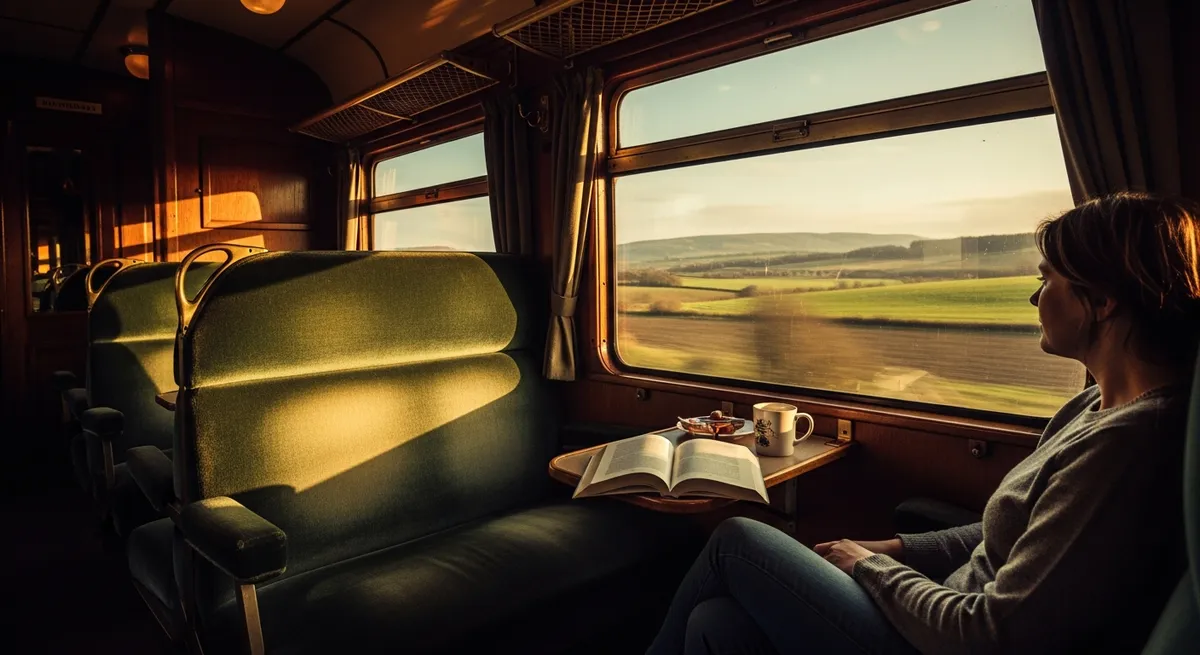
The seats were still cold from the night cleaning. Delia pressed her palm flat against the glass and left a print. She set the thermos between her boots on the floor, where it wouldn't roll, and pulled her jacket across her shoulders without putting her arms through the sleeves.
The book was still open to page forty-three when she looked up and the water towers were gone and there was just a field with a single tire half-buried in the mud. She closed the book on her thumb. A woman in a yellow housecoat was hanging something white on a line behind a house that had no front yard to speak of, only the back, only this, and Delia watched her until the pine break took her. The thermos had gone cold against her boot.
The farmer wore a canvas coat the color of the field itself and moved along the wire with both hands, not looking up, the way a man does when he's long past needing to look. A pail hung from his left hand, a staple gun in his right. She watched him bend at one post, straighten, move to the next, and then the pine break swallowed him the same way it had swallowed the woman in the yellow housecoat, cleanly, as if the train were the thing that had never happened. The book slid off her knee and she didn't reach for it.
She held the phone with both thumbs but didn't type. Outside, a green-painted water pump stood at the cemetery's edge, then a stone with a small laminated photograph clipped to it, the face inside already sun-bleached to almost nothing. She set the phone face-down on the seat beside her. Four seconds, then just the long grass again.
The grain elevator stood in the black like something on fire that wasn't burning, the floodlights turning the concrete a pale yellow she associated with butter dishes left out too long. She could read the stenciled letters, KIMBALL CO-OP, each one taller than her apartment ceiling, and she pressed her forehead against the glass to keep it in view one more second. The cold came through her skull. Then it was gone, and the observation car gave back only her own face, blurred and hovering over nothing.
The Emeryville platform had a smell of diesel and cold concrete and she stood on it with the tote digging into one shoulder, working her jaw side to side the way she did when she'd slept wrong. She found it when she set the tote down to pull out the thermos: a thin curl of register tape, heat-faded, RAMOS printed above OROVADA NV and a total of $14.11 for MISC, someone's ordinary Thursday folded once and left on the observation-car floor like it was nothing. She pressed it flat against her thigh and slid it into the back pocket of her jeans, where it crinkled once and went quiet.
The Lyft smelled like the pine tree hanging from the mirror and the driver took the overpass and Delia watched the backs of the buildings slide past, loading docks, dumpsters, a door propped open with a brick, the same city she'd landed in before, but from the wrong side now, the side that didn't know it was being watched. She still had the register tape in her back pocket and she could feel it crinkle when she shifted her weight against the seat. The driver asked if she'd had a good trip and she said yes and looked out the window at a woman in a parking garage walking fast with her keys already out, and she wanted to say something else but the overpass ended and they were on the surface streets and it was just storefronts again, all of them facing forward, all of them ready.
She ate the burrito standing at the counter with her coat still on, and when she finished she left the foil on the cutting board and stood there with her hands loose at her sides, looking at the cabinet above the stove. The flight confirmation was in her email, SFO-ORD, Thursday 6 a.m., and she pulled it up and then closed it.
She opened the cabinet and took down the coffee mug she'd bought in Whitefish three years ago, the one with the chipped elk on the side, and turned it in her hands without filling it. Outside the kitchen window a FedEx truck was double-parked, the driver jogging with a package held flat against his chest, already gone before the door to the building had swung shut. She set the mug on the counter next to the foil and smoothed the register tape out beside it, OROVADA NV, $14.11, MISC, and left them there together like she was making something out of them, or trying to remember something, which was the same thing.
She woke at five-fifteen without the alarm and lay still with the ceiling above her and the phone already lit on the nightstand, the boarding pass sitting in the notification bar. She got up and went to the kitchen in her socks and stood at the window with her hands around the chipped elk, watching the street, a man in a reflective vest sweeping something into a dustpan at the corner, the bristles catching under the gutter lip the same way every pass. The register tape was still on the counter and she folded it once along the old crease and tucked it into the front pocket of the bag she'd use for the plane, the small one, the one that fit under the seat. Then she rinsed the mug and set it upside down on the rack and stood there a second longer than necessary, looking at the wet oval it left on the rubber.
The gate agent's voice came through the speakers and Delia looked up from the plastic seat and watched the plane through the window, the ground crew in their orange vests moving underneath it with a purpose she couldn't follow, efficient and small, their backs to the terminal the whole time. She had the small bag on her lap and her thumb was hooked through the strap. A man beside her opened a laptop and the blue light hit his face and outside on the tarmac one of the orange vests stopped walking and just stood for a moment looking at something past the nose of the plane, something out on the apron that Delia couldn't see from her angle, and then he looked down and kept moving. She pressed her thumbnail into the strap's stitching and watched the spot where he'd been standing until they called her row.