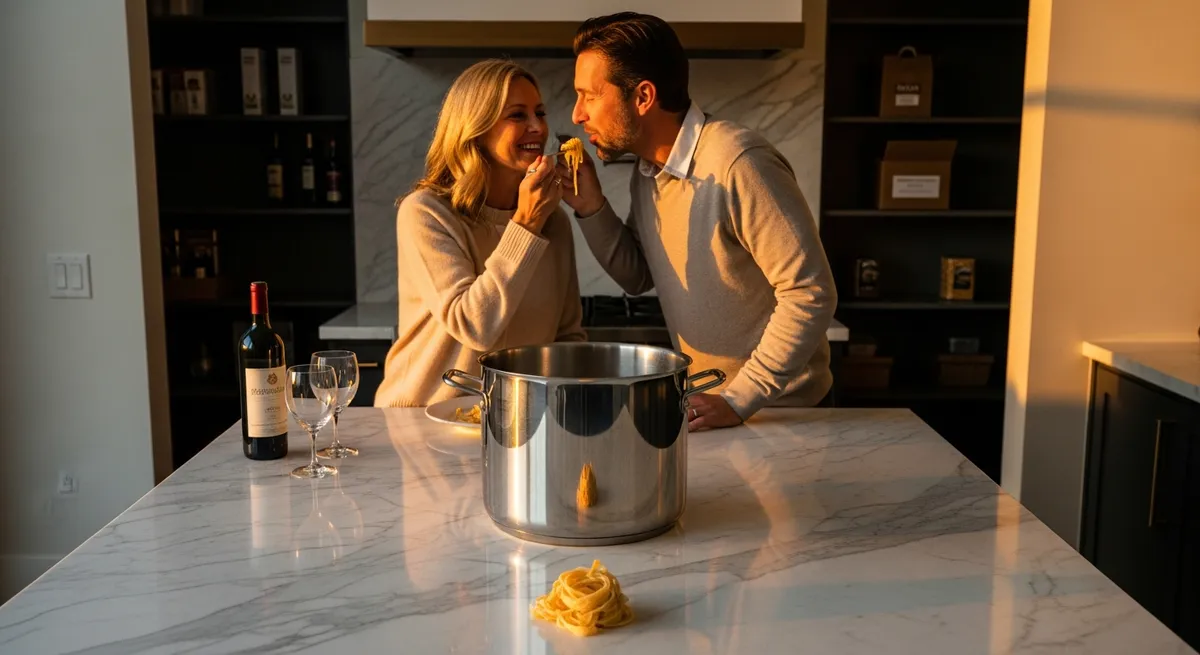
The pot holds twelve quarts. She knows this because the handle says so, stamped into the steel in letters that have gone grey from dishwasher cycles she couldn't count. She had already filled it halfway before she remembered there was no one to feed but herself and Gary, who ate like a man who'd made peace with disappointment.
She set the bag down and her thumb found the dotted line before she'd decided anything. The pasta came out faster than she meant it to - a long slide of rigatoni across the cutting board, off the edge, clattering onto the linoleum in a sound that was somehow too loud for a Tuesday. She stood with the open bag hanging from one hand and counted seven pieces near the toe of her left shoe. Gary called from the other room to ask if she was okay and she said yes - fine, and picked up six of them.
The knife came down and split the third onion and she got through one half before her hands just stopped, the blade still flat against the wet white of it. Four onions and a half on the board, their cut faces gone translucent under the overhead light, and the smell of them everywhere now - in her hair, already. She looked at the heap of it - enough for a Sunday in 2011, enough for people who weren't coming - and didn't move for long enough that the dog got up from his bed to check on her.
She poured the whole bag in anyway, and the water went briefly white. The two bowls took what the two bowls could hold, and she used the big serving spoon - the one with the long handle that Gary had bought for the year they did Christmas for eleven. What was left in the pot she covered with the dented lid - the one that didn't quite fit, that sat a little high and let the steam out one side - and she clicked off the overhead light so the kitchen was just the stove glow and the sound of Gary's program from the other room.
He set hers down at the corner where the placemat had gone the color of old newspaper, then his own beside it, close enough that their elbows would touch. The four empty chairs sat behind them, pushed in neat - their ladder backs catching the light from the fixture nobody had turned on. Gary pulled his napkin from the ring - the wooden ring with the G burned into it, one of six she'd bought the summer Molly went to camp - and spread it across his knee without looking at it.
She climbed down from the step-stool and stood on the linoleum with the lid in both hands, its dented center catching the stove light in a long dull crescent. The rubber seal around the edge had gone soft in one spot, a little give under her thumb where it used to be firm. From the other room Gary's program went to commercial, something bright and loud - and she heard his chair shift. She set the lid on the counter beside the dish rack and left the kitchen without turning the light back on.
She found the index card the next morning, filed between the electric bill and the coupon for the tire place - her own handwriting, blue ballpoint, the ink gone a little thin where the pen had been running out: rigatoni bake / double this for crowd. She stood at the counter in her socks and read it twice. Then she opened the junk drawer and put it in with the rubber bands and the dead batteries, in the back where the flashlight had leaked.
The following Thursday she bought one pound of ground beef and stood at the butcher case for a moment with the package in both hands before she put it back and took the half-pound instead - the one wrapped so small it looked like something you'd buy for a child's lunch. At the register she set it on the belt beside the single bunch of kale and watched the woman scan it without looking up. She carried the bag to the car and sat with it in her lap for a minute before she started the engine, the cold of the package coming through the plastic, through her coat, against her thighs.
She found the slow cooker in the cabinet above the refrigerator, behind the roasting pan - when she was looking for the colander. It was still in the box, the cardboard soft at one corner from some old water, and on the side panel in her own marker she had written Thanksgiving overflow / 6 qt / feeds 10-12. She stood on the step-stool and looked at it for a moment, the marker words facing out, and then she pushed it back behind the roasting pan and got down without the colander.
She found the recipe box on the shelf above the cookbooks - the wooden one with the painted rooster on the lid, and she lifted the lid and looked at the cards inside - hundreds of them, her mother's cursive on the old ones, her own on the newer, the tabs labeled in a system that no longer matched her life: School Nights - Birthday Requests, Picky Eaters (Jess), Picky Eaters (Tom). She pulled the card for Tom's macaroni - the one with the orange thumbprint in the corner, dried and ancient - and stood with it between two fingers. Then she put it back, not in the T section where it lived - but loose at the front, leaning against the tin divider, the way you'd leave a bookmark in a book you weren't sure you were finished with.
She found a bag of frozen corn in the back of the freezer, behind the ice pack shaped like a dinosaur that had been Jess's, and she held it against her wrist for a moment because the kitchen was warm from the oven. The bag was dated in her own handwriting - August - two summers back, the marker gone pale from the frost - and she knew without checking that she'd blanched it herself, six ears from the farm stand, the kind of thing you did when you had people to feed through winter. She put it back behind the dinosaur and took the newer bag from the front, the store brand - the one with no date, and measured out half a cup into the pan. The rest she rolled closed with a twist tie and wrote 1/2 left on the label in the marker she kept on the counter now, the way her mother had, because there was no longer anyone who would simply finish a thing.