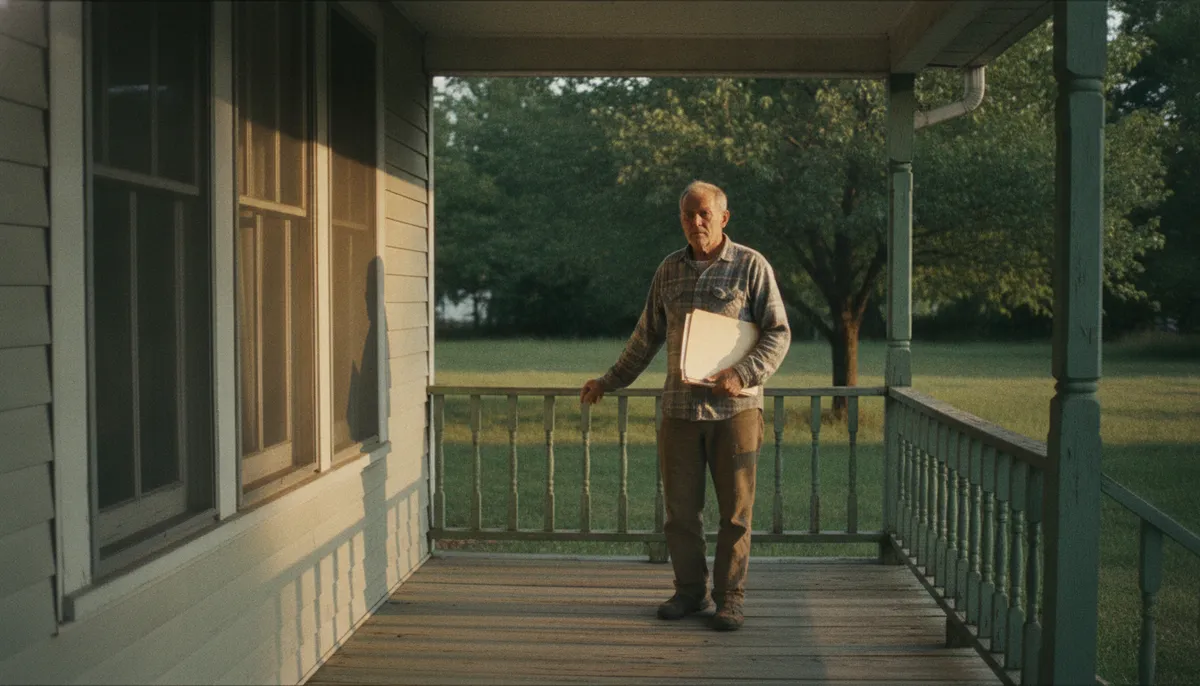
My father bought the label gun at the Walgreens on Route 9, the one with the pharmacy in back where my mother used to pick up her prescriptions. He came home with it in a plastic bag and set it on the counter next to the fruit bowl without saying what it was for. That was October. By November he had labeled the spice rack, the breaker box, and the bin under the stairs. My mother watched him do the spice rack and said nothing, which in her language meant she approved, or at least that she had decided not to fight it.
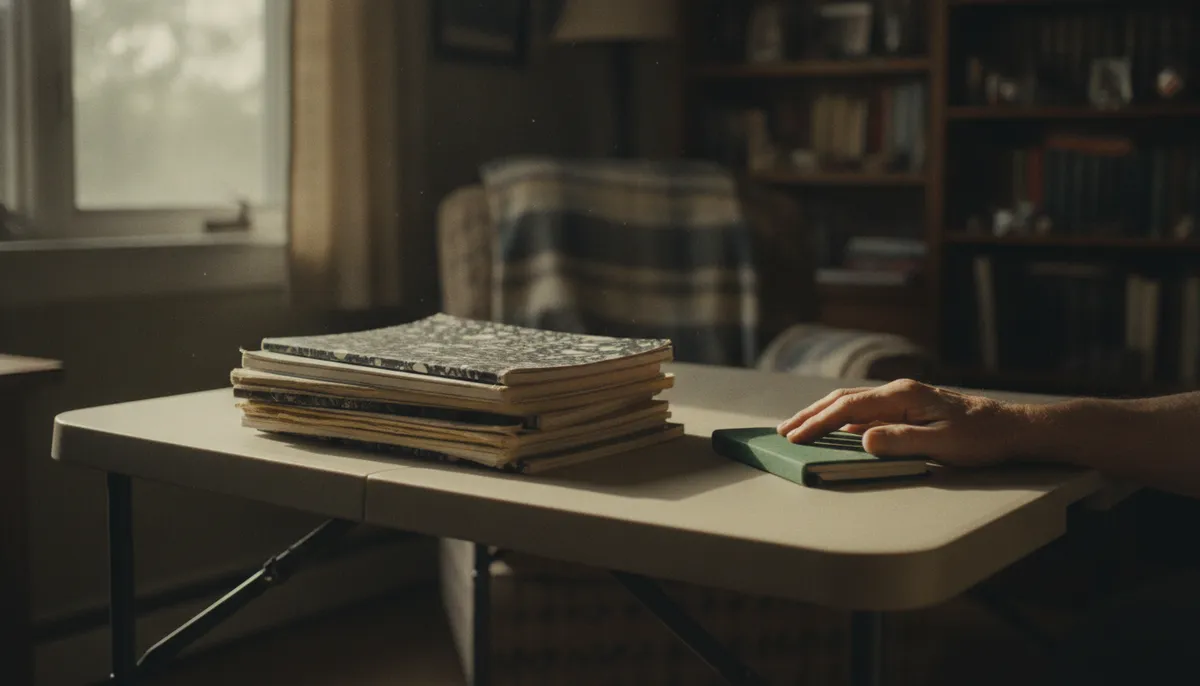
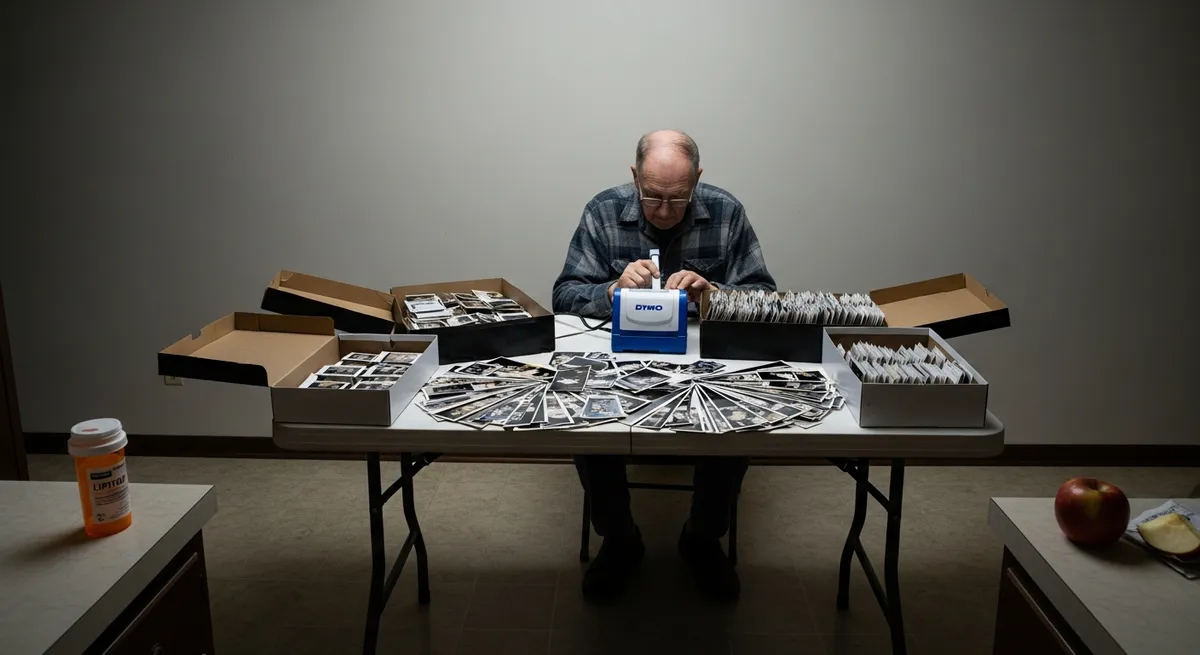
The photo boxes came down from the attic on a Saturday afternoon in December. Nine of them, shoeboxes mostly, two of the sturdier kind that department stores used to give you with boots. He set them on the card table he had unfolded for the purpose, and the bottom box lost its lid on the way down and spilled a loose fan of photographs across the linoleum. Strangers at a picnic. A woman in cat-eye glasses squinting into the sun. A car nobody in our family had ever owned, unless they had.
My mother sat in the chair with the torn armrest and picked up each spilled photograph and held it close to her face, then set it down into one of two piles. One pile she called hers. The other pile she called nobody's. She did this without hurry and without comment, the way she used to shell peas, and the nobody's pile grew three times as fast as the other one. My father loaded the tape into the label gun and it made a small grinding sound each time he pressed the trigger. He printed a label that said 1971-1979 and smoothed it onto a box with his thumb, very carefully, the way you press a bandage onto a child.
She lasted about an hour. Then she said the light was giving her a headache, and she went to lie down, and it was the two of us and nine boxes and the pile she had called nobody's sitting on the table like a verdict. I want to be accurate about this: some of the photographs in that pile were of her own sisters. One was of her mother standing in front of the house on Delancey Street, and she had looked at it the same way she looked at the strangers at the picnic, politely, and let it go. My father did not correct her. He had stopped correcting her sometime in the summer, around when the doctor started using the word we did not use at the card table.
He worked through the first box holding each photograph up toward the window. A woman at a picnic table, red cooler at her elbow, her hand raised against a sun that had set forty years ago. He would tilt it once, decide something, and set it down. The label gun spit out a blank strip in the middle of the afternoon and stopped, and he shook it the way you shake a ketchup bottle, then turned it over and read the small print on the cartridge, black letters the size of something you need reading glasses for. He didn't have his reading glasses. He carried the gun to the window and held it up and read the number aloud to no one: 91331. Then he went to the notepad by the fruit bowl and wrote it under two other lines, archival sleeves and acid-free tissue, all three underlined once with the same blue pen. Somewhere he had read that you were supposed to use pencil on the backs of photographs, that ink bleeds through given enough years. He used the pen anyway. He was not organizing for the next century. He was organizing for this one afternoon.
I found the photograph with the date stamp while he was changing the cartridge. October 1994, red ink gone slightly soft at the corners the way a bruise goes at the edges. A woman laughing at someone the frame had cut off, yellow cardigan, one hand lifted toward whoever it was. I looked at the row of labeled boxes, 1971-1979, 1980-1985, 1986-1993, 1995-2001, and then back at the date, which belonged to none of them, and then I just held it for a while. My father took it from me eventually and looked at it and set it in a box without saying which one.
He got up once and came back with two mugs of tea neither of us had asked for. He set mine on the corner of the card table, where it left a small wet ring on the back of a photograph of a birthday cake, five candles, somebody's hands blurred at the edges from clapping. I moved the mug. The ring had already soaked in. He looked at it the way you look at a crack in a windshield, waiting to see whether it will spread, and then he picked the photograph up and set it in the nobody's pile, which he had not touched until then.
The handwriting stopped him twice. The first was on the back of a print near the middle of the fourth box, blue ballpoint, the cursive she used for grocery lists: Donna's yard, June. He turned it over twice, front to back, the way you check both sides of a coin when you can't believe what you're seeing. He set it in the box marked 1986-1993, then took it out, then set it in again and pressed the lid down until it clicked. The second was near the bottom of the last box. Mom's garden, 1988. That one he didn't put down. He carried it to the window where the light was better, though the light was the same as it had been all afternoon. She had pressed hard enough with the pen that you could feel the letters from the front, raised and faint under the woman kneeling in the dirt with her back to the camera, both hands in the soil. The woman in the dirt was my grandmother. The hand behind the pen was my mother's, from a year when she was the one who remembered everyone, when she was the one who wrote the names on the backs so that nobody would ever have to sit at a card table and guess.
He slid the boxes onto the shelf with both hands and the labels lined up almost straight, except 1986-1993 leaned a half-degree left so the end of the three touched the hyphen of 1995-2001. He looked at the gap for a moment and left it. Then he sat back down in front of the label gun and the notepad, elbows on the table, the way a man sits when he is waiting for the next thing to do and can't think of it. Below the cartridge number and the supplies, in the same blue pen, he wrote a fourth line, pressing hard enough to ghost through to the next page: Mom's garden 1988. No date beside it, no box number. Just what she had written, the same words in his hand instead of hers, the letters slightly larger and slightly wrong.
There was a strip of blank tape stuck to the bottom of the last box, never pressed, the adhesive still good enough that it pulled a little when he peeled it free. He held it between his fingers, then set it on the notepad, on top of the words he had copied from her handwriting, covering them exactly. The card table had a wobble in the left leg, and when I shifted my chair the label gun slid an inch, and he reached out to steady it without looking, the same way he used to reach across the front seat when he braked hard, his arm crossing in front of whoever was there. My tea had gone the color of weak sunlight and I didn't drink it. He picked the blank tape up again and smoothed it onto his thumbnail, pressing down the way he had pressed the labels onto the boxes, and then he sat with his hands flat on the table, the tape on his thumb, and nothing left in the house to label.