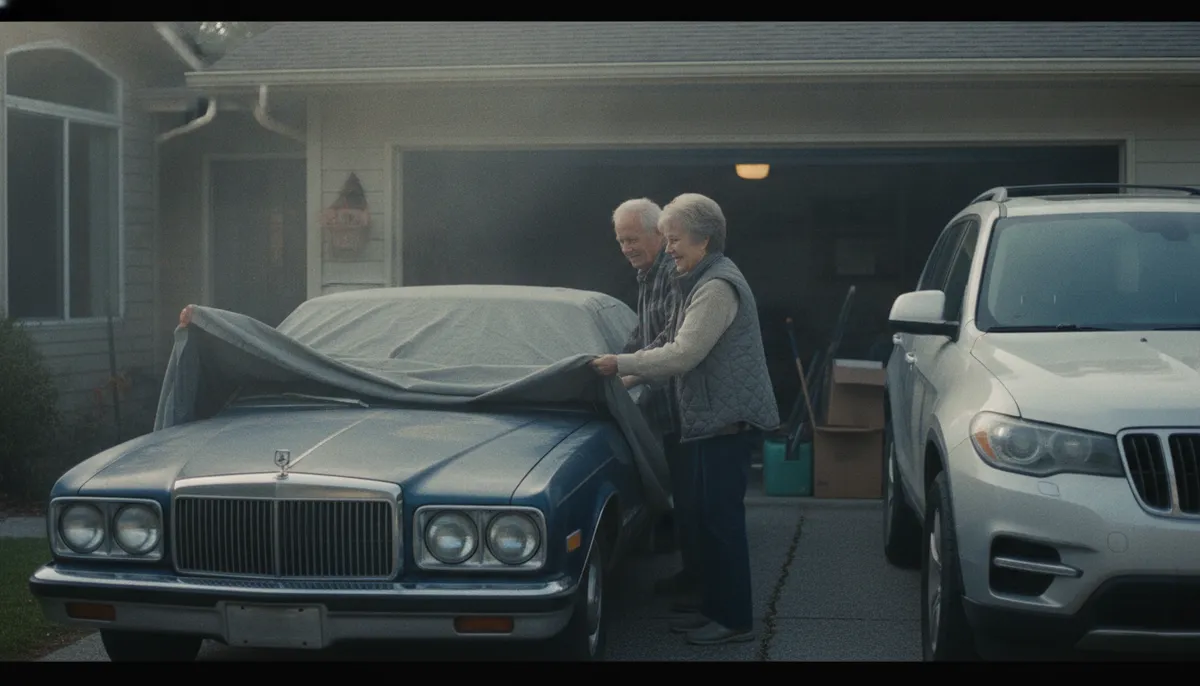
A second car that leaves the driveway twice a week is usually the most expensive transportation you own, measured by what each trip actually costs. That sounds backwards, because the car is paid off and the rides feel free. The trick is that almost everything a car costs arrives whether you drive it or not, while a ride service only bills you when you go somewhere. Once one of you stops commuting, the honest question is no longer whether you can afford the second car. It is whether those specific trips, counted and priced, are cheaper by car or by ride. This piece walks through how to count, using your numbers rather than anyone's averages.
What the parked car costs anyway
Start with the bills that show up regardless of mileage. Suppose insurance on the second car runs $1,100 a year, a plausible figure for an older vehicle with liability heavy coverage, though yours may be far from it; your own declarations page is the only number that counts. Registration is the next line. Fees vary by state and often by the vehicle's value and age, which is why the honest move is to look yours up rather than guess. California, for instance, publishes its full fee structure on the DMV registration fees page, and most states post an equivalent schedule or calculator.
Then comes the category people underestimate on a car that barely moves: upkeep. Low mileage does not mean low maintenance. Tires age out of safe service even with plenty of tread left. Batteries die faster in cars that sit. Oil still needs changing on a time schedule, rubber seals dry, brakes rust, and many states still require an annual inspection. Suppose that all comes to $600 a year in quiet years, with a $1,200 repair landing every third year. Again, these are illustrations. Your maintenance file, if you keep receipts, tells the true story.
There is a useful sanity check on the total. The IRS sets a standard mileage rate meant to reflect the full cost of operating a car for business, covering gas, insurance, maintenance, depreciation, all of it. For the second half of 2026 that rate is 76 cents per mile, published on the IRS standard mileage rates page. The rate assumes normal use, and a rarely driven car behaves worse than that, because its fixed costs get spread over so few miles. Drive 2,000 miles a year on a car with, say, $1,900 in annual fixed and upkeep costs plus fuel, and you are well past a dollar a mile before anything breaks. Fuel itself is the easiest line to pin down: the Department of Energy lets you look up your exact model's fuel costs at fueleconomy.gov.
What the rides would cost
Now count the trips the second car actually makes. Not the trips you imagine it might make someday, the ones it made in the last month. For many households at this stage the list is short: a standing appointment or two, groceries when schedules collide, a weekly commitment across town. Write them down with rough distances.
Price them the same way. Open the ride app you would actually use, or call the local taxi or senior transit service, and get real quotes for those routes at the times you travel. Suppose a typical local ride quotes at $14 each way and the second car makes six one way trips a week. That is roughly $84 a week, about $4,400 a year, and suddenly the comparison is interesting rather than obvious. A different household, with two rides a week to a nearby clinic, might total under $1,500 a year against the same fixed car costs. Same math, opposite verdict. Many areas also run subsidized senior transportation that undercuts every commercial option, which is worth one phone call to your county's agency on aging before you price anything else.
You can run your own comparison here with your real numbers. The calculator is illustrative only.
One side of the ledger the calculator will not show you: selling the car is not only removing a cost, it is recovering money. An older sedan in decent shape has a sale value you can check against any of the major pricing guides, and that lump sum, plus the insurance refund on an annual policy, funds a lot of rides before your own dollars come into it at all.
The numbers that don't fit in a calculator
Every couple who has actually made this decision will tell you the spreadsheet was the easy part. The second car is a backup when the first one is in the shop. It is the freedom to leave separately, which sounds small and is not, especially when one of you volunteers Tuesday mornings and the other has physical therapy Tuesday mornings. Ride services in rural areas can be thin at exactly the hours you need them, and a quoted price is not a guarantee the car shows up at 7 a.m. There is also the plain pleasure of driving, and the independence of never asking. None of that is foolish, and none of it appears in the totals above. If the rides win on paper by a few hundred dollars a year, the intangibles can fairly outvote them. If the rides win by thousands, the intangibles are at least worth pricing honestly.
Health cuts the other way, too. If either of you anticipates giving up driving in the next few years, the second car's costs are a countdown, and the question becomes when rather than whether. Selling a car on your own schedule, cleaned up and in running order, goes better than selling one that has sat for a year.
A fair way to decide
Rather than argue hypotheticals at the kitchen table, run a live experiment. Park the second car for one month. Keep the insurance in force, leave the keys on the hook, and use rides, the other car, and whatever local services exist for every trip the second car would have made. Track two things: what you spent, and every moment you genuinely missed the car, written down while it stings. At the end of the month you will have a real annualized ride cost to set against the car's real annual bills, and you will know which of the intangibles were theoretical.
Then do the arithmetic once, on paper, together. Fixed car costs per year on one side, twelve times your experimental month on the other, the car's sale value amortized over a few years as a credit to the ride column. Whichever way it comes out, you will have decided with your own numbers, which is the only version of this decision that stays decided. And if the car stays, it stays as a choice you priced and made, which is a much more comfortable thing to own than a habit.