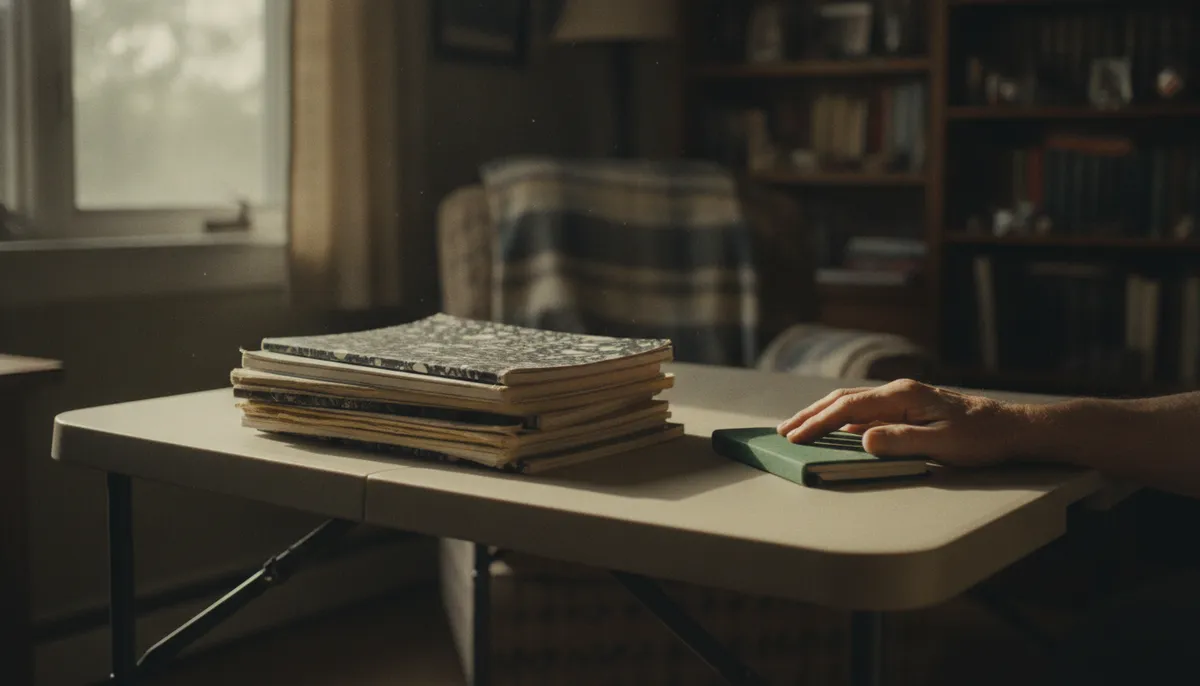
Walter had kept the books since the year we bought the house, which was also the year the furnace quit in January and he learned what it costs to be surprised. One composition book a year, the marbled black-and-white kind, bought every August when the school sales marked them down to almost nothing. Forty-one of them stood in order on the shelf in his den, each spine labeled on a strip of masking tape in his tidy draftsman's print, no gaps, no repeats. He ruled his own columns because the printed lines were never where he wanted them. Date, item, in, out, running total. The running total was always in pencil. Everything else was ink.
We had divided the work the way couples did then, without a meeting. I knew where every birth certificate was and what every teacher had been named, and Walter knew where the money went. If I needed a number I asked him, and he told me, and the number was always right, and that was the arrangement for forty-one years. I am not going to pretend I minded. There is a kind of comfort in a locked room when you trust the man holding the key.
In March a doctor watched Walter's heart on a screen for a long time and used the word episode, and then used it again in a sentence with the word next. We drove home without the radio on. That night I heard him in the den after midnight, not writing, just sitting, the chair creaking once every few minutes the way it does when a person is only shifting his weight. I stood in the hallway in my robe and did not go in, because there are rooms a man needs to sit in alone before he can invite you into them.
He invited me in on a Tuesday. He had cleared the card table we kept for jigsaw puzzles and set two chairs at it, and on the table were this year's book, a yellow legal pad, two pencils sharpened over the wastebasket, and a small green address book I had never seen in my life. He said we were going to do an hour every Tuesday. He said it the way he used to tell the kids the pool was closing, so that the argument, if there was going to be one, would be with the schedule and not the fact.
The green book was the passwords. He had organized it by his own logic, which meant the electric company was under L for lights, the bank was under M for money, and the pension was under W for work. His mother's maiden name was in there twice, spelled two ways, with a note about which spelling the phone company believed. When he slid the book across the card table his fingers stayed on it a moment after my fingers had it. Neither of us said anything about that. Then he let go.
He taught the way he kept the books, in order. The first Tuesday was where the money comes from. The second was where it goes. The third was the difference, which he said was the only number most people ever get wrong. He showed me the furnace entry from the first winter, eleven hundred dollars in ink with a small pencil note beside it that said never again, and then he showed me the savings line that started the following month and never stopped. Decades of never again, twenty dollars at a time, then fifty, then more. I had known we were all right. I had not known I was looking at the reason.
I started my own notebook the fourth week. Not to check him. To have somewhere to be wrong in private. I copied his columns and ruled them worse, ran the same month he ran, and compared my total to his pencil. The first three times I was off by amounts that turned out to be my own arithmetic. The fourth time I was off by fourteen dollars and thirty cents, and it was not my arithmetic. The insurance draft had gone up over the summer, and the notice had gone to an email address Walter checks the way other men check the oil in a car they already sold. He looked at my page for a long while. Then he took his pencil, corrected his own running total, and wrote my initials in the margin, small, the way he noted the source of any number he had not produced himself.
After that the hour stopped being a lesson and became something closer to keeping. Some Tuesdays we barely added at all. He would open an old book and tell me what a line had been. There is a withdrawal in one of them, a large one, with nothing written beside it, the only blank item on forty-one shelves' worth of pages, and one Tuesday he finally said his brother's name and nothing else, and I said nothing back, and the running total ran on underneath the way it always had. A ledger will hold a secret for you if you let it. It just refuses to pretend the money didn't move.
I would be lying if I said the green book sat easy in my hands those first weeks. I kept it in my nightstand and knew exactly where it was at all hours, the way you know where a candle is during a storm. What frightened me was not the arithmetic. It was that he had handed it over at all, this man who re-balanced the checkbook when the bank and he disagreed by a nickel, because handing it over was the one entry he could make about what the doctor had said, and we both could read it.
But fear keeps books too, and its columns do not balance, and somewhere around the second month I stopped consulting mine. Tuesday became the good night. He made the coffee weak the way he likes it and I drank it anyway. He began leaving small sums unresolved on purpose, a receipt tucked in the book with no entry, so I would find it and have to chase it down, and when I caught one he would sit back with his arms crossed like a man watching his kid back a trailer in on the first try.
In August the school sales came around, and I was in the aisle with the crayons and the glue sticks before I fully understood what I had walked in for. The marbled books were forty-nine cents. I bought two, one for his shelf and one for mine, and when I set them on the card table Walter looked at them the way he used to look at the kids' report cards, trying not to let the pleasure show and failing at the usual rate. His already has the masking tape on the spine, next year's date in his print. Mine is still blank. He says a book isn't anything until there's a number in it, and I have learned enough by now to write that down.