I installed the drip system on a Saturday in May, and I want it on the record that the installation itself went beautifully. Each emitter pressed into the half-inch tubing with a small, satisfying click. The controller box came with a diagram inside the flap, four zones in four colors, and I dog-eared that page like a man who intended to consult it often. I laid the line along the pepper plants the way you'd tuck in a child. By dusk I had dirt under my fingernails, a granola bar going stale in the grass beside me, and an app on my phone that promised to think about water so I wouldn't have to.
The App Said Everything Was Fine
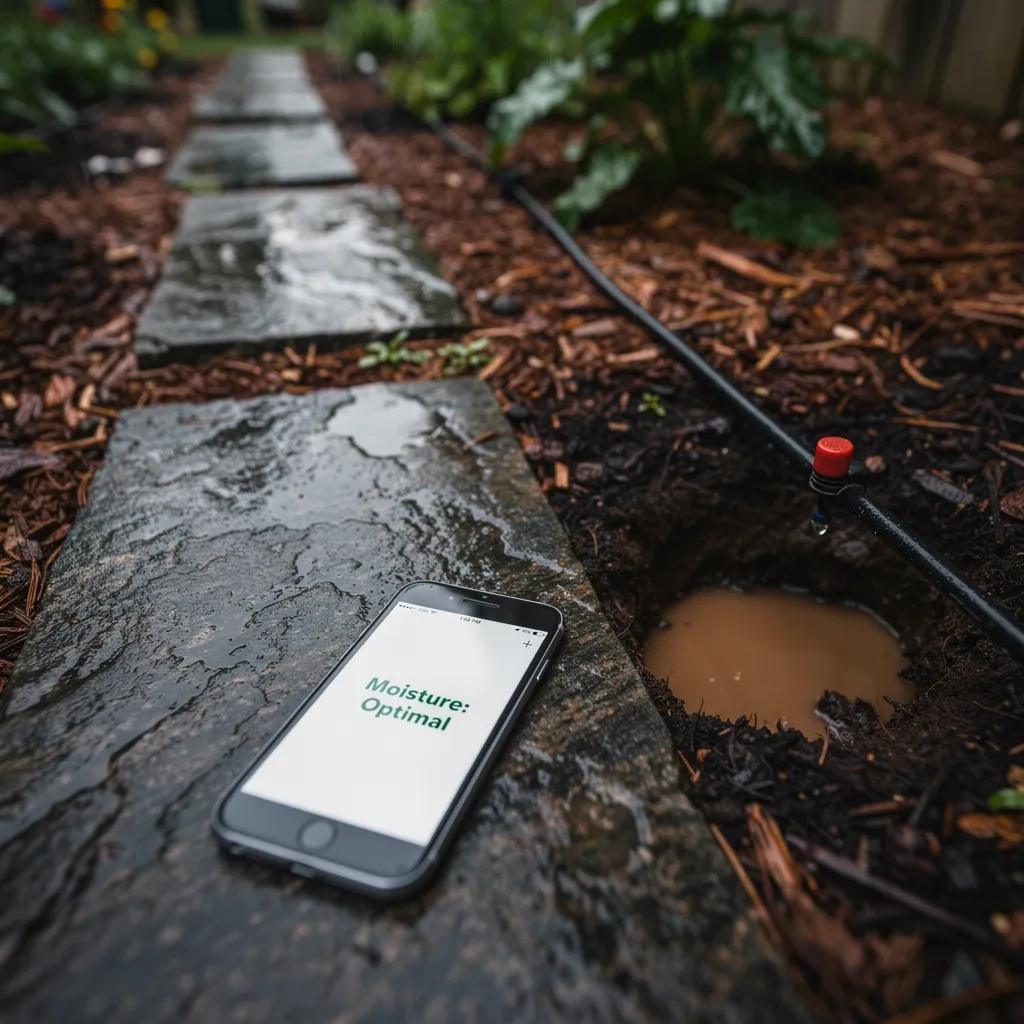
For about three weeks, it was. Then one evening in June I crouched next to the tomato bed during the six o'clock run and watched the water bead up on the soil surface and just sit there, the way rain sits on a waxed hood. I pushed a finger down two inches. It came back the color and texture of dry coffee grounds, and behind it a thin trickle of water was only just beginning to find the hole. The phone lay on the stepping stone beside me, and the app said Moisture: Optimal, in the same serene green font it used for everything. Near the emitter, a small earthworm had surfaced and was not moving the way earthworms move.
I lost six tomato plants that week. They came up out of the bed with no resistance at all, like spoons out of pudding, root balls trailing strings of mud. These were plants I had started from seed in February, in peat pots on the windowsill, labeled on popsicle sticks in permanent marker and watered with a turkey baster so as not to disturb them. I laid them in a row on the lawn and they looked like evidence. The popsicle sticks stayed in the ground, which somehow made it worse.
What Was Actually Going On
Here is the part I'd tell anyone thinking about one of these systems: the app was never lying. It was reporting, faithfully, on a world it could not see.
I spent the next three watering runs sitting cross-legged in the dirt with a cheap moisture probe, the yellow plastic kind from the hardware store, moving from zone to zone while the water ran. Zone 1 read wet. Zone 3 read nothing at all, and I found the reason with my fingers before I found it with my eyes: one emitter had kinked sideways at its barb during installation, mine, my thumb, my satisfying click, and the tubing downstream of it was dry as a cracker. The controller had been dutifully running that zone twice a day for weeks. Running a zone and watering a zone, it turns out, are separate accomplishments.
Then there was the rain problem. The system watches the weather, which sounds wonderful and mostly is. After a good storm one Thursday it decided the garden was satisfied and skipped two runs. Reasonable. Except that Zone 2 sits under the eave of the garage, where I'd moved that raised bed in May without telling anyone, least of all the app. The eave sheds rain in a clean arc that lands about eight inches past the drip line, so the storm that soaked the rest of the yard never touched that bed. The morning after the skipped runs, the soil in Zone 2 was chalk. The basil had begun cupping its leaves inward, edges going pale, and I nearly diagnosed it as sun scald. I nearly put up shade cloth. I nearly checked the app one more time instead of pushing a finger into the dirt, which would have answered the question in four seconds.
The moisture sensor itself, a gray puck zip-tied to a stake in the middle of Zone 1, staged its own quiet rebellion in August. The stake leaned. Not dramatically. Just enough that the puck came to rest in the afternoon shadow of the pepper plants, where the soil stays cool and damp long after the rest of the bed has gone to dust. For eleven days the app trimmed the Zone 1 runs shorter and shorter, confident, its little graph a tidy line, while two of the peppers dropped their blossoms in a ring around their own stems. I only caught it because I went out to deadhead and knocked the stake with my boot. My finger went in past the second knuckle and came out bone dry. The graph, at that moment, said everything was holding steady.
And the soaker hose in the strawberry bed developed a pinhole somewhere in its middle, a split barely wider than a thread, which pushed most of a run's water straight down into one soggy fist-sized spot while the strawberries at the far end went bronze at the leaf tips. The app logged that zone as eight minutes, on schedule, status complete. All true. I found the leak by kneeling on it while pulling a weed, then walking the whole hose with a finger dragging along it, reading it like a line of braille.
What I Do Differently Now
I still run the system. That surprises people who've heard me tell the tomato story. But the drip lines water more evenly than I ever did with a wand, they do it at dawn while I sleep, and the skipped runs after real rain genuinely do save water. The system was never the problem. My faith in it was.
So the routine has changed. The finger goes in the soil before the app gets opened, every time, in at least two spots per bed, because a finger two inches down is the only sensor in the garden that cannot be shaded, kinked, or reassured by a weather forecast. The rain gauge zip-tied to the fence post, a clear tube with a red float in it, gets read with my morning coffee, and its number matters more to me than the app's. Once a week I walk each line while it runs and put my eyes on every emitter, which takes about the length of a song. And the bent barb that cost me six tomato plants sits on the potting shelf now, next to the empty peat pots, where I see it every time I go for the trowel.
The app still says Optimal most evenings. Most evenings, it's even right. But it earns that word now, because somebody with dirty fingernails checks its work, and the two of us together are a much better gardener than either one alone.
Disclaimer
This article is a personal reflection shared for general informational purposes only.