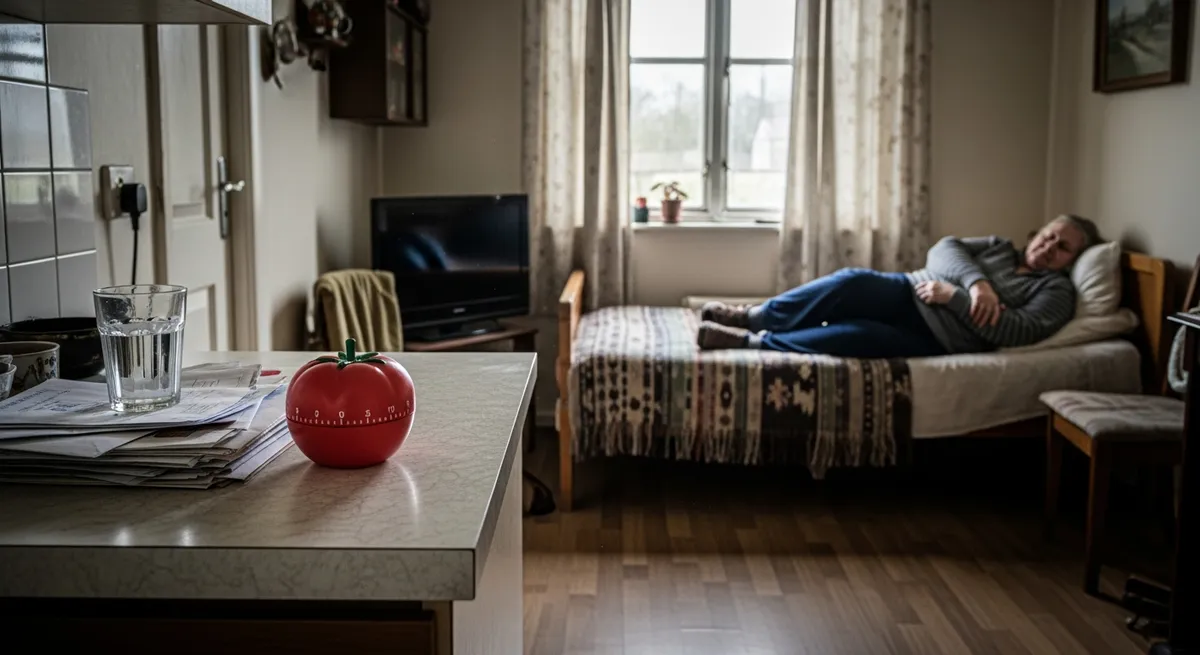
My grandmother napped like a person catching a train. The timer was the color of a school bus and shaped like a tomato, and she set it on the kitchen counter where she could hear it from the daybed. Curtains pulled to exactly the halfway point, no further. Blanket over her feet, shoes still on, laced. She crossed her hands on her stomach and was gone before I could ask her anything, and the beans kept going on the stove, ticking their small ticks against the lid.
To a kid this looked like a magic trick. Sleep was a thing done to me at eight o'clock, a punishment with pajamas. That a grown woman would choose it, in daylight, in her shoes, and then get up twenty minutes later and go back to shelling peas as if nothing had happened, fit nothing I knew about how days worked. I asked her once why she kept her shoes on. She said you don't unpack for a short ride.
The End of the Line
Forty years later I had become the kind of tired that reads as busy. By two-fifteen most afternoons I had a spreadsheet open, a browser tab holding a flight I wasn't booking, and an email three days old that began with the word Apologies. I moved the cursor from column to column and called it working. The clock in the corner of the screen said 2:22 and I looked away from it the way you look away from someone you owe money.
Then one afternoon a pen rolled across the floor of a subway car and stopped against the boot of a man reading his phone, and I watched it for a second before I understood that the pen was mine, and that the train was sitting at Coney Island, which was wrong by a dozen stops. My notebook had landed open to a page of my own handwriting that looked like somebody else's. The car was nearly empty - the man with the boot, a woman with grocery bags, the particular fluorescent quiet of a train with nowhere left to go. I picked up the pen and sat there holding it, partly because the train back wasn't leaving for eleven minutes, and partly because my body had decided, without consulting me, that eleven minutes was what it was going to take.
It happened again in a grocery store parking lot. I came to with the door's interior texture pressed into my cheek in a grid of little squares and the list still folded in thirds in my hand, damp at one corner. The milk on that list had been on it since Tuesday. The store's automatic doors kept opening and closing in the distance for people who were not me, exhaling cold supermarket air at nobody. I did not remember closing my eyes. The sleep itself didn't scare me. The missing border of it did.
I would like to say I changed because I remembered my grandmother. The truth is that my body ran out of patience and started taking the time by force, on trains and in parking lots, the way she had always taken it on purpose, on the daybed, with her shoes on.
The Brass Timer
The one I bought is brass, dented, secondhand, and winds with a sound like a deck of cards being shuffled. I set it for twenty minutes because that is where she set the tomato. I lie on the couch with one arm over my eyes and the pen still in my hand, and I understand the shoes now. Shoes on means this is a scheduled stop. Shoes on means I am getting back up.
The first week felt like stealing. I lay there listening to the building and composing defenses for a trial nobody was holding. Somewhere in the second week the bell went off and I sat up and my notebook had fallen open to a page from Tuesday, and one sentence on that page had a circle around it in ink that matched my pen, in handwriting that was mine. I did not remember drawing the circle. The sentence solved the problem I had been pushing around the desk for three days. I have no explanation for this that flatters me. The work finished itself the moment I stopped standing over it.
Cleaning out a drawer that fall, I found my second-grade report card. In the comments, in teacher cursive: doesn't waste time. A checkmark beside it, ranked the same as shows improvement in fractions. I set the card on the desk next to the timer and sat looking at it while somebody mowed a lawn outside and the smell came in through the screen. Second grade. Someone had been watching me for wasted time in second grade, and at some point, without my noticing the handoff, I had taken over the watching myself.
My mother left me a voicemail around then, four minutes long, in which the word productive appeared three times. It was never a word she used when I was small. I stood at the kitchen counter in my coat, trying to remember when it had moved into her voice, and whose voice it had lived in before hers, and how far back the chain of borrowed words might go. I didn't call her back that night. I wound the timer instead and lay down with my shoes on.
Nothing mystical happens in those twenty minutes. I don't dream. Some days I don't even sleep, just lie there under my own arm listening to the radiator. But I stand up with the afternoon returned to me, the looping sentences unlooped, the screen back to its normal brightness. Naps, it turns out, were never the indulgence. The indulgence was pretending I could skip them and still be present for anyone by dinner.
The egg timer lives on the corner of the desk now, sitting on the small dent in the wood that a sticky note used to cover. Some afternoons I touch the dial without turning it, just the pad of my thumb on the ridged edge, the way a person handles a coin they have no plans to spend. I never set it past twenty. I don't know whose rule that is. She never said, and the beans never burned.