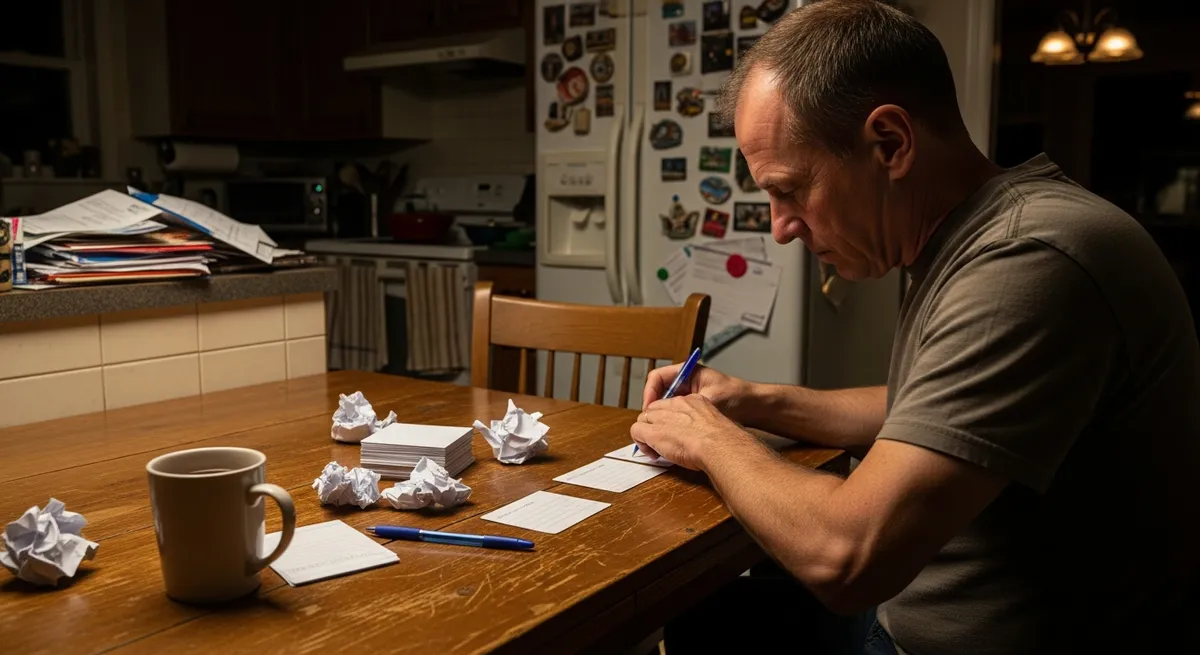
Three cards went into the trash, each one crossed out so hard the pen tore through on the second stroke. The fourth had a corner bent from where my thumb pressed while I read it back, and every line that started with by the time ended in a word I scratched out. By the time you read this I will have already - and then nothing, because I didn't know, and the not knowing sat right there in the scratch marks, visible. The pen skipped on already and left a dry groove in the card, a word with no ink in it. I pressed harder and tore through that one too.
The fifth card made it all the way. I read it back under the overhead light with the rest of the house asleep, my voice just above the refrigerator's hum. I got through the part about the garden, and the part about her stubbornness, which she gets from me, and then I hit the line about her laugh, the one that starts in her nose, and my throat closed around it like a fist. I sat there with the card in both hands and the silver pen rolling toward the edge of the table. The refrigerator clicked off. Upstairs my daughter was breathing in the dark, seven years old, nothing wrong with either of us, and I had just told her goodbye in the past tense at my own kitchen table.
I was at that table because of an envelope of my own. My father left one for me, sealed, my name across the front in his handwriting, the tall careful H he saved for documents. I found it taped inside the lid of his toolbox two weeks after the funeral, which was exactly like him, to file it under things he trusted me to open eventually. I carried it around for a month before I could read it. Eleven sentences. One of them was about the way I stand in doorways like my grandfather did, a thing nobody had ever told me and nobody alive was left to confirm. I have read those eleven sentences more times than I have read anything else I own. That is what I knew when I sat down with the cards: a page of somebody's actual handwriting, saying the small true things, outlasts every speech you never quite give.
The Box
I sealed it with the good tape, the wide clear kind that comes on the orange dispenser, and pressed the flap down with my thumbnail until the paper dented. Her name went on the front in the pen's skipping hand, one letter faded mid-stroke where I had to go back over it. The fireproof box under our bed smelled like a hardware store. It held her birth certificate and her first library card, the laminated one where she is three and squinting, and I slid the envelope in behind those and pressed the lid down until it clicked.
For three years I knew exactly where my hand was in relation to that box every time I reached under the bed. I could pull out the storage bin or the extra blanket without touching it, the way you take a step in a dark house you know. Some nights my knuckle found its corner anyway, and I would stop there a second before moving on. People say these things get lighter once they're written down. It didn't get lighter. It just got an address.
She found it when she was ten. She held it out by one corner the way she holds a dead bug, craft scissors open in her other hand like a beak, and said, what's this one for. I took it from her with two fingers and said, later, and she went back to the floor and her construction paper without looking up. That night I lay with the envelope on the nightstand, the streetlight coming through in one stripe across the ceiling, and read her name in the dark until the letters stopped being letters. The tape had gone slightly yellow along one edge. I tried to remember whether I had actually written the thing about her laugh or only meant to, and I couldn't, and I put the envelope back unopened, which felt like keeping a promise and also like failing one. I didn't sleep for a long time after that.
The Porch
The box moved houses with us twice. The summer she was twenty-three, home between leases with her boxes stacked in the garage, I took the envelope out one morning while the coffee was still going and put it in her hands. I said I had written it a long time ago, and that I had changed my mind about the opened-later part. She looked at the yellowed tape for a while before she carried it outside.
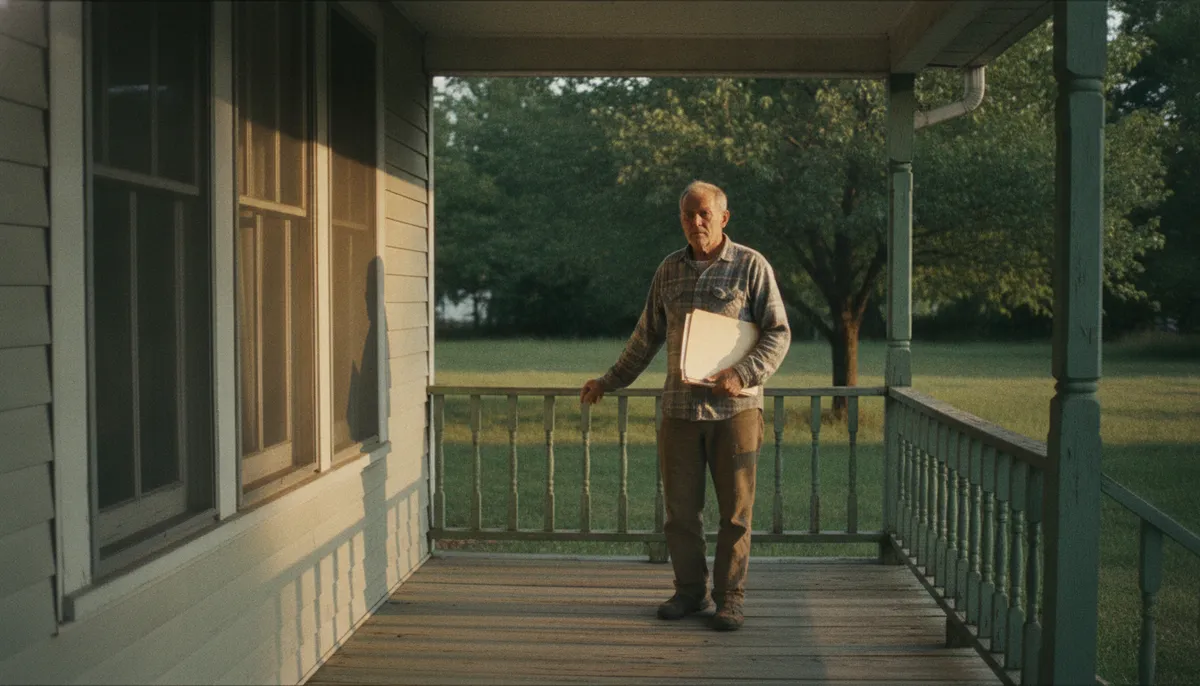
She read it on the porch with her back to the door, the pages bent open against her knee, and I watched through the screen the way I used to watch her sleep when she was small enough that watching felt necessary. I had clipped the silver pen to the envelope, the same skipping pen, and it caught the light once when she turned a page. Then she held it in her fist without writing anything. When she came inside she set the pen on the counter next to the pepper grinder and didn't look at me, and I cracked the first egg wrong and had to fish out a piece of shell with my thumbnail. We stood at the stove for twenty minutes, passing the spatula back and forth. The eggs came out overdone and we ate them anyway, standing up. The pen stayed by the pepper grinder all day, and neither of us moved it.
A week later there was an index card on the kitchen table in her handwriting, lying face down, nothing showing on the back. I made coffee and let it stay the way it had landed. The pen was gone from beside the pepper grinder, and I noticed that the way you notice a tooth you've stopped touching. That night her light was on past midnight, a thin line of it under her door, and I stood in the hallway in my socks on the cold floor for a minute and then went back to bed. In the morning the card was still there. She set her cereal bowl on top of it without thinking, or maybe with thinking, and when she carried the bowl to the sink there was a small ring of milk on the card's edge. I moved it to the counter beside the stove without turning it over, and I don't know if she noticed, and neither of us said anything about the pen being in her room, which we both knew it was.
The Drawer
The envelope I found in the silverware drawer a month after that was hers. Unsealed, my name on the front, the H a little shaky the way mine gets when I am being careful. I put it under the dish towel, the one with the red rooster on it, and finished unloading the dishwasher with the forks going in loud.
Writing mine taught me one thing, and finding hers taught me the other. A letter like that turns out to be less about the day it gets opened than about the night it gets written, when you say the unsayable things out loud once, in a locked kitchen, and discover they survive being said. After that they are shorter to say in daylight. I told her about her laugh eventually, in person, in the car at a red light, nothing ceremonial about it. She rolled her eyes and looked out the window, and her ears went red the way mine do.
Her envelope is still in the drawer. I moved the rooster towel twice that first week for no reason except to have somewhere to put my hands, and then I made myself stop. So the count in this house currently stands at three: my father's eleven sentences in the fireproof box, my five cards' worth already read on a porch, and hers, unsealed and unread, under a towel with a rooster on it. She knows where I keep the spoons. That is the whole arrangement, and it holds.