The bag crinkled when I touched it, that particular crinkle of plastic that hasn't moved in a long time. I could see the blue through it, still that exact cobalt, the blue of something I had carried home on the subway holding the hanger above my head so the hem wouldn't drag. That was four years ago, maybe five. The wire hanger had bent into a question mark from all the times I'd pushed it left to make room for the gray cardigan, the black one, the other black one. I peeled back a corner of the plastic, looked at the blue for a second, and put the plastic back. My palms smoothed it flat, the way you tuck in someone who is already asleep.
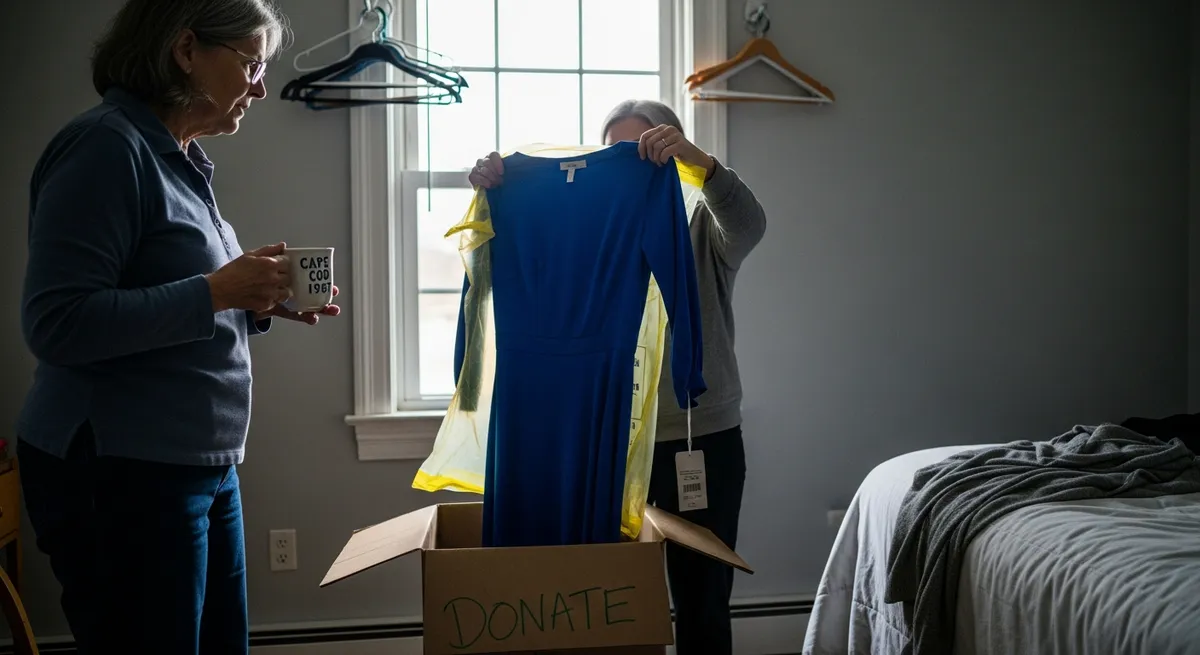
Two weeks later I watched my cousin lift a coral blouse out of my mother's closet by the shoulders, the way you carry a coat over your arm, tissue paper trailing. She set it in the box without unfolding it all the way, and the price tag swung once on its little string. Someone had written donate on the box in green marker, lowercase, like an item on a grocery list. The coral went in next to a bag of rubber bands and a clock still sealed in its packaging from a Christmas I could count backward to. I was holding a coffee mug that said Cape Cod 1987, and I did not put it down, and I did not say anything either, until everyone had moved on to the bedroom, and then I took the blouse back out of the box.
It rode home on the passenger seat in its plastic, the coral going gray in the late light the way coral does when the sun leaves it. At the red light by the CVS I rolled the window down, and the smell came up anyway, cedar and something older underneath, the smell of a drawer I had opened a hundred times looking for scissors. I put my hand flat on the plastic without deciding to, the way I used to tap the banister at her house, and left it there through the whole green light and the one after, while somebody behind me was kind enough to only honk once. At home I hung it on the closet door and told myself I'd find the right hanger in the morning. Her blouse, with its tag still on. She had saved it too.
The next morning I reached into my own closet and the gray cardigan was right there, the familiar gray, and my hand stopped an inch from it like it had hit glass. I took the cobalt out of its plastic instead. In the bathroom mirror I buttoned it from the bottom up, the way my mother used to, the last button the one at the throat. The fabric moved when I breathed. It had been waiting four years to do that. I picked my keys up off the counter, next to the bowl with the single lemon in it, and went out to the car with the grocery list in my pocket, eggs and the good mustard, and I did not change first. The checkout kid didn't look twice. The blue was for me anyway.
The price tag turned up days later under the lip of the nightstand, its loop of white string curled around itself like it had been waiting to be found. I don't remember clipping it off, though there were the little scissors, still on the nightstand, still open. I put the tag in the zippered pocket of my wallet, the one that already held a dry-cleaning ticket for a coat I picked up years ago and a fortune from a cookie that had seemed too important to throw away. It has been there since, through three haircuts and one flight and the particular Tuesday I paid too much for good olive oil without hesitating. When I press my thumb against the string now, gone soft from the other papers, I can't tell you anymore what I was saving it from.
Once you notice the saving, you see it everywhere in your own house. The lemon in the bowl went soft at one end, that give under the thumb that means a line has been crossed, and I stood there pressing it anyway, not ready to admit it. There's a bottle of wine on the shelf above the refrigerator, a birthday gift now three birthdays old, the red and gold paper still twisted around its neck the way the store does it, and every time I move it to reach the olive oil I read the label like I'm reading it for the first time. The good stationery is in the bottom drawer, cream, deckle-edged, still wrapped in the shop's tissue, bought for a letter I have since said out loud on a phone call, then in a text, then never. The heavy pen that goes with it has dried up waiting. Last week it skipped across the corner of an envelope and left a mark like a question mark lying on its side, which felt less like a coincidence than it should have.
The fig jam has been on the second shelf since the September farmers market, handwritten label, wax seal unbroken, saved for toast that is somehow better than the toast I make every weekday morning, which is all the toast I ever make. This morning I took it down and held it up to the window the way you hold a jar of jam to a window, looking for something, and the light came through it dark and particular, the color of the inside of a fig. I heard myself think the word soon. Then I watched my own hand set it back behind the tahini, and that was the moment the whole apparatus showed itself: the jam, the wine, the pen, the stationery, the lemon, the blue blouse, the coral one, all of it one long line of things standing in the dark, waiting for a day I have never once specified.
I don't have a tidy account of why we do this, why the brightest things get rationed hardest, why my mother owned a coral blouse with the tag on it and I owned a cobalt one in plastic and neither of us said a word about it to the other, two women saving their best colors in two closets eleven miles apart. I only know what I did next. I opened the jam. I ate it on ordinary toast, standing up, wearing the cobalt with the sleeves pushed to the elbow, and it tasted like figs, which is to say like something that was always going to be eaten by somebody, and I had gotten there in time to be the one. The coral hangs on the closet door now, where I can see it, tag off. It goes on a Tuesday. Any Tuesday. Soon has a date now, and the date is the next time I reach for gray.