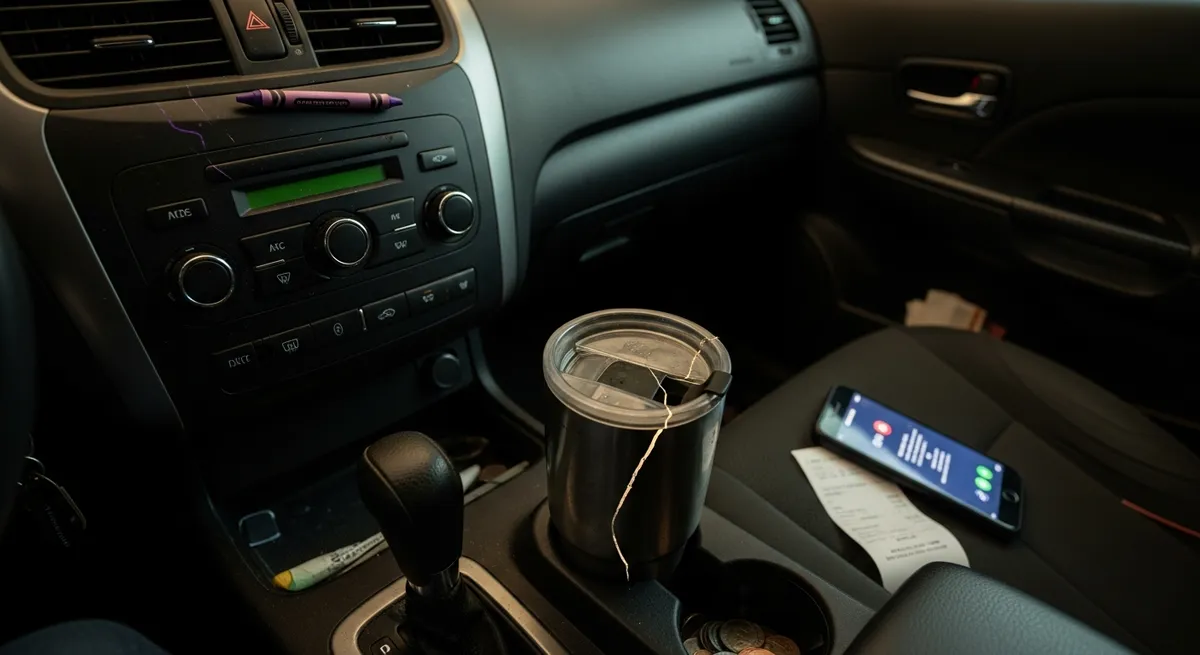
The mug sat wedged in the cupholder, its lid cracked along the rim from the Tuesday he dropped it in the parking garage. He kept meaning to run it through the dishwasher. The crack had gone brown at the edges the way grout does, and at red lights he pressed his thumb against it without noticing he was doing it. There were only two red lights on the long way home, which was part of why he took the long way home.
The short way was the bypass: four lanes, a Meijer, home in eleven minutes. The long way was the old two-lane through the corn, the route from when he and Jenny first moved out here and the bypass didn't exist yet. Driven honestly, it took thirty-five minutes. He had been driving it a little less than honestly since spring.
He kept the radio on the classical station because nobody else in his house ever wanted classical, and a man ought to have one thing in his day that exists only because he chose it. The cornfields pressed up to the shoulder. His headlights caught the silk at the top of the stalks and turned it silver for a second before the dark took it back. He drove with one hand, rolled the window down two inches with the other, just enough to hear the night, then rolled it back up.
That afternoon, at a quarter past four, a man twenty years younger had slid a folder across a table and used the word "transition" three times without once saying what was ending. Thirty-four years, and the meeting took eleven minutes. He had known it was coming since Monday, when an invitation appeared on his calendar with no agenda and his manager stopped meeting his eyes in the hallway; the folder only made it paper. Afterward he carried his box to the car, sat in the parking lot until the windows fogged, and then drove to the store, because Jenny had asked him to pick up soup from the deli counter, and because a person needs a reason to drive somewhere.
At the second red light the purple crayon rolled out of the door pocket, and he picked it up without thinking, turned it in his fingers, and set it on the dash. The wax had a tooth mark near the paper label. Not his. His grandson had ridden back there on Sunday, narrating the whole road, every silo, every water tower. The turn signal stayed on for a quarter mile past the grain elevator before he noticed, and even then he didn't turn.
The screen in the console lit up and said JENNY, and threw a white rectangle across the buckled seat belt on the passenger side. He watched the cornfield. The rectangle shrank to nothing, then came back, JENNY again, and then a bell: the reminder he had typed to himself at seven that morning, standing at the counter in the ordinary light, before any of it was official. It said, "Tell her tonight." He had carried the thing alone for four days, and the four days were up.
The kitchen window was a yellow square with his daughter moving through it, once, twice, holding something flat against her chest, a book, or the lid to something. Her car was in his spot, which meant the boy was there too. The grocery bag on the seat had gone cool through the paper. He put his hand on the gear shift and left it there. Then he counted the slats in the garage door, got to eleven, and stopped, because a man can sit in his own driveway only so long before it becomes something he is doing.
Inside, he set the bag down and the soup container knocked against the counter edge. When he pulled his hand from his pocket the crayon came with it - he hadn't known it was there - and it hit the tile and rolled until the refrigerator stopped it. He crouched, worked it out with two fingers, stood, and dropped it in the junk drawer next to the dead batteries and the twist ties, and pushed the drawer shut with his hip.
Jenny looked at him over her glasses, then at the clock, then back at him. She had called twice, and he had watched the phone ring both times. He put the soup on the stove, turned the burner too high, and with his back still to her he said it: the folder was signed, and after the first of the month he didn't work there anymore. The burner ticked and caught. From the other room his grandson said something that made his daughter laugh, a sound that had no idea what had just happened in the kitchen and was better for it.
Jenny came and stood beside him at the stove. For a moment she said nothing. Then she reached past him and turned the flame down, because he always set it too high, and said that with everyone here tonight they would want the bigger pot anyway, and got it down from the cabinet and handed it to him. He filled it at the sink, feeling the weight build in his hands.
Later, wiping the counter after everyone had gone up, he opened the junk drawer and took the crayon back out. He stood it on the windowsill above the sink, where a person washing dishes in the morning would see it first thing.