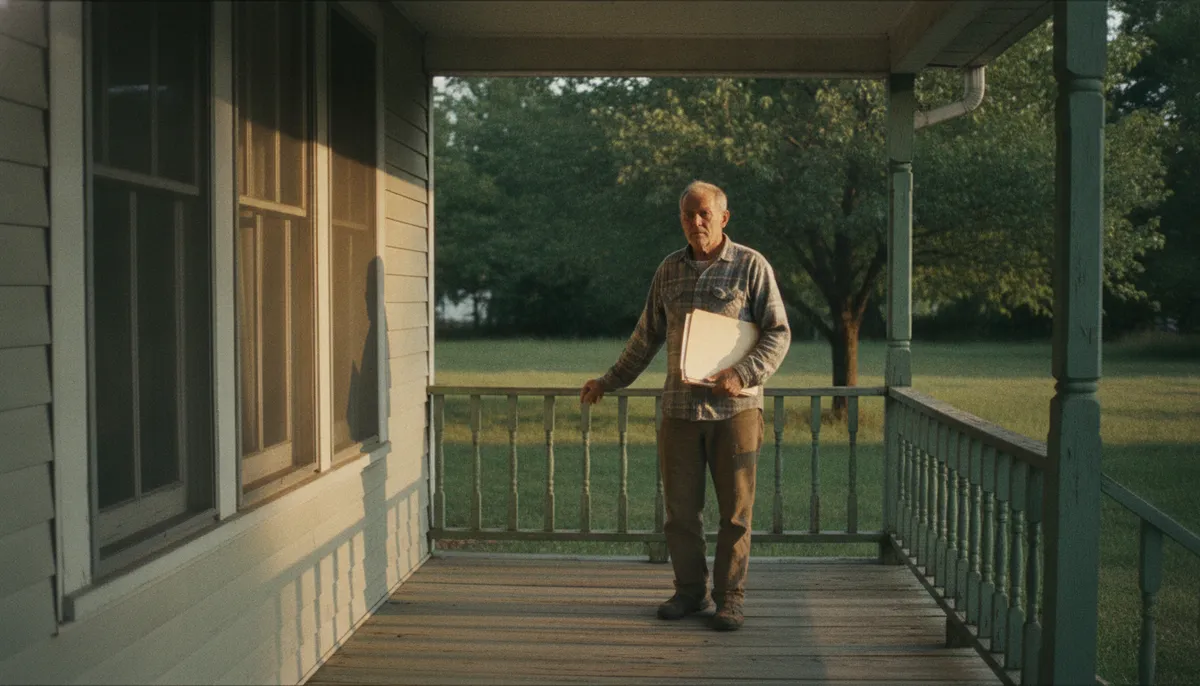
My father called me from the parking lot of a gas station in October, engine running, and told me the new people had rented a tiller. He had driven past his mother's old house, the one we sold in the spring after she died, the way he still drove past it most weeks without ever saying he did. The tiller was orange, he said, the rental kind, and the father of the new family had waved at him from the yard, friendly, the way you wave at a man you assume is a neighbor. Then he told me something he had never told me in forty years: the spider lilies along the back fence had come from Opelika, from his mother's mother's yard, dug up and wrapped in wet newspaper and carried north in the trunk of a Buick before he was old enough to drive. He watched one bulb come up whole in the tines, he said, just for a second. Neither of us said anything for a while. Then he said he needed gas, and I heard him put the car in drive.
What he did not tell me on the phone was that he had parked, walked to the fence line while the family was inside at lunch, and gone down on his knees in his good gray trousers. When I got to his apartment that evening he was sitting in the car in the lot with the heater on, and in his cupped hands was one bulb the size of a shallot, paper-skinned, a snapped stem leaving a green smear across his thumb. There was a half moon of dried mud on each knee. He handed the bulb to me through the window without much ceremony, the way you hand off something too heavy to keep holding, and said his place had no yard. That was all the explanation either of us could manage. Things between my father and me have been complicated since the divorce, his and my mother's, and most of what we mean gets carried in objects.
The saucer winter
I put the bulb on a cracked saucer on my kitchen windowsill because I did not know what else a person does with a rescued thing in November. It sat there all winter with its stem nub pointing up, and the papery skin went the color of old newsprint, then darker. I dusted under it once and set it back in the exact spot, the way you return something sleeping. I read later that you are supposed to store them cool and dry, in sand or sawdust, and I had done nothing right, and it lived anyway. Some things want less rescuing than we think.
Spring came late and I missed the moment. By the time I noticed, a pale shoot stood three inches out of the crack in the saucer, urgent and colorless, like something that had been reaching in the dark for weeks. I owned no flowerpots. What I owned was my grandmother's colander, the dented one from the estate boxes, and I filled it with potting soil on the back step and buried the bulb to its shoulders. My mother laughed when she saw it, one short sound, because she recognized the colander. We stood in the kitchen doorway looking at a lily growing out of a pasta strainer, and neither of us said Opelika, or Buick, or my father's name, though all three were in the room with us.
In August it bloomed. Six thin red petals opened in a way that looked startled, over one afternoon, and I took a photograph on my phone and then sat down at the kitchen table to decide who to send it to. I typed my father's name. I deleted it. I typed it again and let it sit there over the picture, the wooden spoon I had wedged in the colander to stake the stem just visible in the corner, and everything in that frame descended from a wet square of newspaper in a woman's hands on a day fifty years before I existed. I did not send it. I did not delete it either.
The map
In November a woman knocked on my mother's door with a baby on her shoulder and a folded piece of paper pressed flat against the baby's back. She was the new owner. She had found the paper in the track of the storm door while cleaning, folded small, soft at the creases, and she had asked a neighbor where the family had gone and been pointed to my mother's address across town. It was a map of the back beds in my grandmother's handwriting. I would have known it anywhere by the letter p, a loop that came back and crossed itself. Peonies here. Dahlias, moved 1988. Along the fence, in her small caps: LILIES, DO NOT DISTURB.
The woman said she did not know what peonies looked like when they were only leaves, and she wanted to be sure before she planted anything in the spring, because it seemed to her that somebody had already made decisions about that ground and written them down. My mother stood in the doorway holding a dish towel and decided, visibly, not to cry in front of a stranger. Then she invited her in and they spread the map on the kitchen table, and my mother told her which marks were flowers and which were the dog's grave, and the baby slept through all of it.
The tiller had already been through the beds by then. Most of the map described things that no longer existed. The woman took it home anyway, and my mother let it go with her, which surprised me until I thought about it longer. The garden was never going to belong to us again. The knowing could.
In October I dug the bulb out of the colander with a butter knife to move it somewhere better, and it had made three more of itself. Four bulbs where one had been, each the same shallot size, the same paper skin. I stood on the back step holding them and not knowing what a person does with increase. Two went back in the soil. Two went into a coffee mug with a broken handle, up in the cabinet where I keep things I mean to deal with, and I wrote my father's phone number on a Post-it and stuck it to the mug. I peeled it off once, threw it away, and wrote it again on a fresh one. His number has not changed. The mug needed something written on it, even if I did not yet know what I meant by that.
This January a realtor sign went up in that yard again. I saw it driving past on my way to somewhere else, the grass winter-tan and smooth over the old beds, no sign of anything red ever having grown along the fence. I slowed down. I did not stop. Whoever comes next will not get a map. But two towns over there is a colander with lilies in it, and a mug with two more waiting, and a phone number, and spring is a long season. Somebody is going to get a phone call before planting time.