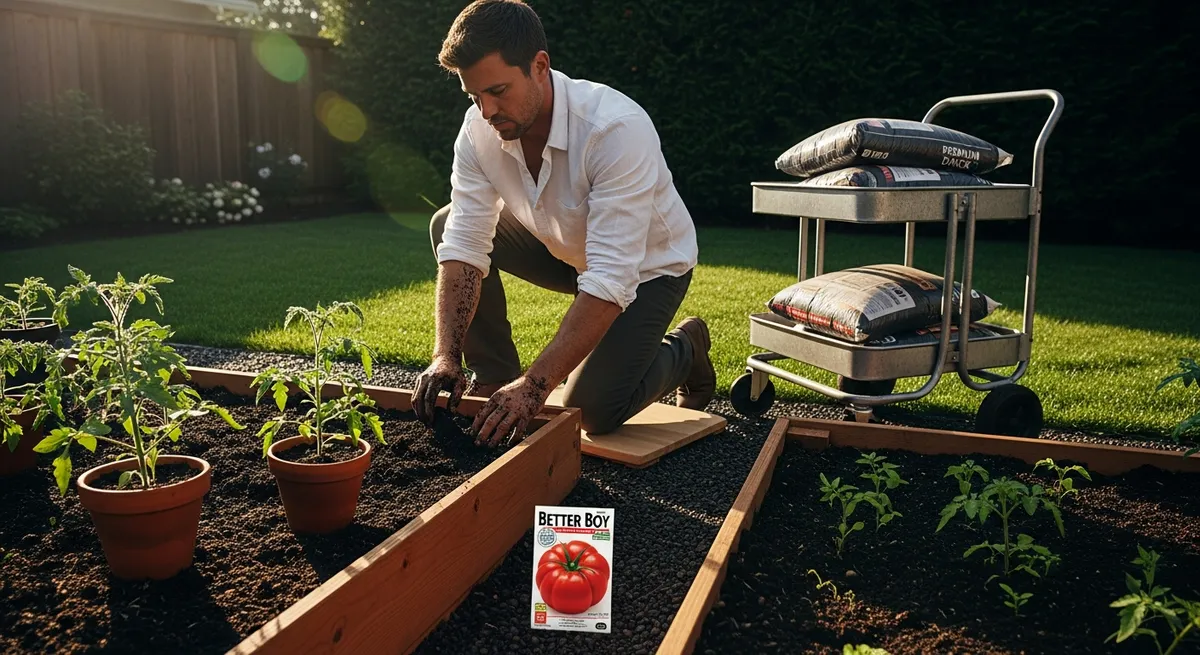
He turned the seed packet over and read the back, then turned it face-up again to look at the tomato. The tomato on the packet was the size of a softball. He set the packet on top of the clay and walked back inside to find a tape measure.
He came back with a cart that had a wobble in the front wheel, and he loaded it with a six-pack of Better Boys still in their plastic cells, a bag of Miracle-Gro Garden Soil whose green lettering promised him something in a font he trusted, and a copper butterfly tag he couldn't explain needing. There was a bamboo stake four-pack - a hand trowel with a rubber grip, and then, at the end of the aisle, a second six-pack of cherry tomatoes because they were right there. The woman ahead of him had a rewards card and he didn't. He slid his card into the reader and looked at the gum display until the machine beeped.
He set his phone timer for six o'clock and each evening pulled the green hose from its loop on the fence post, walking it out so it wouldn't kink at the elbow joint behind the spigot. The Better Boys had put out a second pair of leaves - pale and small as a child's earrings, and he crouched at the bed's edge to look at them the way he used to look at sourdough starter before he understood that he couldn't make that work either. The cherry tomato plants leaned east by Wednesday, and by Friday they had leaned back, and he told himself this was normal in a voice he used when he wasn't sure. He left the copper butterfly tag pressed into the dirt between two plants because moving it felt like admitting something.
He counted five of them before his hand moved, each one gripping the stem with legs he hadn't known caterpillars had - their bodies the precise green of the plant so that he'd only seen them because one was chewing and he'd watched the motion before he understood what was making it. Below them the first tomato hung from its cluster, the bottom gone soft and black and caved inward, the skin around the crater still red and taut, as if the outside hadn't gotten the news yet. He picked one hornworm off with two fingers and held it in his palm, and it gripped his skin the same way - steady, unhurried, and he stood there with it for a moment before he understood he was waiting for someone to tell him what to do next. The dropped tomato landed in the dirt with a sound too small for what it was.
He dropped each one into the Maxwell House can, and they landed soft against the plastic lid he'd set in the bottom, and he counted seven before he stopped counting. The porch light had come on at some point without him noticing - and it threw his shadow long across the bed so that he had to move to see the plants at all. Three stalks stood, and leaves he'd thought were there were not there, and the graph-paper sketch on the fridge had shown six neat rows in green marker, the squares optimistic and even. He stood with the can at his side and looked at what was left the way you look at a receipt you already know is wrong.
He cut both tomatoes with the bread knife because the good knife was in the drying rack and he didn't want to wait. The juice ran into the grooves of the cutting board and pooled at the crack where the wood had separated, and the smell came up sharp and warm and nothing like the grocery store. He folded a slice into his mouth over the sink and stood very still. Then he opened the junk drawer with his elbow - his hands still wet, and slid the seed packet behind the twist ties and the expired coupon for a restaurant that had closed, and pushed the drawer shut with his hip.
He found the graph-paper sketch when he cleaned the fridge in October, the green marker squares still neat and even, and he stood at the counter with it for a moment before he folded it once and dropped it in the bag with the coffee grounds and the cilantro that had gone to slime at the bottom of the crisper drawer. The copper butterfly tag was on the windowsill now; he didn't remember bringing it inside. On the back of the seed packet envelope - which he hadn't thrown away either, he'd written in pencil the word hornworm and then below it, in smaller letters, blossom end rot, and below that a number that was either the pH he'd looked up or a phone number - he couldn't tell anymore. He set the tag back on the windowsill with the flat side down and went to find his coat.
The seed catalog came in January, addressed to the previous owner, and he set it on the kitchen table instead of the recycling bin. He opened it to a page called Early Season Favorites and the tomatoes there were the size of softballs, each one lit from inside like something had been promised. He found a pen in the mug by the stove and circled one variety, then a second - pressing hard enough that the ink bled through to the peppers on the other side. The copper butterfly tag was still on the windowsill, and the sun through the glass had turned it green at the edges, the way copper does when it stays in one place long enough.
He drove to the garden center in February, when the beds were still frozen, and came back with a soil thermometer still in its paper sleeve and a packet of Roma seeds he'd chosen because the picture showed one cut in half - the inside dense and dry, less likely he'd read to split. The thermometer had a dial like a meat thermometer and he pressed it into the bed anyway and stood over it with his hands in his coat pockets while the needle climbed to thirty-one. He wrote the number on the paper sleeve with the pen he'd brought outside for this purpose. He put the pen in his shirt pocket and went back inside and the thermometer stayed in the dirt, its red dial facing the house.
He ordered a grow light in March and it came in a box printed with a spectrum diagram he looked at once and then set face-down on the recycling bin. The light hung from a hook he put in the ceiling joist above the kitchen table, and the Roma seedlings sat beneath it in a tray from the dollar store, each cell labeled in masking tape with a toothpick and his handwriting - which was smaller than he remembered. By the second week four cells had nothing in them and two had something, and the something was pale and bent toward the light like it was asking a question he didn't know how to answer. He moved the tray an inch closer and then an inch back and left his coffee cup next to it and stood there in the purple light until the coffee was cold.