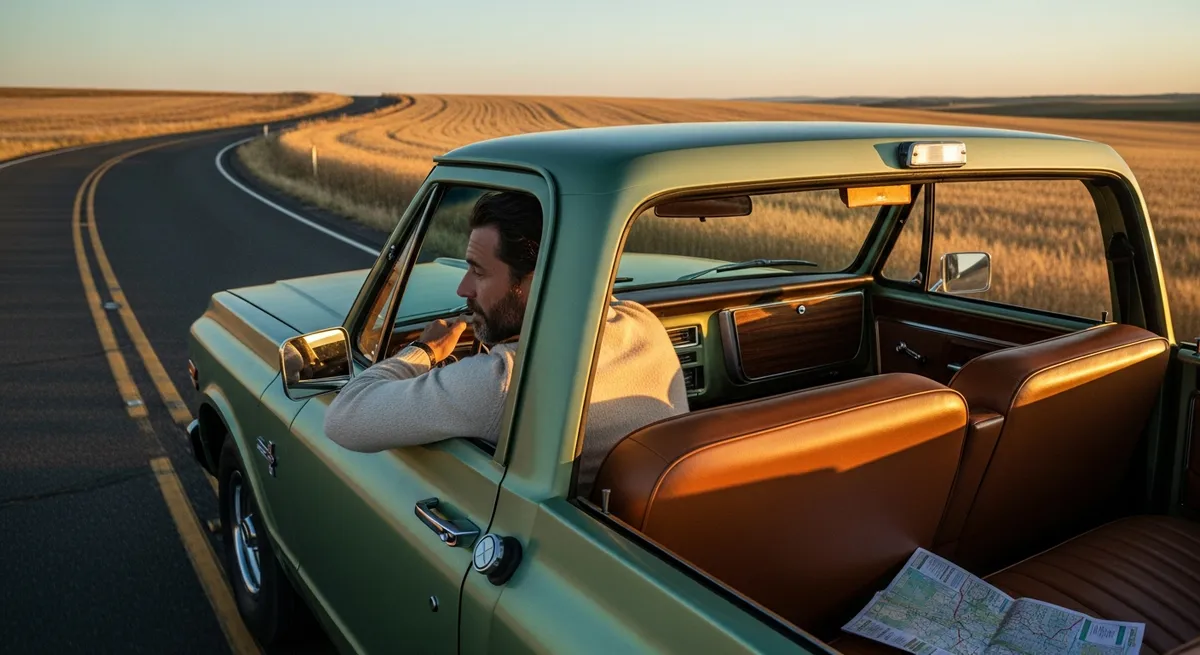
The hood latch took the nail of her index finger and bent it back, and that was the first thing the truck taught Dani: nothing on it comes free. She worked the latch again with the flat of her thumb the way Roy said to, and when the hood went up, the smell of warm oil came up with it. The stick read low. He let her find that out for herself.
He put two fingers on the back of her wrist while she reached in, resting there the way you'd steady a jar lid you weren't sure had caught. The yellow loop was warm from the engine and she drew the dipstick out hand over hand, like something living. Wipe it first, he said. She did, one stroke down, the rag already dark from the last time and the time before that, some of those marks older than her mother.
She held the stick up and the amber caught the light, and Roy watched her tilt her head the same way he tilted his, which he did not mention. The film sat just below the top hole, a thin crescent, the color of his wedding ring in a certain light. She asked what the holes meant and he said that's all the room you've got, and then neither of them said anything. A crow landed on the fence post behind the truck and left again. She looked at the two little punched holes for a long time before she slid the stick back into its tube.
The Civic came next, because the Civic was going to be hers. Its hood had a different prop rod, thinner, and she found the right notch without trying. She used a paper towel from the house, the kind with the blue diamonds printed on it, and it tore when she drew the stick through and left a small white curl in the amber that she didn't see, because she was already tilting the stick toward the morning light, her head going left the way his did. Roy watched from the kitchen window with his second cup of coffee cooling against his palm, the bypass paperwork folded under the sugar bowl where he'd put it so he wouldn't have to look at it. She let the hood down with both hands, easy, the way you set a sleeping child in a crib.
Back in the garage the rag had gone the color of old putty and held its crease like cardboard, the four corners curled slightly where his thumbs had been. Dani picked it up the way you pick up a stone on a path, no reason you could name until your hand is already closing. She folded it again, the same fold, two hands, and set it back in the same spot on the workbench, on top of its own gray shadow in the dust.
She stood there a moment with her hands loose at her sides, the oil still faintly bright on one knuckle, and then she took her phone out and photographed the engine bay the way Roy had seen people photograph meals before eating them. He said nothing about that either. His coffee had gone cold and he set it in the sink and looked at the paperwork under the sugar bowl and thought about how the bowl had been her grandmother's, the one with the small chip on the rim that everyone knew to turn away from company.
That evening he went to the drawer where he kept the rubber bands and the expired coupons and the small screwdriver he'd never matched to anything, and found the index card he'd written years ago, the word CIVIC in his own printing across the top, mileage intervals in columns below, some numbers crossed out and rewritten where he'd changed his mind. The card had a water ring on one corner from a glass set down in a different life. He carried it out to the garage and clipped it to the sun visor with a binder clip, and explained nothing. Dani was wiping her knuckle on her jeans, and she looked up at it hanging there, and he saw her read his handwriting, her lips still, her eyes going slow the way a person's eyes go when they're keeping something.
When the Civic went east with her, it went with fresh oil and a sticky note on the dash, his printing smaller than usual, the felt tip running dry on the last letter so that the final G in CHANGE looked like a C, and he didn't fix it. Under the seat, tucked against the rail where you find old french fries and forgotten pens, he'd left the blue shop rag folded in its same fold, washed and dried and creased back exactly, the fabric thinner than it used to be but holding its shape the way old things do. She texted him a photograph of the sticky note. He looked at it on his phone for a long while before setting the phone face down on the counter, next to the sugar bowl, the chip turned toward the wall.
She called him on a Tuesday and he could hear the Walgreens sign buzzing behind her voice, that particular fluorescent hum, and she said the stick's showing right at the bottom hole, and he said okay, and she said I already wiped it twice, and he said okay again, and for a moment there was only her breathing and the sign. He was standing in his kitchen in his socks, his free hand pressed flat against the counter the way you press a map to keep it from rolling. When he hung up he stood there a minute, and then he took the bypass paperwork out from under the sugar bowl and put it in the drawer with the rubber bands, face down, underneath the small screwdriver that had never matched anything.
The rag was in the glovebox the first time she brought the car to Jiffy Lube without him, and the kid at the desk handed it back in a clear plastic bag with a rubber band around it, the way they return your valuables. She set it on the passenger seat and drove home with it riding there.
It went into her own drawer after that, the one with the takeout menus and the dead lip balm and the spare key to a door she no longer owned. The fold held.
In March she found the index card still clipped to the sun visor, and she took it down and read his numbers in the Costco parking lot, his printing, the crossed-out mileage where he'd changed his mind, and she sat in the cold car long enough that the windows fogged at the edges, her breath doing that.