The shoebox had been on the closet shelf since before the closet was mine, wedged between a broken humidifier and a box of checks from a bank that no longer exists. Inside were slide trays, and inside the trays were the sixties and the seventies, in cardboard mounts with my grandmother's crossed sevens penciled along some of the edges. The top tray had already gone wrong. Whole frames had turned the color of brick dust, faces bleached to fog, a summer lake reduced to an orange smear with a horizon in it. I put that tray back the first time I found it. That is the part I'd take back if I could, the putting it back.
Two years later I tried the phone. I balanced it on a stack of paperbacks and angled the desk lamp under a slide, and the screen filled with something greenish and blown out, a hot white coin burned through the middle where the bulb sat too close. I moved the phone half an inch and the coin moved with it. At the edge was a shape that might have been a shoulder, or a fencepost, or nothing at all. I pressed the sleep button and set the phone face down on the table.
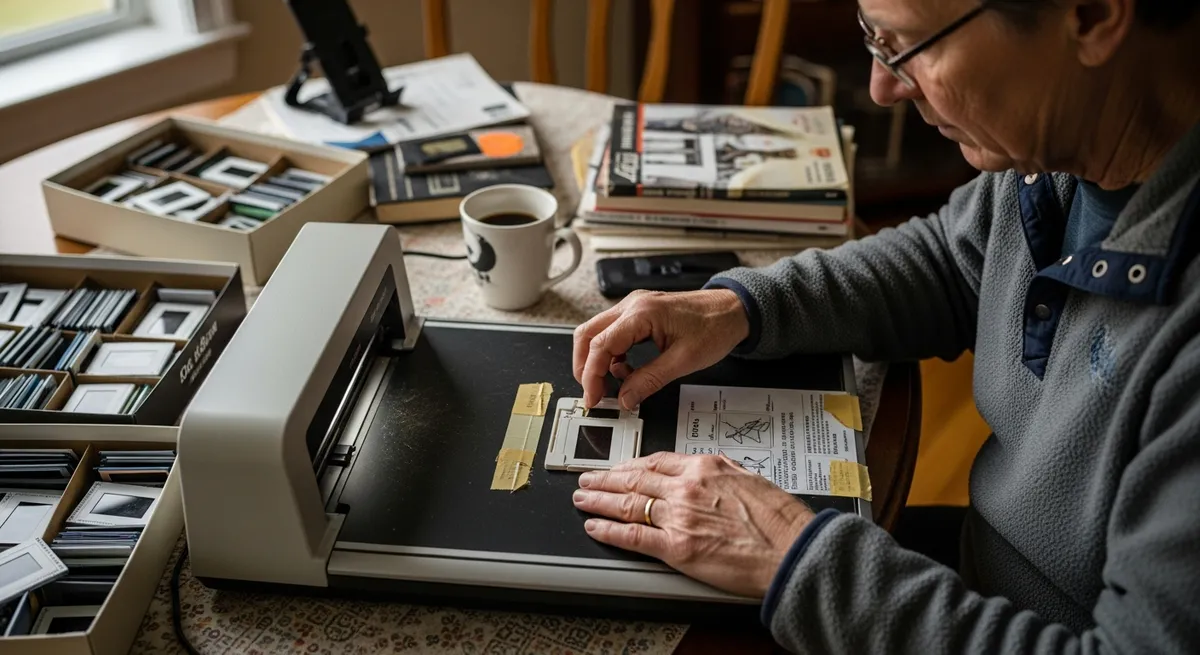
The library scanner was gray and heavy and smelled like warm dust when I lifted the lid. I laid a slide into the transparency holder the way the laminated card showed, face down, crossed sevens toward the ceiling. The preview came back a flat gray rectangle. Then I typed 2400 into the resolution box, clicked, waited, and something resolved out of the gray the way frost clears off a window. A jaw first. Then a cheekbone. Then a small gold hoop I recognized before I recognized the face. My grandmother, maybe forty, in a collar of green and white plaid, and it was the same plaid as the blanket I slept under at her house for the first ten years of my life. I had owned both of those facts for decades without ever holding them together. I sat in the library with my hand over my mouth and the cursor blinking.
I finished the last tray on a Sunday night with a bowl of cold soup beside the keyboard, and I named the folder the way I name everything I mean to deal with later, which is to say badly. The shoebox went back on the shelf. November came, then December, with its talent for making four months feel like a week, and the folder sat in a corner of the desktop under an icon I never moved. In January my cousin texted to ask if I'd found any pictures of her mother, and I opened the laptop and stared at four hundred files named IMG_0001 through IMG_0400, every one of them in the same gray font. I typed back, still working on it, and closed the lid. The shoebox and the laptop sat in their separate darknesses, each exactly as far from her question as the other.
The Names
So I drove the forty minutes to my father's with the laptop wedged open on the passenger seat, throwing pale light on the door panel. He named the first eleven without looking away from the screen, tapping the edge of the keyboard the way he used to tap a road map, and I typed each one into a filename field with a thumbnail still gray from the parking lot gravel:
- Eddie and the Rambler, Dellwood Ave
- Aunt Charlotte, Easter, the year of the hats
- the back porch before the addition
- Roy, dock at Vermilion
At the twelfth slide he stopped and looked at the window, where the bird feeder hung empty and swinging, and said, that one's right on the tip. The same words he uses for the name of a restaurant we both know on a street we've both driven a hundred times. By slide twenty he had folded his hands in his lap and was watching the screen the way you watch a television in a waiting room, present, no longer reading it. I kept clicking anyway, the little arrow moving thumbnail to thumbnail in the quiet. Into the filename field I typed unknown, and the cursor blinked, and outside the feeder swung once more and went still.
There was one sleeve I kept separate after that visit, translucent paper with a red jacket bleeding through it like a pressed flower through a book page. Its little folder held eleven files, and every one of them had a name now. I hadn't understood until that evening how different eleven named things are from eleven numbered ones. I left the sleeve on the left side of the keyboard, which is where I put things I'm not finished with.
The slide called Roy, dock at Vermilion was the one I emailed to my father's sister in Florida, in a message I typed three times before sending. She called back inside of four minutes. That's not Vermilion, she said, that's Put-in-Bay, and Roy's been dead since eighty-nine. She said it in the same voice she uses to correct the scores of card games we've already finished playing. I opened the filename, deleted Vermilion, sat with the cursor blinking inside the word dock, then deleted that too and typed what she told me letter by letter, the way you copy a phone number off a wall. She stayed on the line while I typed. I could hear her television going. Then she said, your grandfather took that one, he had the good camera, in a tone that assumed I knew which camera and which grandfather. I didn't, and there was nobody left to be casual about it with. I typed unknown photographer into the field and pressed enter, and the words sat there in the gray font, accurate and nowhere near enough.
The orange tray never came back. Those frames are gone the whole way now, and no scanner setting reaches into them and pulls a face back out. The near miss turned out to be only half about film, though. The other half was a man tapping a keyboard like a road map while a name drifted farther off, and a woman in Florida with her television on, correcting docks. The files hold still. The people who can read them don't. I drive over with the laptop more often now, and we do a few at a time, and some days the tip of his tongue gives a name up whole, and I type fast.