The granola bar came out of her coat pocket, which was lucky, because the box marked KITCHEN was somewhere under four other boxes and the light in the main room did not work. She sat on the floor of the new apartment with her coat still on and ate it in the dark. A bus went by outside and the window shook a little in its frame, a small rattle she did not recognize yet, and she thought: that will be the sound now. Thirty years on Dunmore Street had a maple that brushed the gutter when the wind came up. Here it would be a bus, every eleven minutes, shaking a pane of glass that was not hers and now was.
By nine the next morning the floor had disappeared. Curtains lay puddled against the baseboard. The brass lamp was under the cutting board, or behind it, or possibly in the bathroom. A framed print of the coast leaned against a framed print of a dog, both facing the wall like children being punished. She had opened eleven boxes and finished none of them, and the apartment looked worse than it had in the dark. She stood in the doorway between the kitchen and the rest of it with her hand on the light switch and did not flip it, because there was nothing in there she wanted to see.
She spent a while on the bathroom floor after that. The tile was cold through her jeans. In her lap were two of the three pieces of the curtain rod, and the third piece was in the main room somewhere, probably under the coat she had dropped by the radiator. Through the open door she could see the cutting board on the floor with a spatula on top of it, and a balled-up sheet, and the dog print lying face down on the sheet. She set the two rod pieces in the sink, carefully, as if someone might need them later, and understood that she could not do the whole apartment. Not this weekend. Probably not this month. The whole apartment was not available to her. One corner might be.
So she picked the corner by the window and made a deal with it.
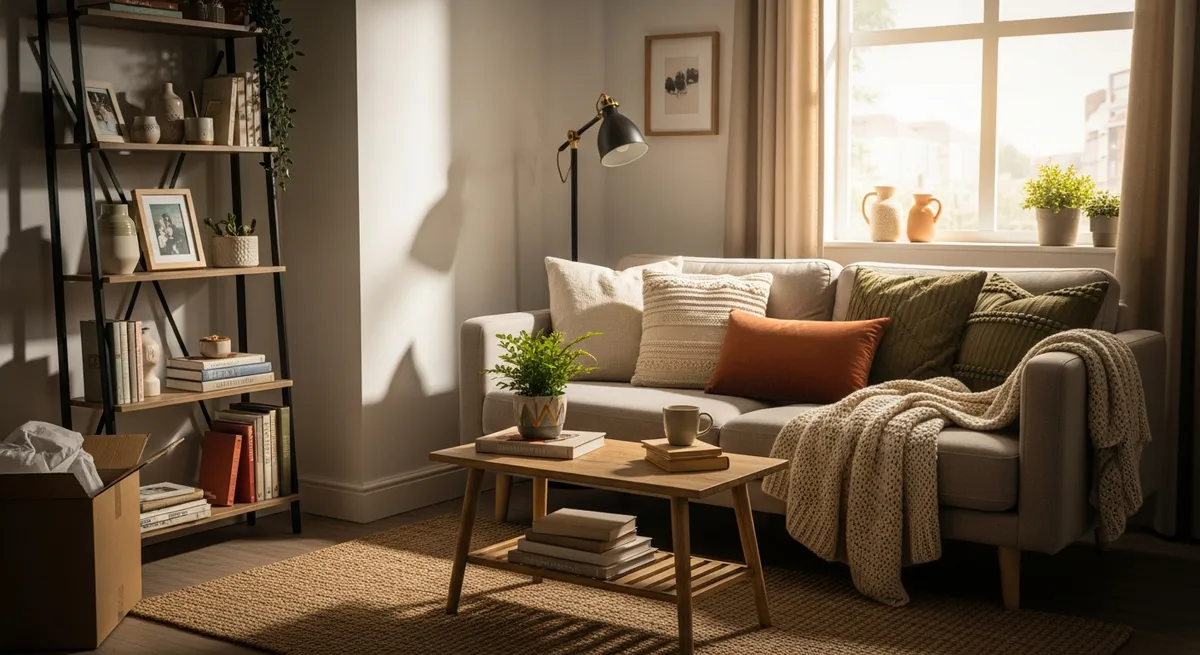
It took moving the coat, three boxes, and a bag of hangers, and then the armchair was just there, angled toward the glass like it had always intended to end up somewhere like this. The brass lamp turned up inside a box of towels, and she put it on the sill. She found the coffee maker on the fourth try, made coffee that came out too strong, and drank it in the chair with both hands around the mug while a pigeon walked the fire escape railing across the street, considered the gap, and decided against it. Behind her the cutting board was still on the floor. She did not turn around. That was the deal: the corner did not have to answer for the rest of the room.
The dog print went up first, slightly crooked, and she left it crooked. The coast went beside it, lower than she meant, and that was fine too. The two of them hung there at uneven heights above the armchair like they had been arguing about the arrangement for years and had agreed to disagree. Saturday afternoon she unrolled the rug, which covered the worst of the scuffed boards, and tucked the fringe under the chair leg without deciding to, just because her hand was near it. Sunday came and went with the shower caddy still in its plastic bag by the bathroom door and the curtain rod still in pieces in the sink. She made coffee both mornings and drank it in the chair. The pigeon came back twice.
The mug had a chip on the rim, and her thumb found it without her looking, the way it had in the kitchen on Dunmore Street and in the first apartment before that, in every place the mug had ever lived. Sunday evening a streetlight came on outside the bare window and laid a long yellow stripe across the rug. She noticed for the first time that the dog in the print had one ear up and one ear down. She had owned that print for nineteen years. She sat and looked at it for a while and did not get up.
Monday she stepped over the shower caddy on her way to fill the kettle, and again on the way back, and the third time she stopped, looked at it, and kept walking. She had put the coffee beans in the cabinet above the sink, same cabinet, same shelf, the way they had lived on Dunmore Street, and her hand went there now without her head going first. That was the thing she was starting to understand about the corner. It was not decorating. It was teaching her hands the new place by letting them do one old thing in it, over and over, until the doing stopped requiring her.
Tuesday the tap water ran over the curtain rod packaging in the sink and darkened it, and she moved the pieces to the counter, metal cold and lighter than she remembered, and forgot them again before the kettle clicked. In the afternoon the rug fringe came untucked and she pressed it back with the side of her shoe, the way you straighten something you have always owned. Wednesday she found a spare bulb in a tote bag she had never fully unpacked and changed the dead one in the bathroom, and the mirror stopped showing her a gray woman coming back from somewhere far away and gave her an ordinary yellow face she recognized. She set the burned-out bulb on the counter next to the curtain rod pieces. Neither one was urgent. The kettle was already hot.
Somewhere in there the apartment tipped. She could not say which day. The boxes were still stacked in the main room, the curtains were still on the floor, and the shower caddy stayed in its bag until the following weekend. But the corner held: chair, lamp, rug, two crooked prints, a mug with a chip her thumb knew. Every morning she sat in it and the room arranged itself around her a little more willingly, the way rooms do when one thing in them has stopped being temporary.
People who move late in life get told to unpack fast, get the pictures up, make it look settled so it will feel settled. She had heard all of that. What worked was smaller and slower and almost embarrassing to say out loud: one honest corner, defended for a weekend, where the coffee was too strong and the dog had one ear up and the bus went by every eleven minutes, shaking a window that was, by Thursday, unmistakably hers.