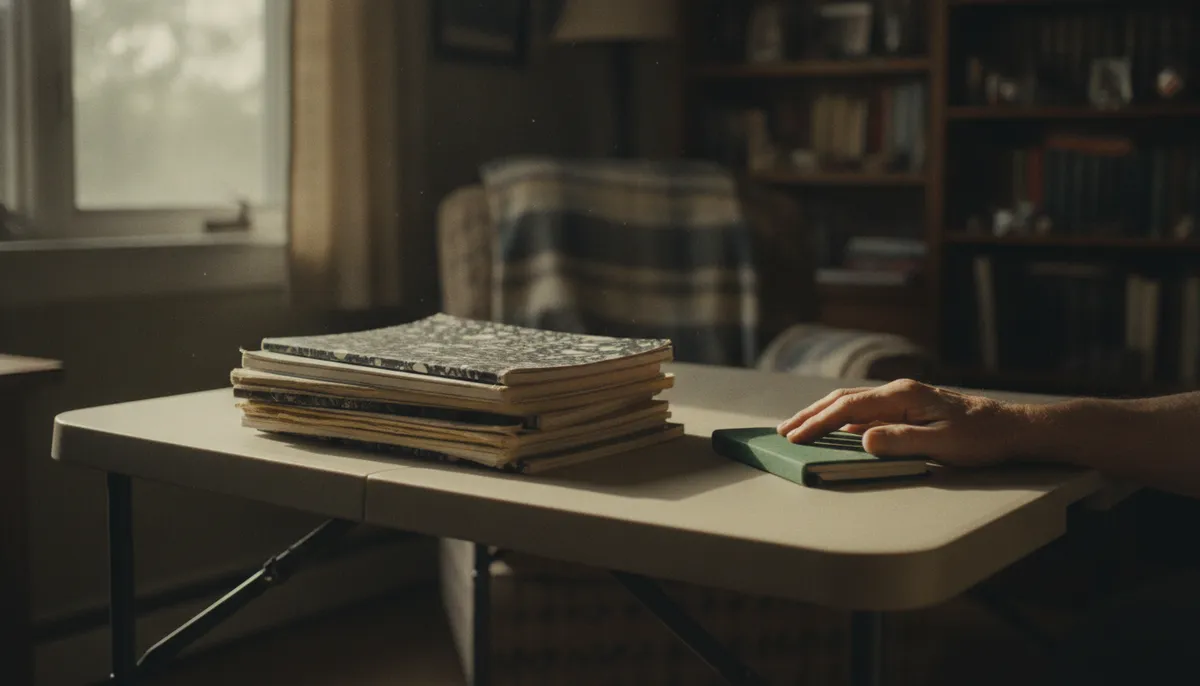
Vera Malinowski kept her notebooks in the kitchen drawer, under the dead flashlight and the coupon scissors, and for a long while nobody knew they were there. She had taught third grade for thirty-one years, and when she finally sat down at her own table with a black-and-white speckled composition book, the kind she used to buy by the dozen for other people's children, it felt less like starting a diary and more like taking attendance. She uncapped the pen with her teeth, the way she always had, leaving a small blue mark on her bottom lip. Today is, she wrote, in careful schoolteacher cursive, and then she stopped. The microwave said 12:00, which was no help. She looked out the window, where the oak past the back step had gone almost entirely yellow, and worked it out the way she worked everything out now, from evidence. The recycling bins were still at the curb on the Delgados' side. Monday, then. She wrote it down.
That was the whole method. Not feelings, not confessions. The date, figured honestly. The weather. What she ate. Which bird was at the feeder and whether it was the same cardinal as yesterday, a question she took seriously. Her husband Roy had been gone four years, and the house had a way of letting whole afternoons slide off its surface without leaving a mark, so she started leaving the marks herself.
Her daughter found the notebooks one Sunday while hunting for a rubber band. "What are these, Ma," she said, holding the stack, and it was not quite a question. Vera wiped her hands on the dish towel, said, "Nothing. Notes," and pushed them back into the drawer herself, past the flashlight, past the scissors. Her daughter's hand stayed in the air a moment, empty. Then she asked if Vera wanted decaf, and that was the end of it, which was how Vera preferred most conversations about herself to go.
In November she went looking for something she half remembered writing. She found the page by feel, the paper slightly warped where she had pressed too hard, and read the words his hands looked like walnuts, the knuckles, and had to stop. There was no photograph of Roy's hands. She had checked every envelope in the shoebox, every birthday card he ever signed, and there was nothing, just his face and his face and his face. The five words in the notebook were the only place his hands still existed. She held the pen over the next line for a long time, ink drying at the tip, the oak throwing its yellow light across the page, and wrote nothing else that day. She didn't need to. The entry had already done its work once, and it would keep doing it.
On the ninth of January she picked up the Bic and it rolled sideways between her fingers like an object she had never handled before. The notebook lay open to a fresh page, pale blue lines, and she gripped the pen the way a child grips a crayon, knuckle-white, elbow braced against the table's edge. Four words came out uneven and enormous, the I listing left, the here climbing uphill, letters the size of the ones on the chart at the DMV. She sat and looked at them. Then she dated the page and left it in. A teacher knows the difference between an ugly page and a false one, and this page was true. She didn't tear it out.
The new pen she bought afterward was blue, cap still on, and she bit the cap off and set it by the salt shaker. Within a few weeks the date sat small and even in the top right corner again, her elbow braced against nothing. She put the January notebook away flat, on top of Roy's last grocery list, milk, WD-40, the good bread, and pressed the cover down until the drawer would close.
The March notebook smelled like onions, because she had rested it on the cutting board while she hunted for the blue pen, which had rolled behind the salt shaker again. In the margin she wrote cardinal, red, same one? because the lines below were already filled with something she did not remember writing. Her granddaughter, six, climbed onto the chair beside her and asked what all those words were for. "So I don't forget," Vera said, and the girl accepted this the way children accept weather, then reached over and drew a small sun in the corner of the page. Yellow crayon. Five spokes. Vera left that in too.
April brought a coffee ring on the cover, a perfect O she traced with one finger before opening the book. She wrote 8:14 in the corner, then 8:22, because the microwave had changed by the time she found the pen behind the dish rack. The neighbor's brown dog barked twice in the alley and she wrote dog, and then, after a moment, still here, still here, the second one smaller than the first, as if she had caught herself at something private.
In June the blue Bic finally went dry, its barrel see-through and empty as a straw, and she wrote the whole month with a red pen she found in her winter coat, a hotel logo on the clip, no memory of the hotel. The red ink looked wrong on the pale lines. She kept going anyway, and by the third week the letters had loosened, gone rounder, the way her handwriting had looked in 1987 when she wrote everything fast. On the last day of the month she wrote her own name at the top of the page, just Vera, no reason she could have given, then the time, then the cardinal, still red, and underlined all three twice.
The twelfth notebook came from the dollar store on a Tuesday in August, solid green instead of speckled, and she stood in the aisle holding it against her chest before she put it in the basket. The checkout girl, who had a small moon tattooed below her left ear, asked if she needed a bag, and Vera said no and carried the notebook under her arm the whole walk home, past the Laundromat, past the fire hydrant someone had painted silver. That night she wrote the date, and below it the single word green, and underlined it once.
In September she bought a second green notebook, same store, same girl with the moon below her ear, and put it above the refrigerator still banded in plastic. A spare, waiting, the way she used to keep chalk. The pen she had ordered from the catalog arrived in a box packed with more paper than pen, stiff and new, and its cap left no mark on her lip at all. She opened the first page and signed it the way she had signed permission slips for thirty years, both names, Vera Malinowski. Then the date. Then nothing for a while, just the blue ink drying on the i, the furnace ticking on downstairs, the catalog still open to the page she had ordered from, and tomorrow already scheduled to be written down.