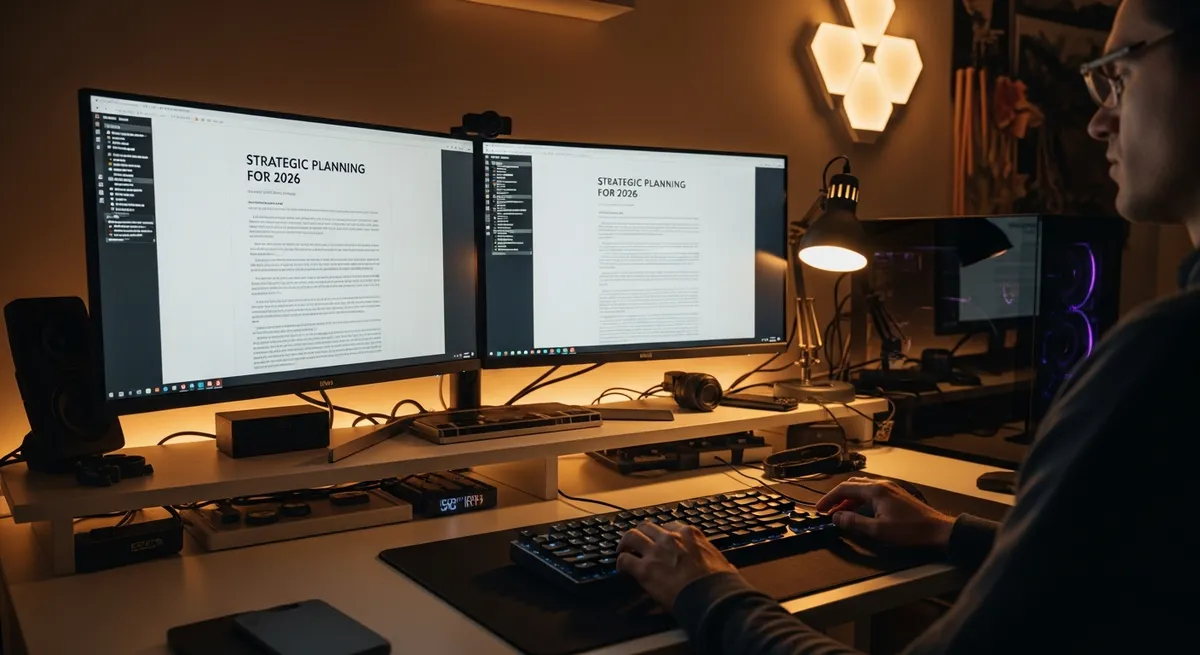
I am currently hunched over my desk - which is littered with three different kinds of legal pads and a half-eaten bagel that is definitely older than some of my friendships - while I stare at a digital calendar for the year 2026. (The year 2026 sounds like a timestamp from a science fiction film where we should all be commuting via jetpack, but my car still makes a rhythmic clicking sound when I turn left and I am fairly certain my mechanic is lying to my face.) It is a terrifying prospect to look that far ahead. Most of us cannot even decide what to have for dinner by five in the afternoon, let alone decide where a multi-million dollar organization should be in twenty-four months.
Plotting for the year 2026 is already hanging over us like a massive, gray storm cloud composed of spreadsheets and pure, unrefined anxiety. My neighbor Bob - a man who thinks he can repair a gasoline engine with duct tape and a very stern lecture - recently asked me why I am even bothering to look that far into the future. (I have watched him do it; the lawnmower remains unimpressed and his grass is now high enough to hide a small circus.) I informed him that lacking a clear direction makes you a passenger in a vehicle steered by an angry, blindfolded badger. That is not a metaphor for success. It is a metaphor for a very expensive insurance claim. You must conquer your 2026 strategic roadmap so your grand ideas actually meet reality. (And if you do not, you might as well just set your budget on fire in the parking lot and save everyone the meeting time.)
The Hallucination of Vision Without Data
We all loathe the metrics because they are dull and they occasionally scream truths we would rather ignore. (It is like stepping on a scale after a long weekend in New Orleans; the truth is rarely pleasant but it is always necessary.) But a grand vision without a hard number to back it up is nothing but a fever dream. I did not invent that phrase, though I am certainly prepared to steal it for the sake of looking clever. (I would have added more flair, but the point remains valid.) You cannot just wish your way into a successful 2026. You need numbers. Hard ones. Cold ones. The kind of numbers that do not care about your feelings or how many motivational posters you have in the breakroom.
I was looking at reports from the Bureau of Labor Statistics and noticed that things are changing at a breakneck pace, with some industries looking at a fifteen percent jump by 2026. (I had to read that twice because it felt like a typo, but the government does not usually do slapstick comedy with its data.) According to the Bureau of Labor Statistics 2023 Employment Projections, we are seeing a massive shift toward healthcare and technical services. If you do not track your movement against these real-world markers, you are trying to win a marathon without knowing where the road actually goes. Or if you even have shoes on. (I once showed up to a board meeting in one loafer and one sneaker, so I am speaking from a place of deep, personal experience regarding lack of preparation.)
The Synergy Pitfall and the Basement Numbers
I have sat through those endless meetings where we toss around words like synergy until my ears bleed, only to realize nobody knows the actual revenue target for next month. It is soul-crushing. It is a waste of a good Tuesday. It is also a massive risk to your professional health. We use these big, fluffy words to hide the fact that we have no idea what we are doing. (I once used the word influence six times in a single sentence just to see if anyone would stop me; they did not, and that is when I knew we were all doomed.)
Success demands that you stare at the hideous numbers hiding in the basement while you are fantasizing about the view from the penthouse. I recall a project I managed in the late nineties - back when the world thought the internet was a passing whim for nerds and shut-ins. (I also thought my goatee looked good, which shows you how wrong a human being can be.) We had a plan to conquer the digital world. (I am physically recoiling as I type that sentence.) The only thing we actually conquered was the delivery menu at the local deli. We ignored the data because the data told us that our user acquisition cost was ten times higher than our revenue. We focused on the vibes. It was a disaster that cost more than my first house. That massive failure was a blessing in disguise, even if it felt like a punch in the throat at the time when I was explaining to the investors why their money had evaporated into thin air.
Connecting Your Head In The Clouds To The Reality On The Ground
How exactly do we untangle this disaster before 2026 arrives and catches us entirely unprepared? (I am speaking metaphorically, though my neighbor Bob once had a very literal incident involving a leaf blower and a fence.) You have to construct a bridge. On one side, you have your dream: "We want to be the most trusted provider of artisanal widgets in the tri-state area." On the other, you have the math: "We will drop our acquisition costs by twelve percent and increase our retention to eighty-five percent by 2025." The strategy is what keeps you from falling into the ravine in the middle. It is as simple as that. (And yet, we continue to repeat the same blunders because we fear that a measurable goal will just prove we are incompetent if we miss it.)
The most effective method involves working in reverse. Imagine it is December 31, 2026. What does the landscape look like from that peak? (I hope it looks like a bank balance that resembles a long-distance phone number.) Now, trace your steps back to this very moment and identify the specific levers you must pull to make that future happen. You cannot simply pluck random numbers from the sky like you are playing a tragic game of office bingo. (This is not exactly a thrilling page-turner, but it is significantly better than filing for bankruptcy.) The metrics you track must actually relate to the behaviors you are trying to force into existence. If you tell your sales reps that the only thing that matters is the volume of calls, they will spend all day calling their own mothers just to hit the target. (I once had a sales rep who did exactly that; his mother was thrilled, but our revenue was nonexistent.)
Constructing Your Plan Without Losing Your Mind
Start by rounding up the essential players - and I am not just talking about the executives with the reserved parking spots. (Often, the person in the shipping department knows more about your failures than the CEO ever will because they talk to the angry customers.) Ask them what is actually happening in the trenches. Then, hold that up against your 2026 dream. If there is a massive canyon between the two, you have some serious digging to do. You must be honest about where you are starting from. (If you tell the GPS you are in Paris when you are actually in a ditch in New Jersey, you are never going to get to the Eiffel Tower.)
Utilize frameworks like a SWOT analysis, but do not let the paperwork become the actual point of the exercise. (I have seen people spend three months making a scorecard that was so beautiful it belonged in a museum, but it was completely useless for actually running a business.) Everyone on the team needs to know the current score. Imagine a basketball game where the scoreboard is under a tarp and the ref tells you who won three weeks later. That is how most offices run. Instead, build a dashboard. Keep it simple. If you are tracking more than five things, you do not have a strategy; you have a grocery list. (And I always forget the eggs if I do not write them down, which is why I always come home with cat food but no milk, even though I do not have a cat.) What are the three things that will actually move the needle by 2026? Everything else is just static. (I am looking at you, Bob, and your ruined lawnmower.)
The Review Rhythm and the Truth About "Pivoting"
Finally, you must establish a regular rhythm for review. This is not a set it and forget it situation. The reality of 2026 is going to look nothing like the world we are standing in right now. I loathe the word pivot because it makes me think of sweaty people in bad 1990s sitcoms shouting at furniture, but sometimes there is no better word for the chaos. Your roadmap needs to be a living, breathing thing, not a stone tablet you use to bash people over the head. Numbers from the Bureau of Labor Statistics show us that employees are on the move more than ever, which means your 2026 strategy better explain why someone should stay at your company instead of fleeing for greener pastures. If your plan ignores the human element, it is not a strategy; it is a suicide note for the company. (People are the ones who do the work; the spreadsheets just watch and judge.)
My dentist, who frankly scares me with his obsession with flossing, once told me that you only have to brush the teeth you want to keep. Strategic planning is the same way. You only have to plan for the parts of your business you want to still have in 2026. If you want to wing it, go ahead. But do not be surprised when you end up like my friend Gary. Gary decided to skip the planning phase for his new tech startup because he said he wanted to be agile. (Gary is currently working at a car wash and his agility is mostly used for dodging high-pressure water jets.)
The Final Word
Planning for 2026 requires both a wild imagination and the discipline of a monk. You have to be brave enough to dream about where you want to be, but you must also be grounded enough to track the boring details that will get you there. Vision and data are two sides of the same coin; one provides the inspiration, while the other provides the evidence. (It is like a marriage, but with more focus on profit margins and less on who left the lights on.) Do not wait until December of 2025 to start this. The clock is ticking far too fast. Start today by picking the objectives that matter and building a culture where people are actually responsible for things. Be honest, stay focused, and for the love of everything holy, stop saying synergy in mixed company. It makes you sound like a robot that has been programmed by a marketing intern. If you do this right, 2026 will be a year of victory instead of a year of panic. You will finally see your effort pay off in a way you can actually prove. And if it fails? Go help Bob with his lawnmower. (But please, just stick to the plan.)
Key Takeaways
Frequently Asked Questions
How often should I update my strategic plan?
Treat your plan like a living thing that needs a checkup every three months. While the 2026 vision remains the North Star, the specific tactics must adapt to market changes. If you wait a full year to look at your roadmap, you will find that it is as useful as a VHS tape in a Netflix world. (And nobody likes a plan that is as outdated as a flip phone.)
What is the difference between a goal and a KPI?
A goal is the mountain peak you want to reach; the KPI is the oxygen sensor telling you if you are about to pass out before you get there. You need both to reach the top without ending up in a ditch. (Or New Jersey, which is basically the same thing in this context.)
How do I choose the right KPIs for my business?
Select the numbers that actually change the way your team works and are within their power to influence. Ignore the stats that just make you look cool on the internet if they do not lead to actual sales. Focus on numbers that provide real insight rather than just looking good on a chart. (A chart can look like a mountain peak even when you are falling off a cliff.)
Why do most strategic plans fail during execution?
Most plans die because the people at the top are dreaming while the people at the bottom are just trying to survive the day. If employees do not see how their specific tasks help the company win, they will not prioritize them. A lack of clear accountability is usually the final nail in the coffin. (If nobody is holding the map, everyone is going to walk in circles.)
Can I plan for 2026 if the economy is uncertain?
Uncertainty is exactly why you need a map. A good plan gives you a way to stay calm and make decisions when everyone else is running in circles. It allows you to build a safety net for the messy parts of the future. (And things are always messy; that is just physics.)
References
Disclaimer: This article is for informational purposes only and does not constitute professional business or financial advice. Strategic planning involves risks that are inherent to business, and outcomes will vary based on market conditions. You should consult with a qualified advisor before making any significant shifts to your organization.