Around 2018, I squandered a significant sum of money - roughly the price of a charming home in Ohio - on a digital property focused on expensive kitchen gadgets. (I was forty, I was bored, and I had just discovered that organic kale was a personality trait.) I thought I was a genius, but the universe clearly possessed a different set of blueprints for my future. (My accountant, a man named Arthur who refuses to look me in the eye, still brings it up during tax season with a sigh that sounds like a collapsing building.) I have witnessed this specific cinematic catastrophe unfold on previous occasions, and it generally terminates with an individual forfeiting their primary residence. It is a slow, agonizing process of watching your hard-earned traffic bleed out into the digital ether while you desperately try to remember why you thought selling five hundred dollar juice extractors was a sustainable lifestyle choice.
The Librarian has Left the Building and the Puddle is Dry
For two decades, we had a deal with the internet. We provided the content, and the search engines provided the map. It was a symbiotic arrangement, quite similar to the rapport I maintain with my local dry cleaner, where I supply the catastrophic mess and he provides the chemical miracle. (I once dropped off a tuxedo covered in what I can only describe as a mixture of red wine and profound self-loathing, and he did not ask a single question about my life choices.) But the map is changing. The search engine has ceased its function as a mere cataloger and has instead adopted the persona of an unsolicited narrator. The software consumes your entire manuscript, recites the conclusion to the gathered crowd, and then neglects to even whisper your name. It is, quite honestly, an act of supreme discourtesy. (I am not being theatrical; I am simply being an astute observer of my own impending doom.)
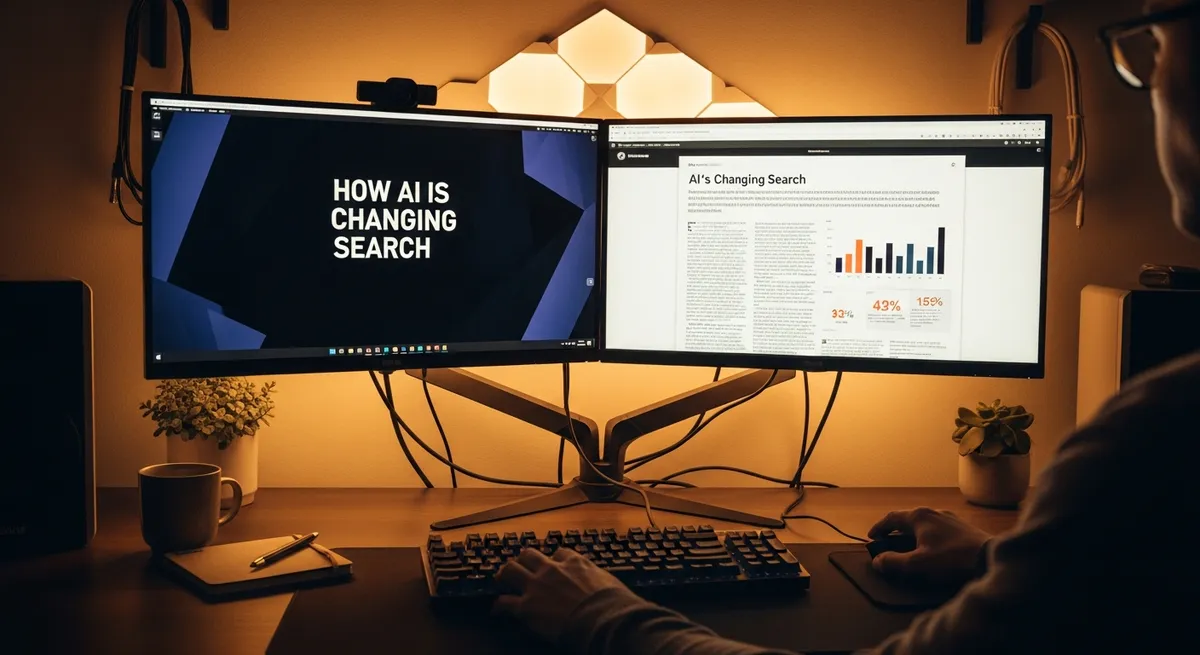
The click is dying. I checked the data because I enjoy hurting my own feelings. According to a 2024 report from Gartner, search engine volume is expected to drop 25 percent by the year 2026. Think about that for a second. One quarter of the traffic we rely on to sell our blenders or our legal services or our hand-knitted mittens for cats will just... evaporate. (I do not even own a cat, but the thought of their cold paws makes me sad enough to order another glass of Merlot.) When the algorithms transitioned toward providing immediate resolutions, my traffic vanished with the speed of a puddle in a Mojave July. It was there on Monday, and by Friday, it was just a salt stain on the pavement. If the consumer identifies the solution on the result page, they possess no incentive to visit your digital domain. This creates an existential crisis for anyone who relies on digital visibility to pay their mortgage.
My friend Bob - who sells artisanal beard oil and thinks crypto is a retirement plan - is currently panicking. (Bob panics at the sight of a gluten-free menu, so this is not entirely new behavior.) But he has a point. If the search results summarize his "Top 10 Ways to Groom a Beard," why would anyone ever click on his store? They will not. They will just walk away with their well-groomed faces and leave Bob with a warehouse full of sandalwood-scented oil. Bob recently called me at three in the morning to ask if he should start selling beard-themed non-fungible tokens. I told him to go to sleep. (I am a good friend, even if I am a terrible business consultant.) We are being narrated out of existence. A 2024 study from SparkToro found that nearly 60 percent of searches now end without a single click to a website. Zero. Nada. Plus, the technology is moving at a velocity that far exceeds our capacity to regulate it or even comprehend the long-term consequences. The National Institute of Standards and Technology (NIST) has noted that the evaluation of these generative models is still in its early stages, often leading to a lack of transparency in how information is prioritized. (This is the scientific way of saying that the machines are making it up as they go, and we are all just along for the ride.)
The Ghost in the Machine and the Hawk-Talking Consultant
You are no longer competing with other brands; you are competing with the very platform that previously functioned as your most vital ally. It is a messy, complicated reality that requires a complete rethink of what it means to be a publisher in the modern era. My former consultant, a man named Gary who wore too many copper bracelets and smelled exclusively of patchouli, once suggested that I could win by simply changing my meta-descriptions every Tuesday. (Gary also claimed he could talk to hawks, so I should have known better.) The technical tricks of the past are becoming irrelevant. You cannot out-optimize a machine that is designed to replace you. If the search engine is the narrator, you have to ensure you are a character so compelling that the audience demands to hear from you directly. (My neighbor hides behind his hedge when he sees me coming, so clearly I am still working on my personal brand.)
I learned this lesson the hard way after my kitchen site failed and Arthur the accountant started sending me brochures for more stable careers in lighthouse management. I started a small newsletter where I wrote about my disastrous attempts at gardening. (My neighbor Bob once told me that my tomato plants looked like they were participating in a hunger strike, which was both accurate and hurtful.) Because the content was so personal and weird, the search engines could not provide a summary that captured the essence of my failure. For years, we obsessed over rankings and raw click counts. I used to check my analytics every twenty minutes, which is a habit I would not recommend to anyone who values their mental health or their marriage. Now, the focus must shift toward brand affinity and direct engagement. The vast majority of the guidance you will encounter involves arcane technical maneuvers and tedious back-end modifications. You should also look at where the data is coming from. If the search engines are using your content to train their models, you need to ensure that your brand is so deeply embedded in the text that it cannot be removed without ruining the summary. (It is like putting too much garlic in a sauce; once it is in there, you are committed to the experience.)
How to Survive the Machine Narrative and the Stench of Sandalwood
This is not about being difficult; it is about pure survival in a digital ecosystem that has turned predatory. If you are a brand, you need to be the definitive source of truth in your niche. Finally, stop trying to beat the algorithm at its own game. Build on land that you actually own. This means email lists, direct relationships, and a voice that is too messy for a machine to mimic. I am not being dramatic. I am being observant. There is a difference, and it is usually found in the bottom of a wine glass. What do we do? We have to become more than just data points. We have to be humans that people actually want to talk to. We have to build brands that people search for by name, rather than just stumbling upon them because they typed "how to fix a leaky faucet" into a box. If you do not have a name, you do not have a future. (And if you do not have a future, at least you have the sandalwood oil Bob is going to give us for Christmas.)
Key Takeaways
Will SEO become completely irrelevant for small businesses?
It will not become irrelevant, but it will certainly become a far more strenuous endeavor to manage without a distinct brand identity. (Bob, for instance, cannot just rank for generic terms anymore because the narrator will just steal his punchline.) Small businesses must focus on local signals and highly specific expertise that machines cannot easily generalize for a mass audience. If you are the only person in town who knows how to fix a vintage 1950s radiator, people will still find a way to get to your website. (Machines are good at patterns, but they are terrible at knowing which wrench works on a rusted bolt in a basement in Cleveland.)
How do I know if my content is being used by AI?
You can check your server logs to see which automated bots are crawling your site, as many major technology firms now identify their training scrapers. (Arthur the accountant tried to explain this to me once, but I fell asleep halfway through his PowerPoint.) While it is difficult to stop the process entirely without blocking search engines, you can use technical directives to limit how your data is processed. However, the most effective strategy is to ensure your brand is so integrated into the content that it remains visible in the final output. (Make yourself the garlic in the digital sauce.)
Should I stop writing long articles to focus on short summaries?
You should not abandon long-form content, as deep expertise is exactly what builds the authority that search engines eventually recognize. (Gary the consultant would probably tell you to write in haikus, but Gary also talks to hawks.) However, you should ensure that your articles are structured so that a machine can easily find the main points while still providing unique value for the human who decides to click through. The goal is to provide a depth of insight that a summary box simply cannot contain due to its inherent limitations. (A summary can tell you that a book is about a whale; it cannot make you feel the salt spray on your face.)
What is a zero-click search exactly?
A zero-click search occurs when a user enters a query and finds the answer they need directly on the results page, usually within a snippet or an AI overview. This means the user never clicks on a website link, resulting in a loss of traffic for the original content creator. This phenomenon is becoming increasingly common as search engines prioritize immediate satisfaction over directing users to external sources. (This is essentially the digital equivalent of someone reading your diary and then telling everyone the secrets without inviting you to the party.)
Is it worth investing in brand personality if I sell boring products?
It is even more important to have a personality if your products are considered boring or utilitarian. (If you are selling something like industrial fasteners, you need to be more memorable than a robot-generated list of metal screws.) If you sell something like industrial fasteners or insurance, your voice is the only thing that separates you from a thousand other identical options that a machine can summarize in a second. A unique perspective or a memorable way of explaining your industry is what will keep you relevant when the robots start doing the shopping for us. (If I am buying a bolt, I want to buy it from the guy who knows the history of that bolt and makes a joke about it.)
References
Disclaimer: This article is for informational purposes only and does not constitute professional marketing, financial, or legal advice. The digital ecosystem is evolving with terrifying speed; therefore, you should consult with a qualified professional before making significant strategic changes to your business model or digital publishing strategy.