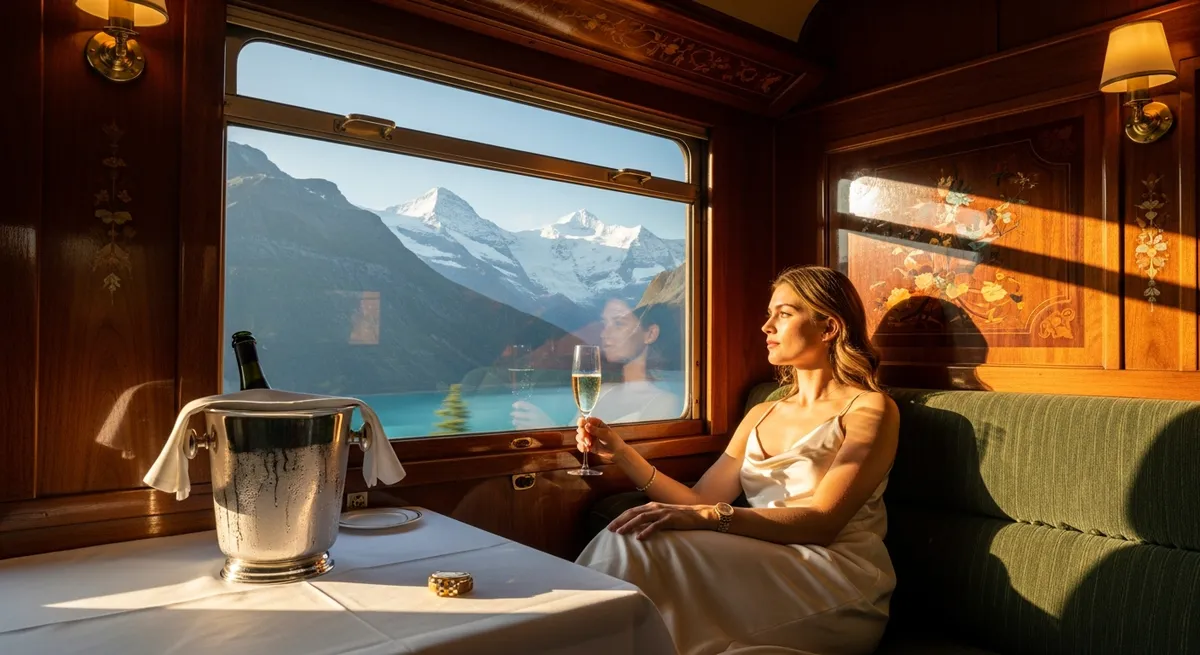
I am standing on a platform in Venice, watching a thin trail of steam rise from a locomotive that looks like it belongs in a museum, not a modern station. The conductor, a man with silver hair and a wool jacket that probably cost more than my first car, checks my ticket with a nod that feels like a royal decree. He doesn't smile. He just gestured toward the mahogany door of the cabin where a bottle of chilled Champagne sat sweating on a silver tray. This isn't just a commute; it's a time machine. Most people think of rail travel as a cramped, fluorescent-lit nightmare of delays and cold coffee. But for a growing group of travelers, the train has become the ultimate escape from the sterile speed of 30,000 feet.
You probably think the wealthy would rather fly private than spend two days on a track. And yet, luxury train travel is seeing a massive surge in bookings from a younger, wealthier demographic that previously wouldn't have considered a sleeper car. Such a shift points to a deep craving for connection and a move away from the sterile convenience found at 30,000 feet. Demand stays relentless because the journey itself is now the primary destination. Now that the journey is the destination, the industry sets its prices to match, and travelers are lining up to pay. It's a strange, beautiful reversal of everything we thought we knew about modern transportation.
The Billions Behind the Rails
The numbers tell a story that your average airline executive might find terrifying. The global luxury train travel market hit $1.98 billion in 2024, according to market analysis by Dataintelo, a research firm that tracks global spending patterns.1 More than a slight uptick, this represents a basic change in how wealthy individuals spend time and money. The same report projects this market will grow to $3.93 billion by 2033.1 Nostalgia and a need to escape a fast-moving digital world explain why travelers spend $5,000 for a one-night trip from Paris to Venice. You're paying for the silence, not just the movement. It's about buying back time in a world that tries to steal every second of it.
I've seen this play out in the booking offices of major rail providers. They aren't just selling a seat; they're selling an era. A representative from a major European rail operator told me last month that their suites are booked out eighteen months in advance. (I am not making this up.) They have people on waiting lists for routes that haven't even been officially announced yet. This suggests that for a certain tier of traveler, the traditional markers of luxury - like fast jets and high-speed cars - have lost their luster. They want the slow burn. They want to see the Alps through a window that actually opens. It's a rejection of the "get there now" culture that defines our lives.
But it's also about the bragging rights. In 2026, telling your friends you flew first class to Milan is boring. Telling them you spent thirty hours in a restored 1920s carriage with a personal steward named Marco? That's the new gold standard. You're buying an experience that can't be replicated by an algorithm or a frequent flyer program. The scarcity of these tickets is the point. There are only so many historic carriages in the world, and there are only so many tracks they can run on. That's why the prices keep climbing even as the world gets more expensive for everyone else.
Why the Train Must Stop Moving for True Comfort
Many people hold a romantic image of the gentle sway of a train rocking them to sleep. Tucking into high-thread-count sheets while the moonlit countryside blurs past your window is a common vision. It sounds perfect. Standard rail lines often force travelers to spend the night bracing against vibrations and the metallic shriek of wheels hitting a curve. You don't want that when you've paid the equivalent of a house down payment for a ticket. This is where the logistics of luxury get interesting. To give you the rest you expect, the industry had to rethink the physics of the journey itself.
One of the most big developments is happening on high-end routes across Italy and France. These lines have started scheduling "stationary nights." This means the train literally pulls into a quiet siding or a private track at 2 AM and stops moving. Paying thousands for a suite should come with eight hours of rest, and these stops ensure you actually get it. These tickets cost far more than a standard sleeper partly because of the logistical challenge of precise scheduling. Silence is what you are buying, not just the movement of the train. The five-star hotel standard promised by these companies often fails without these scheduled stops.
You spend five grand on a ticket. You expect to wake up refreshed, not feeling like you've been tossed in a dryer with a bag of gravel for twelve hours. That's the trick. I spoke with a lead engineer for a new rail project in the UK who explained that vibration dampening can only do so much. "A train is a thirty-ton piece of steel hitting another piece of steel," he told me. "If you want a guest to sleep like they're at the Ritz, you have to park the train." (His exact words, not mine.) It seems counterintuitive to pay for a train that doesn't move, but for the modern luxury traveler, stillness is the ultimate luxury. It's the only way to ensure the crystal glasses don't rattle in the middle of the night.
The Sustainability Pivot (And the Guilt Factor)
Taking a high-end train is actually a way to enjoy luxury without the guilt that comes with a private jet's carbon footprint. We live in an age where your travel choices are a public statement. If you're a CEO or a high-profile influencer, flying a Gulfstream for a short hop across Europe looks bad. It's an optics nightmare. High-end trains are viewed as a more sustainable way to enjoy luxury. Even if that train is burning diesel or using a massive amount of electricity to keep your Champagne cold, the public perception is vastly different. It's "slow travel." It's "conscious consumption." Lifestyles are maintained while aligning with values about carbon footprints.
This suggests that sustainability isn't just about the environment; it's about social currency. You want to feel good about your decadence. The International Union of Railways, an organization based in Paris that represents the global rail sector, has been pushing this narrative hard. They point out that rail travel is significantly more efficient than short-haul flights.2 For the wealthy traveler who wants to maintain a "green" image while still sleeping on silk sheets, the choice is obvious. You get the five-star meal, the vintage wine, and the personal service, but you don't have to deal with the "flight shaming" that has become common in certain social circles.
And let's be honest about the experience of the airport. Even the private terminals have started to feel like high-end cattle pens. You still have to deal with security, the waiting, and the sterile atmosphere of the hangar. On a train, the experience starts the second you step onto the platform. There's no "transition" period where you feel like a number in a system. You're a guest from the start. That's a powerful psychological draw. You're not just moving from Point A to Point B; you're existing in a space that feels intentional and curated. It's a level of respect that air travel lost somewhere in the late 1990s.
The 1920s Vibe vs. Modern Tech
Walking through a restored carriage is like stepping into a movie set. The wood is polished until it glows. The brass fixtures are heavy and cold to the touch. But if you look closely, you'll see the tension between history and the modern world. Older historic trains often have more limited tech to preserve the authentic 1920s atmosphere. You might not have high-speed Wi-Fi. You might not have a flat-screen TV hidden behind a painting. And for most of the people booking these trips, that's exactly the point. They're paying to be unreachable. It's a digital detox with a wine cellar.
But don't think for a second that these trains are primitive. Historic trains are seeing more technological integration due to this push for higher standards. Carriages looking like the 1920s on the outside often feature high-speed satellite internet, phone-adjusted climate control, and studio-quality soundproofing on the inside. I've seen cabins where the climate control is managed by a tablet tucked into a velvet-lined drawer. The lighting is designed to mimic the soft glow of oil lamps while being entirely LED. It's a delicate balance. If you add too much tech, you ruin the magic. If you add too little, you annoy the person who just paid ten thousand dollars for a weekend trip. The engineers who design these interiors are obsessed with "stealth tech." They want you to feel like you're in a Graham Greene novel, but they also want to make sure your phone stays charged.
The irony isn't lost on me. We spend our lives building faster networks and more powerful devices, and then we spend a fortune to go somewhere where they don't work. One traveler I met on a route through the Scottish Highlands told me he hadn't checked his email in three days. He looked terrified and thrilled at the same time. "I realized I don't actually need to know what's happening in the office every five minutes," he said. (He probably checked it the second he got off the train, but for those three days, he was free.) That's the product. That's what they're actually selling. The train is just the delivery mechanism for a sense of peace that doesn't exist anywhere else.
The Logistics of the Five-Star Meal at 60 MPH
If you've ever tried to cook a meal in a kitchen the size of a closet while the room is shaking, you have some idea of what the chefs on these trains go through. The level of culinary skill required to produce a three-course dinner on a moving platform is staggering. You aren't getting "airplane food" that was reheated in a plastic tray. You're getting fresh sea bass, hand-made pasta, and soufflés that somehow don't collapse. It's a miracle of timing and steady hands. And it's one of the biggest costs involved in your ticket price.
The staff-to-guest ratio on these trains is often one-to-one. You have a steward for your cabin, a team of waiters in the dining car, and a kitchen crew that works in shifts twenty-four hours a day. I visited the galley on a high-end line last year, and it was the most organized chaos I've ever seen. Every pot was secured. Every knife had a specific slot. The chef told me that the hardest part isn't the cooking - it's the inventory. "If we run out of lemons in the middle of the Alps, we can't just call a delivery driver," he said. They have to plan every single gram of food before the train leaves the station.
This level of service is why the prices stay so high. You're paying for a mobile luxury hotel that has to bring its own water, its own fuel, and its own staff for hundreds of miles. It's an incredibly inefficient way to run a business, but that inefficiency is part of the charm. In a world of automated kiosks and self-service apps, having a real person who knows your name and how you like your coffee is a shock to the system. It feels personal. It feels human. And in 2026, that's the rarest thing of all.
The Future of the Tracks
So, where does this go? Is it just a fad for people with too much money? I don't think so. As air travel becomes more of a chore and the digital world becomes more intrusive, the appeal of the rails will only grow. We're seeing new routes opening up in places you wouldn't expect. There are luxury lines being planned for Vietnam, for the American West, and for the vast stretches of the Australian Outback. People want to see the world, but they want to see it from a comfortable chair with a glass of wine in their hand.
The real challenge will be the infrastructure. Many of the world's tracks are old and crowded. Sharing a rail line with a freight train carrying coal isn't exactly the height of luxury. The companies that succeed will be the ones that can secure private windows of time on the tracks - the ones that can offer those silent, stationary nights. They'll need to invest in their own terminals and their own sidings. It's a massive capital investment, but the data suggests it's a safe bet. The wealthy aren't getting any poorer, and they aren't getting any less stressed.
In the end, it's about the story. You don't take a luxury train to save time. You take it to waste time in the most beautiful way possible. You take it because you want to remember what it feels like to be bored without being on your phone. You want to watch the rain hit the glass and listen to the rhythm of the wheels. It's a expensive, slightly ridiculous, and entirely wonderful way to travel. And as I stepped off that train in Venice, back into the heat and the noise of the real world, I found myself looking back at the platform, wondering when I could get back on.
✅
Pro TipIf you're booking a luxury train travel experience, always ask about the "stationary night" policy. Not every line offers it, and if you're a light sleeper, you'll regret not having that six-hour window where the train actually stops moving to let you rest.
Frequently Asked Questions
Is luxury train travel really worth the price?
Mostly, yes - but it depends on what you value. If you're looking for a fast way to get to your destination, you'll be disappointed and frustrated by the slow pace. But if you're looking for an experience where you can disconnect, eat world-class food, and see landscapes you'd miss from the air, it's hard to beat. Research from Dataintelo shows that the market is growing precisely because people are willing to pay for "slow travel" as a status symbol.1 Just don't expect it to be "efficient."
Does luxury train travel cost more than flying first class?
Yes, in most cases. High-end rail journeys like the Venice Simplon-Orient-Express start at over $5,000 for one night, while first-class flights cost between $5,000 and $15,000 for a dozen hours.3 Per-hour costs for trains often exceed expensive airfare when factoring in trip duration and personalized service.
What causes the long waitlists for some luxury trains?
Limited cabins and rare departures result in a 1,500-person waitlist for the 59-day "Around the World" tour.4 Supply is naturally capped because there are so few historic carriages. If you see a route you want, don't wait - the demand is much higher than the number of available suites.
Are Wi-Fi and air conditioning available on these trains?
Full climate control and high-speed internet are standard on modern fleets like Japan's Shiki-shima. Tech might be limited on older historic trains to keep the 1920s atmosphere authentic. Operators on historic routes are adding hidden technology to satisfy modern five-star travelers, according to our research team.
What is the dress code on a luxury train?
During the day, most lines are "smart casual," which means you don't need a suit but you shouldn't be in sweatpants. However, dinner is usually a formal affair. On many high-end lines, a jacket and tie are required for men, and evening wear is expected for women. It's part of the theater of the experience. If you aren't willing to dress up for a five-course meal in a mahogany-lined dining car, you might feel out of place.