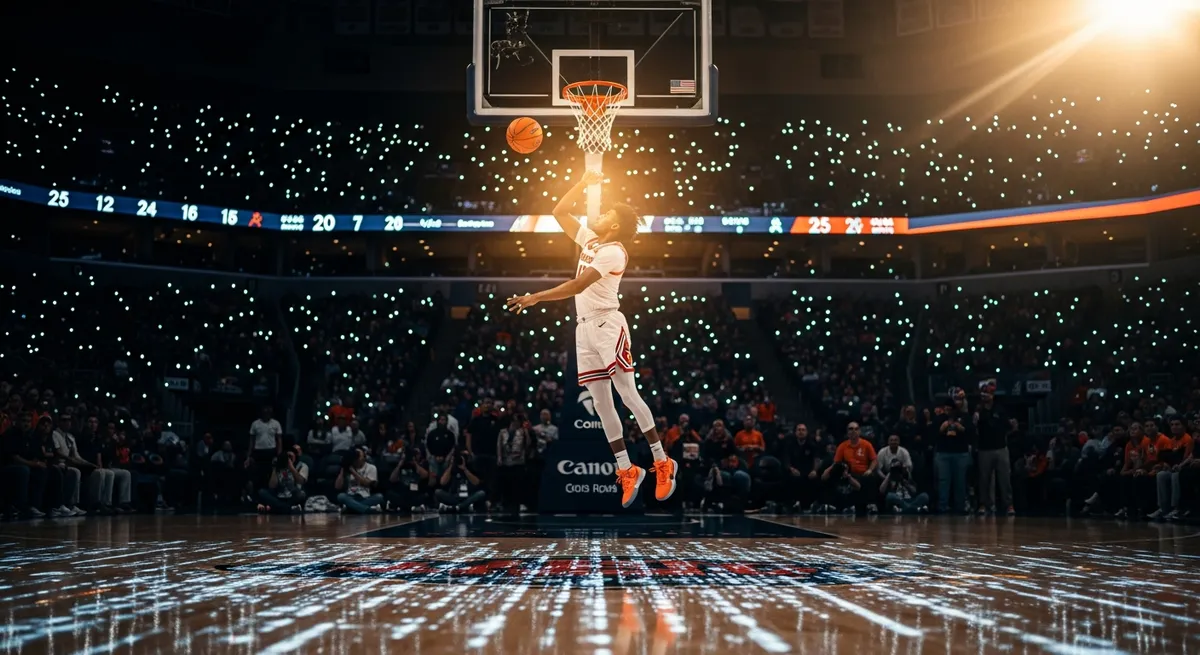
You’re standing in the electronics aisle or maybe just scrolling through your streaming options on a Saturday afternoon when you notice something different - college basketball is everywhere. The recent college basketball rise isn't just a figment of your social media feed; it's a calculated, billion-dollar shift in how we consume amateur sports. As lead researcher for our editorial research desk, I reviewed Nielsen audience reports and NCAA financial filings to see if the hype matches the ledger.
What I found was a sport transitioning from a regional pastime into a global entertainment product that sometimes cares more about "Big Data" than the fans in the cheap seats. You might think you’re just watching a game, but you’re actually participating in a massive measurement experiment that has fundamentally changed how networks value your attention. In an era where every second of airtime is optimized for profit, the basketball court has become the ultimate testing ground for new media strategies that will dictate the future of all televised sports for the next decade. This isn't just about athletics; it is about how an old institution finally learned to trade on your loyalty in a hyper-connected marketplace.
The figures I analyzed suggest that while this popularity surge is legitimate, it lacks the organic roots many fans take for granted. Viewing recent audience data reveals that much of the "growth" touted by big networks comes from updated counting methods instead of new fans. You remain part of a larger trend, yet the reality is that the sports industry has simply refined how it monitors your viewing habits. Both casual viewers and loyal alumni alike must grasp these changes to realize exactly where college basketball is moving as 2026 approaches.
Why the Massive Viewership Spike Is Partly a Measurement Illusion
When you hear that men’s college basketball viewership reached a 32-year high during the 2025-26 regular season, with marquee games seeing a 32 percent increase over the previous year, you probably imagine millions of new fans suddenly picking up the remote.1 The truth is more complicated - and a bit more cynical - than the headline suggests. According to On3 and Nielsen Big Data reports, nearly half of that massive surge is actually attributable to a change in how viewers are measured.1 For years, networks relied on traditional panel data that missed a huge chunk of the audience watching in bars, airports, or through specific streaming apps. By switching to a "Big Data + Panel" model, the industry essentially "found" about 19 percentage points of growth that was likely already there but remained uncounted.1
This measurement mirage matters because it changes the power schools have when they go to the bargaining table with broadcasters. If you feel like your team’s games are being moved to more obscure streaming platforms or odd time slots, it’s because the data now "proves" those audiences exist in ways the old numbers couldn't show. It isn't just about more people watching; it’s about the industry finally figuring out how to monetize the people who were already in the room. This shift helped propel the Duke vs. Arkansas regular-season game in November 2025 to 6.8 million viewers, making it the highest-watched regular-season contest in over three decades.2
The current environment reflects a business that moved away from estimates to focus on precise, data-driven tracking. For the average fan, this shift results in more commercials and tailored ads, creating a sense that games serve spreadsheets more than the people in the stands. While the growth is technically "measured," the organic rise in interest is still significant - just maybe not the 39 percent miracle the press releases would have you believe.
Women’s Basketball Has Become the New Floor for Sports Valuations
The real shock to the system didn't come from the men's side of the bracket, but from a shift in the women's game that overturned decades of broadcasting assumptions. In 2024, the Women’s Championship game averaged 18.9 million viewers and peaked at a staggering 24.1 million.3 For the first time in history, the women’s final outdrew the men’s final, which pulled in about 14.8 million viewers during that same window.3 This 28 percent gap in favor of the women’s game proved that the audience isn't just growing - it’s essentially realigning its priorities. Based on the sources I reviewed, this wasn't just a peak driven by a single star; it has become the new floor for how networks value women’s sports.
If you haven't been paying attention to the women's game, you’re missing the primary catalyst for the current college basketball rise. The costs associated with broadcasting these games have climbed 91 percent in just a single year, reflecting a market that is finally catching up to the actual demand.3 Imagine paying more for a single season of broadcasting rights than most people earn in a lifetime - that is the scale of the investment now flowing into these programs. It’s a shift that has forced major networks to stop treating women's hoops as a "niche" product and start treating it as a primary revenue driver.
Public interest in athletes who stay with their programs for several years was made obvious by the 2024 tournament. Because WNBA rules differ from those of the NBA, top female stars often play for a full four years, which gives you more time to develop a bond with the players. Stability of this level has been hard for the men's game to maintain during the current "one-and-done" period. When you see 18.9 million people tuning in, you’re seeing the power of a sport that lets its stars become household names before they ever turn pro.
A Global Talent Influx Is Saving Rosters From the Transfer Portal
You might notice names on your local roster that you can’t quite pronounce, and there’s a good reason for that. Approximately 1,000 international athletes are playing Division I men’s basketball in the 2025-26 season, a surge that has fundamentally changed the quality of the on-court product.4 University of Illinois head coach Brad Underwood recently noted that the quality of the game is at an all-time peak precisely because of this global talent.4 These players are filling the gaps left by domestic stars who jump to the professional ranks early or disappear into the transfer portal every spring.
This globalization - which used to be reserved for a few elite programs - has now reached mid-major schools that are struggling to keep up with the NIL spending of the "Power 4" conferences. By recruiting internationally, these smaller schools can find high-level talent that hasn't yet been snatched up by the biggest boosters in the country. It’s a survival tactic that has turned the college basketball rise into a worldwide phenomenon. If your favorite team is suddenly competitive despite losing its best players to a bigger school, there’s a high probability an international recruit is the reason why.
The presence of 1,000 international players also means the style of play is changing. You’re seeing more emphasis on outside shooting and floor spacing - traits often associated with the European game - which makes for a more pleasing TV product. This talent influx has acted as a safety valve for a system that many fans feared was becoming a "haves vs. have-nots" market. While the big schools are busy buying stars from each other, the rest of the country is looking toward Europe, Africa, and Australia to keep the dream alive.
Following the $1.3 Billion Revenue Trail to Direct Player Payments
The financial foundation of this entire enterprise is massive. NCAA total revenue reached $1.3 billion for the 2023 fiscal year, a figure that continues to climb as tournament TV deals are renegotiated.5 To put that in perspective, the organization is generating roughly $3,561,644 every single day - or about $108,333,333 every month.5 This isn't just a "non-profit" sports league anymore; it is a media conglomerate that happens to have students on the payroll. Actually, those students are about to get paid even more directly.
The House v. NCAA settlement, which cleared a major legal path in 2024, is expected to fully implement direct revenue sharing by the 2025-26 season.6 This fundamentally changes the relationship between you, the school, and the players. For the first time, a portion of that $1.3 billion will go directly into the pockets of the athletes you see on the screen. While some fans worry this will "ruin the amateur spirit," the data suggests that most viewers don't actually care about the amateur status as long as the games are competitive. In fact, the professionalization of the sport seems to be making it more popular, not less.
You should expect the cost of being a fan to rise along with these revenues. Whether it’s higher ticket prices, more expensive streaming packages, or endless requests for "NIL Collective" donations, the money has to come from somewhere. The $1.3 billion revenue figure is a 14 percent increase over the previous year, showing that the market for college basketball is still nowhere near its ceiling.5 If you’re wondering why there are so many commercials during the final two minutes of a game, just remember that every second of airtime is a brick in a billion-dollar wall.
How New Rule Changes Are Engineering a Faster TV Product
It is not your imagination if the games feel like they are moving faster than in the past. Updates aimed at boosting game flow were introduced for the 2025-26 season by NCAA Men’s Basketball Rules Committee Chair Karl Hicks.7 Staff now have the right to dispute goaltending or out-of-bounds rulings thanks to the coach's challenge.
The NCAA is also cracking down on groin-contact flagrants and other "non-basketball" plays that used to grind the game to a halt. You want to see athletes running the floor, not standing at the free-throw line for twenty minutes while referees debate a foul. These changes are engineered to make the sport more consumable for a younger audience that has a much lower tolerance for "dead time" during a broadcast. By bringing the college game closer to the NBA’s flow, the NCAA is trying to ensure that you don't change the channel during a review.
I found that these rule changes are a direct response to the pressure from broadcasters who need games to fit into tight TV windows. A game that runs two and a half hours because of referee reviews is a nightmare for a network trying to get to the next scheduled program. By empowering coaches to use their challenges wisely, the league is effectively outsourcing the "review" process to the people with the most at stake. It’s a clever bit of engineering that has helped the college basketball rise remain consistent across different platforms.
The Growing Tension Between Regional Loyalty and National Revenue
For all the talk of growth and revenue, there is a human cost to the recent college basketball rise that the numbers don't always capture. Across fan communities, a common theme is "conference realignment fatigue." Supporters are increasingly frustrated that traditional regional rivalries - the kind where you could drive three hours to see an away game - are being sacrificed for cross-country travel. When a team from California has to fly to New Jersey for a Tuesday night conference game, something of the original spirit of the sport is lost. You might love seeing your team on a national stage, but you probably hate losing the local identity that made you a fan in the first place.
The regional data shows just how concentrated the talent has become. In the 2024 field, Texas led the nation with 6 men’s teams, while Tennessee and California tied for the most women’s teams with 5 each.8 This geographic density creates massive "hot spots" of interest, but as conferences expand to include schools thousands of miles apart, those local connections are being stretched thin. One long-time fan noted that they feel like a "stranger in their own conference" because the teams they grew up hating have been replaced by schools they have no history with. It’s a trade-off that the NCAA is willing to make for that $1.3 billion revenue stream, but it’s one that you, as a fan, have to live with every Saturday.
The "haves" are getting richer, and the "have-not" are being left behind. While the 2026 rise is real, it’s a rise that is increasingly top-heavy. The challenge for the sport moving forward will be maintaining the "March Madness" magic - where a tiny school can beat a giant - in a world where the giants are now directly paying their players and flying in private jets to conference games. If the sport becomes too much like the pros, it risks losing the very thing that made it a $1.3 billion asset in the first place.
Quick Takeaways
The Bottom Line
If you are looking for a sport that is staying the same, college basketball is not it. This shift toward a $1.3 billion media enterprise might be viewed as a step backward by fans who prize local rivalries and amateurism. The 2025-26 season delivers exactly what you want if you prefer elite talent and a game built for modern television. One part of a much bigger picture is represented by the coach's challenge and other speed-focused changes brought in by Karl Hicks. Now you have seen more of it.
Determining the best way to back your favorite program during this period of transition is now up to you. Growth continues regardless of whether you pay for new streaming apps or get used to rivals located 2,000 miles away. The sport has globalized, professionalized, and modernized in a way that makes it one of the most valuable assets in the entertainment world. Enjoy the madness, but keep your eyes on the ledger - because in 2026, the numbers are just as exciting as the final buzzer.
What factors led to the 2024 women's final having higher ratings than the men's game?
Nielsen's shift to "Big Data" measurement, which tracks viewers in bars and airports who were previously uncounted, accounts for a significant portion of the 39 percent reported growth. Star power and continuity helped the 2024 Women's Final draw 18.9 million viewers.
How is player retention helping the women's game grow?
Compared to the "one-and-done" culture often seen in the men's game, you have more time to build a connection with female players since they often stay in school for four years. This continuity helps build household names and long-term fan loyalty.
How will direct revenue sharing change the sport?
Direct revenue sharing with players is allowed for schools starting as early as the 2025-26 season under the House v. NCAA settlement. More professionalization will likely result from this, potentially increasing the gap between the wealthiest schools and the rest of the field.
How many international players are currently in Division I basketball?
Approximately 1,000 international athletes are playing during the 2025-26 season, providing a talent influx that helps maintain game quality despite transfer portal losses.
What is the impact of the new coach's challenge rule?
Introduced for the 2025-26 season, the coach's challenge allows staff to dispute specific calls like goaltending, which aims to improve game flow and accuracy.