I am currently residing in an ergonomic throne that cost more than the rusty 1998 Honda Civic I drove during my undergraduate years, yet I find myself shaped like a punctuation mark that was crushed by a falling anvil. (That car featured a tape player and a distinct aroma of ancient French fries, but at least the seats did not actively harbor a grudge against my lumbar region.) Even with this high-priced support and these infinite adjustable armrests, I feel like a biological disaster. (I do not exaggerate; my lower back is currently hosting a heavy metal concert of agony to which I never purchased a ticket.) It is a catastrophe of modern engineering. We devote the vast majority of our conscious existence to leaning toward shimmering rectangles of glass like primitive ancestors mesmerized by a particularly fascinating campfire. (I suspect the fire was at least warmer than my inbox.) We have not evolved for this specific brand of torture. We are essentially folding our skeletons into salty snacks for the benefit of a spreadsheet. The financial and physical cost of this biological sabotage is high. It is very high.
🤔 My Chiropractor and His Third Vacation Home
My spine specialist, a fellow named Dr. Henderson who possesses three separate vacation properties solely because of my inability to sit straight, refers to me as his favorite source of predictable cash flow. (He has a digital scan of my compressed vertebrae framed in his hallway, which I find both mildly flattering and deeply offensive.) He treats me like a frequent-flyer member of a club I never wanted to join. (I desperately hope his boat is named 'Slipped Disc' just to complete the irony.) But the data regarding our collective failure is not amusing. The human frame was intended to pursue mammoths across a frozen tundra, not to languish in a cubicle for nine hours while consuming a sad, lukewarm salad. (I am convinced that kale tastes like regret when eaten under fluorescent lights.) We are essentially fighting a war against gravity, and gravity is winning because it never sleeps and it does not have to pay taxes. I checked. It is true. (Gravity is the ultimate bureaucratic villain.)
🔴 The Staggering Cost of the Slouch
The Bureau of Labor Statistics published a report indicating that musculoskeletal disorders represented 33 percent of all employee injury and illness cases in a recent calendar year. That is one out of every three people. (I assume the other two-thirds are dealing with repetitive strain from aggressive stapling or burning their tongues on office coffee.) One third of the workforce is literally crumbling. That is a truly horrifying number. When you allow your chin to migrate forward like a bewildered tortoise searching for a snack, you are exerting nearly 60 pounds of pressure on your cervical spine. (My neck currently feels as though it is supporting a bowling ball manufactured from solid lead.) The National Institute for Occupational Safety and Health has repeatedly suggested that long periods of static posture are a primary driver of chronic pain. I remember a specific Tuesday when I could not rotate my head to the left to see if a vehicle was approaching. (This is a suboptimal way to live, especially when you are attempting to merge onto a busy highway.) I had to pivot my entire upper body like a malfunctioning robot from a 1970s science fiction film. It was not a moment of dignity for me. (I looked like I was trying to do a very slow, very painful version of the 'Robot' dance while driving a minivan.)
We have been ignoring the dull throb in our shoulder blades for months. (I personally assumed it was just the heavy weight of my own brilliance, but it turns out it was just poor posture.) We believe we can solve this crisis with a standing desk. We cannot. (I purchased one of those motorized contraptions as well, and it now serves as a very expensive, waist-high shelf for my growing collection of unread mail.) The issue is not the furniture. The issue is the lack of movement. We were built to be in motion. However, we are not in motion. We remain still. We stare at screens. We ache. (And then we pay Dr. Henderson to fund his next trip to the Cayman Islands.)
🟢 Designing A Space That Does Not Hate You
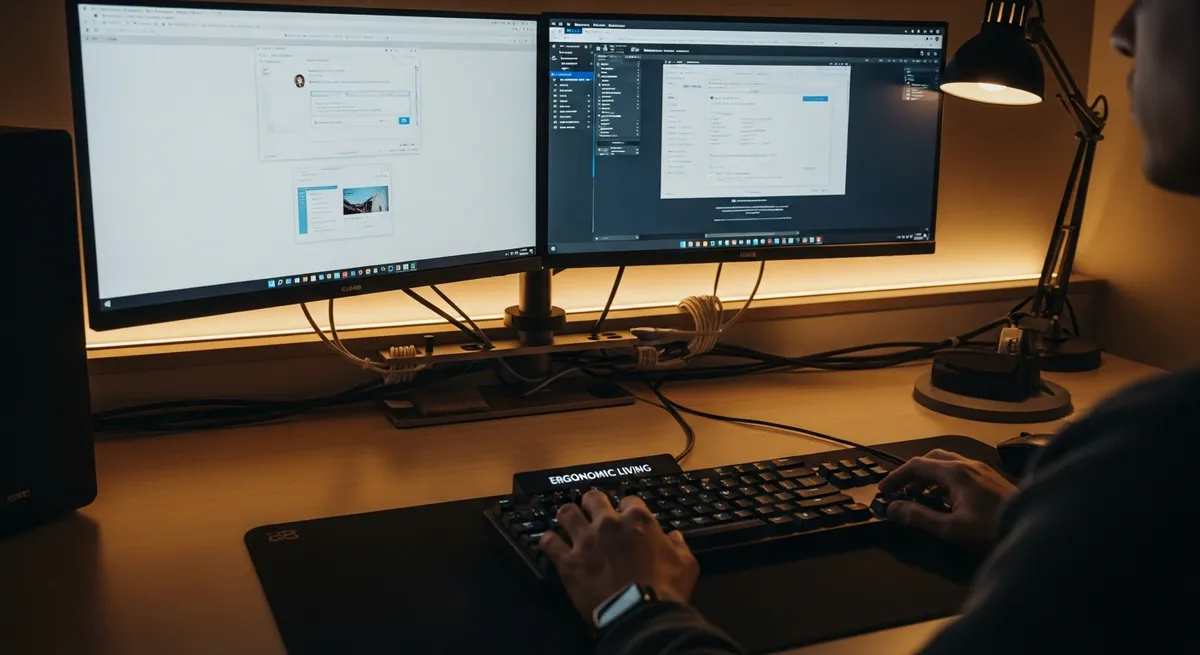
If you wish to cease feeling like a discarded piece of crumpled paper, you must submit to the geometry of the 90-degree angle. (My cousin Greg, who is an architect and very particular about right angles, would be so proud of this.) Your elbows should reside at 90 degrees. Your hips should settle at 90 degrees. Your display should be positioned at eye level so that you are not constantly tilting your skull downward. If you are peering down at a laptop monitor for eight hours a day, you are engaging in a slow-motion criminal act against your own neck. (I used a stack of outdated encyclopedias to elevate my screen because I am far too frugal to purchase a professional riser.) It works remarkably well, and it makes me appear significantly more intellectual than I actually am during video calls. (People assume I am referencing the 'G' volume for Britannica, but I am actually just trying to avoid a neck cramp.)
The chair is the protagonist of this unfortunate story. (It is often the villain, but let us call it a protagonist for the sake of drama.) The Mayo Clinic notes that your feet should rest flat on the floor or upon a sturdy footrest. If your legs are dangling in the air, you are inhibiting your circulation and placing unnecessary stress on your thighs. (I spent many years sitting with my legs crossed like a pretentious Victorian poet, and I am now paying the price in pins and needles.) You cannot simply stand perfectly still for eight hours either. That is just substituting one version of agony for another. (My legs usually begin to vibrate like a cheap motel bed after twenty minutes of standing.) The National Institutes of Health discovered that interrupting sedentary periods with even tiny amounts of physical activity can notably improve your metabolic health. I try to stand for twenty minutes of every hour. (If the answer to 'where does it hurt' is 'everywhere,' you have a significant amount of work to do.)
Start by adjusting your seat height. If your desk is too high, your shoulders will migrate toward your ears like they are attempting to hide from a predator. This generates a level of tension that causes headaches that feel like a tiny construction crew is using a jackhammer inside your skull. (I used to believe I had a caffeine problem.) Well, I do have a caffeine problem, but the headaches were actually a result of my trapezius muscles being permanently locked in a defensive stance. If you are squinting at your monitor, you are leaning forward. It is a chain reaction of physical failure. Place your monitor approximately an arm-length away from your face. If you cannot read the characters from that distance, do not lean in; simply increase the font size. (You are not a pigeon peck-pecking at the glass.)
⏱️ The Movement Mandate
Use a separate keyboard and a mouse if you are working on a laptop computer. This setup allows you to place the screen at the ideal height while keeping your hands in a neutral, relaxed position. It is a straightforward adjustment that most individuals ignore because they prefer the aesthetic of a minimalist, trendy desk. (I have realized that an 'aesthetic' workspace is worthless if I cannot stand up straight at the end of the day.) Set a timer on your device. Every thirty minutes, you must stand up and reach toward the ceiling. Pretend you are a majestic willow tree or perhaps a person who actually has their life in order. (I usually just look like I am attempting to catch a fly that does not exist, which worries my dog.)
Stretch your hip flexors frequently. A study from the American Journal of Preventive Medicine suggests that even low-intensity physical activity can help minimize the hazards of a sedentary lifestyle. It just requires a degree of consistency. You are the architect of your own physical environment. (If your current structure is leaning like the Leaning Tower of Pisa, it is probably time for a major renovation.) We are living in an era where our professional worth is often tied to how long we can remain tethered to a plastic rectangle. It is a strange way for a biological organism to exist. (But until the robots replace us and we can all reside in floating pods, we must manage the reality of our biology.)
The positive news is that the human body is surprisingly resilient. If you begin making these minor adjustments this afternoon, you will detect the difference within a week. You might even find yourself being less irritable at the dinner table because your lower back is no longer screaming at you in a high-pitched frequency. (My spouse has observed that my personality improves significantly when I am not in a state of constant physical distress.) Invest in yourself. (Because if you do not, nobody else is going to do it for you.) It is easy to feel defeated by the abundance of expensive gadgets and the conflicting noise of the internet. Focus on the fundamentals: height, light, and consistent movement. These are the three pillars of a sustainable workspace. I am going to stand up now and perform a stretch because my timer just went off. (My knees just made a sound like a bag of potato chips being crushed, but we are making progress.)
Key Takeaways
❓ Frequently Asked Questions
How high should my desk be for the best posture?Your desk should be at a height that allows your elbows to stay at a 90-degree angle while your shoulders remain relaxed. (If the desk is too high, you will shrug your shoulders unconsciously, leading to significant upper back tension.) If it is too low, you will likely hunch forward, which is equally problematic for your spine.
Is a standing desk actually better than a sitting desk?A standing desk is beneficial only if it encourages you to change positions throughout the day rather than staying stationary. (Static standing can be just as hard on your circulatory system and lower back as static sitting if you do not move.) The ideal scenario involves a mixture of sitting, standing, and walking to keep your muscles engaged and your blood flowing.
Where should I place my computer monitor?You should place your monitor directly in front of you, about 20 to 30 inches away, which is roughly an arm-length. (The top of the screen should be at or slightly below eye level so that you are looking slightly downward without tilting your neck.) This position reduces the strain on your eyes and prevents you from adopting a 'turtle neck' posture.
What is the most important feature in an office chair?Adjustable lumbar support is the most vital feature because it maintains the natural inward curve of your lower spine. (Without this support, most people tend to slouch, which flattens the natural curve and puts excessive pressure on the spinal discs.) A good chair should also allow you to adjust the seat height and armrest position to fit your specific body dimensions.
How often should I take breaks from sitting?You should aim to take a short break every 30 minutes to stand up, stretch, or walk for at least two minutes. (These frequent micro-breaks are more effective at preventing musculoskeletal strain than taking one long break in the middle of the day.) Consistent movement helps to reset your posture and provides a necessary rest for the muscles that hold you upright.
Disclaimer: This article is for informational purposes only and does not constitute medical or professional ergonomic advice. The information provided is based on general guidelines and should not replace the recommendations of a qualified healthcare provider or a professional ergonomic specialist. Always consult with a professional before making significant changes to your physical environment or exercise routine, especially if you have pre-existing health conditions.