I am presently hunkered down in a Zurich airport terminal, glaring at a cup of tepid espresso that cost more than my first used sedan, while my laptop battery emits its final, desperate gasps for life. (I am not exaggerating; the red light is blinking with a rhythmic intensity that suggests a countdown to a very small and very expensive explosion.) This is the gritty, unpolished reality of trying to balance your professional duties with constant travel when you lack a functional system. It is a mess. It is loud. My neck hurts from an angle that no human vertebrae should ever be forced to endure. (I suspect the architect of this terminal chair was a sadist who specialized in lumbar torture.)
The Jerry Problem and the Illusion of Freedom
My neighbor back in Connecticut - a fellow named Jerry who wears wool socks with rubber sandals and once attempted to groom his lawn with a handheld weed whacker - is convinced that I am living a shimmering, glamorous fantasy of coastal sunsets and digital freedom. (Jerry also once tried to use a toaster in a bathtub to see if it would heat the water faster, so his judgment regarding life choices is questionable at best.) In reality, I am just a man who forgot his universal power adapter in a hotel room in Lisbon and is now paying for that sin with interest. The struggle is not actually about the travel itself; it is about the friction that comes with moving through space while trying to remain a productive member of society. It is the constant, grinding grit of the logistics. (I have spent more time apologizing to editors for latency issues than I have spent looking at historical monuments.)
You are not just fighting time zones; you are fighting the inherent chaos of the universe. According to a 2023 report from MBO Partners, there are 17.3 million American digital nomads currently roaming the earth. That is a massive number of people looking for a decent Wi-Fi signal. (Most of them are likely sitting in this exact overpriced Zurich cafe, looking just as miserable as I do.) We think we can work on the plane, but then the person in front of us reclines their seat, and suddenly our workspace is four inches wide. My elbows are pinned to my ribs. I look like a T-Rex trying to write a quarterly earnings report. It is humiliating. (I once dropped a blueberry muffin into the seat crack during a particularly aggressive recline, and it is still there, haunting the future passengers of Flight 402.)
The Italian Train Incident and the Productivity Pitfall
I learned this the hard way in 2019 when I tried to file a column from a rural train chugging through the Italian countryside. The Wi-Fi was a myth, my phone hotspot was a joke, and I ended up shouting my final paragraph to an editor over a crackling landline at a station cafe. (The locals thought I was having a very specific and very public mental breakdown involving a lot of gesturing and sweating.) We underestimate the mental tax of being "in transit." A 2021 study from the National Institutes of Health regarding environmental stress found that cognitive function can be significantly hindered by unpredictable surroundings. (I do not need a study to tell me that a crying baby in seat 14B lowers my IQ by forty points, but it is nice to have the scientific backup.)
I am not being dramatic. I am being honest. There is a difference. I now carry three different ways to connect to the internet, including a dedicated satellite-linked device that looks like a 1990s pager but has saved my skin in the middle of a desert. (It was a very beautiful desert, but the total lack of bars on my phone made me feel like I was the opening victim in a low-budget horror movie.) Even with the gear, you are at the mercy of the environment. Because the person sitting next to the only working outlet in the airport will always be a teenager playing a video game who has no intention of moving for the next four hours. (I do not blame the teenager; I blame myself for not being prepared for his existence and his apparent immunity to my passive-aggressive sighing.)
The Ritual of the Modern Exorcism
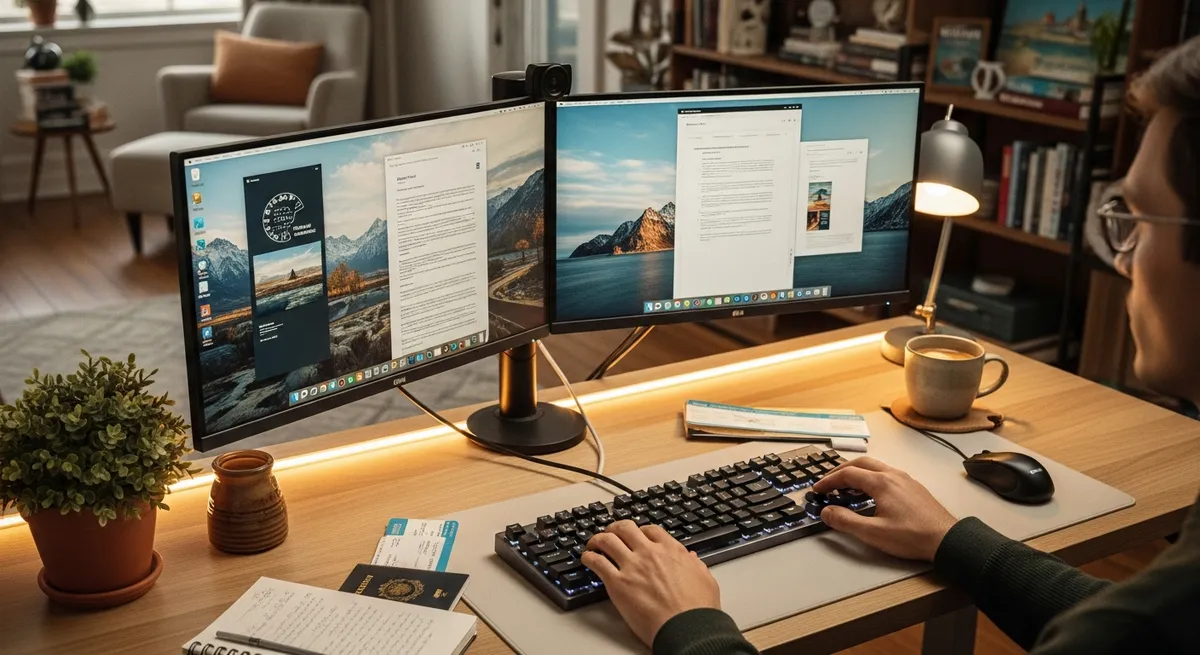
When you finally arrive at your destination, whether it is a hotel, a shared workspace, or your aunt's spare bedroom, you must perform the ritual. (It looks a bit like a modern exorcism, but with more cables and slightly more swearing.) You find the desk, you check the signal strength, and you set up your physical boundaries immediately. I have a literal "go-bag" that stays packed even when I am at home. It contains every cable, every dongle, and every adapter I could possibly need. (I once had a security agent ask if I was a traveling bomb technician because of the sheer volume of copper wiring in my carry-on.)
You must also learn to read the rhythm of your environment. If the hotel Wi-Fi is screaming fast at six in the morning, that is when you do your heavy lifting. (I have written entire chapters while the sun was still hidden because that was the only time the router was not being strangled by four hundred tourists streaming movies.) If the afternoon is a blur of travel delays and loud crowds, that is when you do your low-intensity tasks like clearing out your inbox or organizing your files. It is about adaptation, not force. (I tried to force productivity in a crowded Parisian bistro once and ended up with red wine on my keyboard and a very confused waiter.)
Why Redundancy is Your Only True Friend
My friend Chad - a man who reads financial broadsheets in the shower and thinks he has life figured out - told me I should just work from the hotel. (Chad is an idiot who has never left his climate-controlled bubble.) Hotels have the worst Wi-Fi in the developed world. It is a law of nature. The more expensive the room, the worse the signal. I once paid four hundred dollars for a room in London where the internet only worked if I stood on one leg in the bathroom. I checked the router. It was from 2004. Total disaster. (I do not recommend standing on one leg in a tiled bathroom; it is a recipe for a very embarrassing insurance claim.)
Be kind to yourself. Set your "must-do" list to three items. You will find yourself trying to type a report on a smartphone in a bathroom stall because it is the only place with a working light. (I have been there, and the acoustics are terrible for Zoom calls, though the echo does add a certain gravitas to my voice.) The goal is not to reach a state of perfect, zen-like harmony where you work from a hammock without a care in the world. That is a lie sold to you by people who make money from selling filters. The goal is to build a system that is resilient enough to survive the chaos of reality. Invest in the right hardware, embrace the philosophy of redundancy, and stop pretending that the world owes you a stable internet connection.
When you let go of the expectation that travel should be easy, it actually becomes manageable. You might even find that you enjoy the challenge. (I am still working on that last part, but at least I have enough battery power to finish this sentence.) The road is long, the Wi-Fi is weak, but your system can be strong. Now, if you will excuse me, I need to go find my universal adapter before I have to start writing my next piece in crayon on the back of a cocktail napkin. (The cocktail napkin has better uptime than the Zurich airport guest network.)
Frequently Asked Questions
How do I handle time zone differences without burning out?
You should pick a four-hour window where you are always available and guard the rest of your time for sleep and travel. (If you try to be awake for the New York opening and the Tokyo close, you will eventually start hallucinating that your laptop is talking to you.) Consistency is the only thing that keeps your clients from realizing you are currently twelve thousand miles away.
What is the most important item in a mobile productivity kit?
It is not the laptop, but the power bank. I travel with a power reservoir so massive that it frequently prompts intense interrogation at security checkpoints, but it is worth the specialized scrutiny. (Having power when the rest of the terminal is fighting over one loose outlet feels like having a superpower.)
Is public Wi-Fi safe for work tasks?
Public Wi-Fi is about as secure as a screen door in a hurricane. You should never, ever connect to a network at an airport or coffee shop without a reputable virtual private network (VPN). (I have seen how easy it is for a bored teenager to see your data, and it is enough to make you want to live in a Faraday cage.) If you do not have a VPN, use your phone's cellular hotspot instead.
How do I stay focused in loud environments like planes or trains?
Active noise-canceling headphones are not a luxury; they are a piece of essential medical equipment for your sanity. (They allow you to pretend that the world does not exist, which is the only way I get anything done.) Invest in a pair from a leading electronics manufacturer and do not look back.
Should I tell my clients that I am traveling?
Transparency is usually the best policy, provided that it does not sound like an excuse for poor performance. Frame it as "working from a remote office" rather than "on vacation." (My most prestigious clients remain under the impression that I am working from a mahogany-clad office in Manhattan, whereas in reality, I am frequently composing emails in my pajamas while sitting on a floor pillow in a yurt. I do not correct their assumptions because the mahogany image is much more expensive to maintain.)
Disclaimer: This article is intended solely for informational purposes and does not constitute professional career or financial advice. (I am a writer, not a life coach, and my own career is held together by caffeine and spite.) The author is a columnist, not a travel agent or a certified productivity coach. Consult with your IT department or a qualified professional before implementing new digital security measures or making significant career changes.