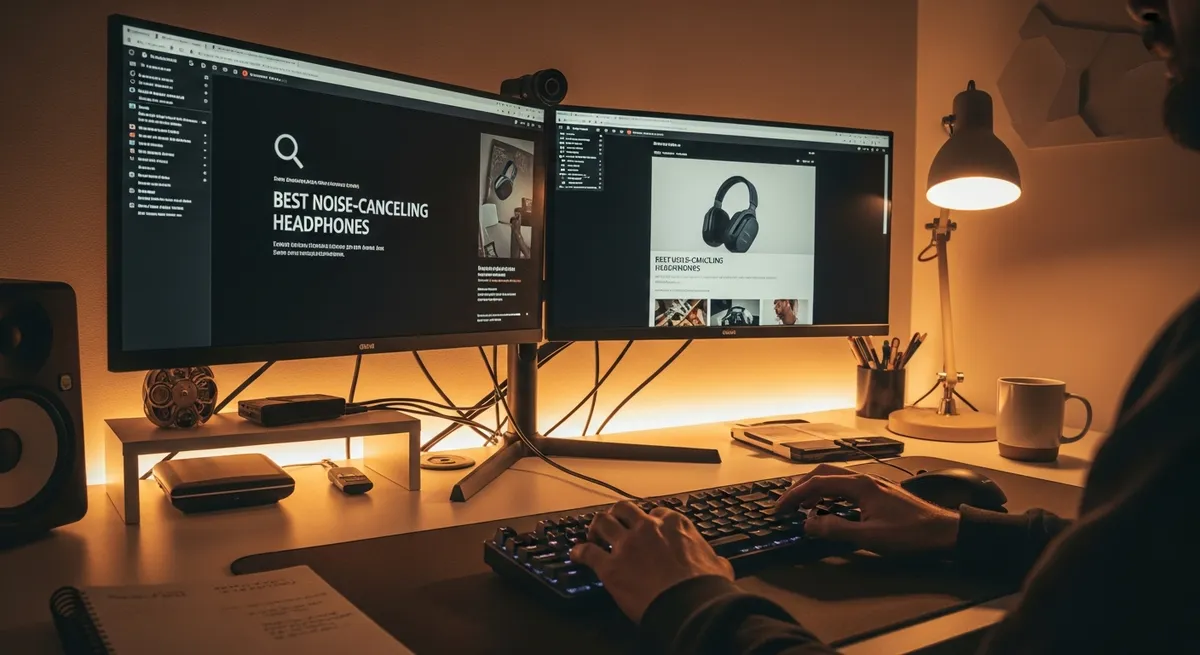
I was occupying seat 14B on a flight that felt less like a modern marvel of engineering and more like a pressurized aluminum tube filled with human sorrow. (I am not a fan of flying, but I am even less of a fan of people in confined spaces.) To my left, a gentleman whom I shall call Arthur was enthusiastically consuming a tuna sandwich that smelled of industrial despair and failed life choices. (He also possessed a smear of mayonnaise on his chin, which did not help the visual aesthetic.) To my right, a toddler was performing a vocal exercise that I can only describe as a siren song for the end of days. (The parents looked like they had not slept since the Obama administration.) It was in this precise moment that I realized my quest for the best noise-canceling headphones was not a luxury, but a biological necessity for survival.
I reached into my rucksack, retrieved my cumbersome over-ear cans, and activated the electronic noise suppression circuitry. (I might have permitted a single, mute tear to fall as the environment finally descended into silence.) The piercing engine roar vanished into a subtle, remote drone, and abruptly, the tuna sandwich became a visual tragedy rather than a sensory assault on my nose and ears. It was absolute peace. Pure, unadulterated tranquility. I have spent a small fortune on audio gear over the last twenty years, mostly because I have a neighbor named Bob who thinks 7:00 AM is the perfect time to use a leaf blower. (Bob is wrong, but Bob has a very powerful engine and a lot of dead leaves.) I could finally hear myself think, although my thoughts were mostly just internal shouting at poor Arthur and his mayonnaise. That is the point of good gear. It buys you back your own mind.
The Science of Not Hearing Arthur Eat
Active Noise Cancellation - or ANC for the individuals who enjoy acronyms - is essentially a tiny computer in your ear that fights sound with more sound. It is a bit like magic, but with more physics and less glitter. (I failed physics in high school, but I have paid dearly to understand this specific concept.) According to a study from the Journal of the Acoustical Society of America in 2023, the most effective devices use external microphones to listen to the world and then play an inverted sound wave to cancel it out. When the peak of a noise wave meets the trough of the anti-noise wave, they vanish. (Think of it as two waves crashing into each other and turning into a flat, boring pond.)
But here is the catch. These things are not perfect. They are great at low, steady noises like jet engines or Bob and his leaf blower. They are less great at sudden noises, like my brother Steve shouting because he dropped a bowling ball on his foot. (That actually happened last Thanksgiving; the headphones did nothing for the screaming.) We are currently enduring an era of unprecedented noise pollution that is quite literally shrinking our brains and elevating our heart rates. My neighbor Bob is a primary combatant in this auditory war. (I have considered writing him a strongly worded letter, but I suspect he would just blow it away with his machine.) The problem is not just annoyance; it is a matter of cognitive load. According to the National Institute for Occupational Safety and Health, prolonged exposure to ambient noise above 85 decibels can cause permanent damage, but even lower levels of "nuisance noise" trigger a physiological stress response. This is why you feel exhausted after a day in an open-plan office. Your brain is working overtime to filter out the chatter of Brenda from accounting and the rhythmic clicking of a broken HVAC vent. (Brenda is a lovely woman, but she types like she is angry at the keyboard.)
The Expensive Mistake I Made So You Do Not Have To
I once spent six hundred dollars on a pair of headphones because a salesman named Derek told me they were the "pinnacle of acoustic engineering." (Derek wore a vest and smelled like sandalwood, so I trusted him more than I should have.) I took them home, put them on, and realized they were heavy enough to give me a neck cramp within twenty minutes. (My first pair of high-end headphones snapped when I sneezed too hard, and Derek refused to refund me.) Plus, the battery lasted about as long as a cheap candle in a windstorm. I ended up giving them to my nephew. He lost them at a park. (I am still slightly bitter about those six hundred dollars.)
The lesson here is simple. Do not buy for the brand name alone. Look at the weight. Look at the battery life. If the headphones weigh as much as a bowling ball, you will never wear them. (Even if they make the world sound like a quiet library.) You want something that disappears on your head. If you feel like a pilot from 1944, you have made a mistake. I checked the latest data, and you can get incredible silence for under three hundred dollars now. Anything more is usually just for the fancy logo on the side. I once hired a contractor named Dave who insisted on playing heavy metal at a volume that could liquefy granite. (Dave was a talented tiler, but his taste in music was a war crime.) I attempted to wear my noise-canceling gear while he worked. It did not end well. I could not hear him when he asked where the spare grout was kept. (He ended up using a color that I can only describe as "sad beige".) This is a key point. These devices do not just block out the things you hate. They block out the things you actually need to hear. This is why situational awareness is not just a buzzword; it is a survival tactic for your social and physical life.
Pros and Cons of High-End Silence
Pros:Protects your hearing from Bob and his leaf blower.Makes long flights feel like a nap in a cloud.Signals to people that you do not want to talk about their tuna sandwich.
Cons:You might miss the doorbell or your spouse calling you for dinner.Good ones cost as much as a decent television.The batteries always seem to die at the worst possible moment.
Concrete Steps You Can Take to Reclaim Your Mental Focus
If you are serious about focus, you must stop treating headphones as a fashion accessory and start treating them as a tool for deep work. (Silence is a utility, like water or electricity.) I spent three weeks in a library trying to finish a manuscript while a construction crew renovated the building next door. It was a nightmare. A good seal around the ear is the foundation upon which the silicon chips build their silent empire. When you are hunting for the premier noise-canceling headphones, you must prioritize the specific frequency range that the device can successfully neutralize. (Not all silence is created equal.) Most consumer-grade gear is excellent at blocking out low-frequency drones, such as the hum of a refrigerator or the rumble of a bus. (I once slept through a minor earthquake because my headphones were so good at ignoring low-end vibrations.)
However, they often struggle with high-frequency, unpredictable sounds like a human voice or a clattering keyboard. A study from the Journal of the Acoustical Society of America suggests that the most effective devices are those that use hybrid cancellation, placing microphones both inside and outside the ear cup to create a more accurate anti-noise profile. I also recommend looking at the battery life, because nothing is more tragic than your silence dying thirty minutes into a ten-hour flight. (I have been there, staring at the battery indicator like it was a failing pulse.) If they do not last at least twenty-five hours, they are not worth your time. You should also consider the "transparency mode" feature. (This allows you to hear the world without taking the gear off.) If the world suddenly feels like it is underwater when you engage the ANC, you are on the right track. If you can still hear the exact details of the breakup happening at the table next to you, put them back on the shelf. You are paying for a private cone of silence, not a front-row seat to a neighborhood soap opera. (Even if the drama is quite entertaining.) The core noise-canceling technology in a flagship model from two years ago is often ninety-five percent as good as the current version, but it can be found for half the price. This is how you win the game. You obtain the silence, you secure the focus, and you retain enough currency in your wallet to purchase a respectable sandwich that does not smell of industrial despair and nautical regret.
Wait, Should You Get Earbuds or Over-Ear Cans?
This is the big debate. My dentist, who is a very intense man named Dr. Miller, swears by tiny earbuds. He says they are more portable. (He also thinks flossing is a spiritual experience, so take his advice with a grain of salt.) Over-ear headphones provide better passive isolation. That is just a fancy way of saying they cover your whole ear like a earmuff. The World Health Organization reported that over one billion young adults are at risk of hearing loss due to unsafe listening practices, which often stems from turning up the volume to drown out the world. If you are going to listen to music in a loud area, the noise cancellation allows you to keep the volume lower. That is the real win. You do not have to blast your music to drown out the world. (Your future self will thank you when you can still hear the birds chirping at age eighty.)
Look, the world is loud. It is getting louder. Between traffic, construction, and the inevitable return of Arthur and his tuna, you need a way to opt out. Do not overthink the technical charts. Find a pair that is comfortable, has at least twenty hours of battery, and makes you feel like you are in a quiet room even when you are in the middle of a riot. It is the best money I have ever spent. (Except for that one time I bought a self-cleaning litter box, but that is a story for another day.) Invest in a pair that makes you forget you are wearing them and makes you forget that the rest of the world exists. Whether you are traveling across the ocean or just trying to survive a Tuesday in the office, the right gear is your best defense. Once you experience true silence in a noisy room, there is no going back. (It is like seeing in color for the first time, only it is for your ears.) Go forth, find your silence, and tell Bob to keep his leaf blower away from your window.
Quick Takeaways
Focus on battery life and comfort over brand names. High-end noise cancellation from two years ago is often a better value than the newest models. Always check for a hybrid microphone setup for the best results.
Frequently Asked Questions ❓
How long do noise-canceling headphones usually last? ⏱️
A high-quality pair of headphones should last between four and six years if you treat them with reasonable respect. The lithium-ion battery is usually the first component to fail, as it will lose its capacity to hold a charge after several hundred cycles. (Physics is a cruel mistress.) You can extend their life by avoiding extreme temperatures and keeping them in their protective case when they are not in use. I checked my old pair from 2018, and they still work, although the ear pads look like they have been through a war.
Can noise-canceling headphones hurt your ears? 🤔
The technology itself does not cause physical harm to your eardrums because it uses sound waves to cancel other waves. It is a zero-sum game for your ears. However, some people experience a sensation of "ear pressure" that can be uncomfortable or lead to a mild headache. (I felt this with a pair I bought in 2015, and I felt like I was at the bottom of a swimming pool.) If you feel this, try a different brand or model, as the specific frequency of the anti-noise can affect individuals differently.
Do they work on human voices? 🟢
Human voices are notoriously difficult to cancel because they are unpredictable and occupy a higher frequency range than the steady hum of a jet engine. (The machines struggle with the erratic nature of human speech.) While they will not make a shouting coworker completely silent, they will significantly muffle the sound and make it much easier to ignore. Combining your cancellation with some low-volume white noise or rain sounds is the best way to disappear completely from the office environment.
Are expensive headphones always better for noise cancellation? 🔴
There is a powerful correlation between the sticker price and the actual performance in the noise-canceling world because the silicon chips and high-fidelity microphones required are expensive. (You cannot get champagne silence on a light beer budget.) That being said, you are frequently paying a heavy premium for the brand name and the massive marketing budget. You can frequently locate mid-range options that provide eighty percent of the auditory performance for half the cost of a top-tier luxury brand. Dimensioning returns hit hard once you pass the four-hundred-dollar mark.
Is it safe to wear them while walking outside? ⚠️
You must be extremely careful when using full noise cancellation in public spaces or near heavy traffic. Your ears provide vital safety information about approaching vehicles or other hazards that you might not see. (I almost collided with a cyclist named Gary because I was listening to a podcast about ancient Rome at full volume.) Always use a transparency mode or keep one ear cup off when you are in an environment where situational awareness is necessary for your physical safety.
References:
Disclaimer: This article is for informational purposes only and does not constitute professional medical or technical advice. Noise-canceling headphones should be used responsibly to avoid hearing damage or safety risks in public environments. Hearing health is a serious matter; please consult with an audiologist if you have concerns about your hearing health or before purchasing specialized equipment for hearing protection.