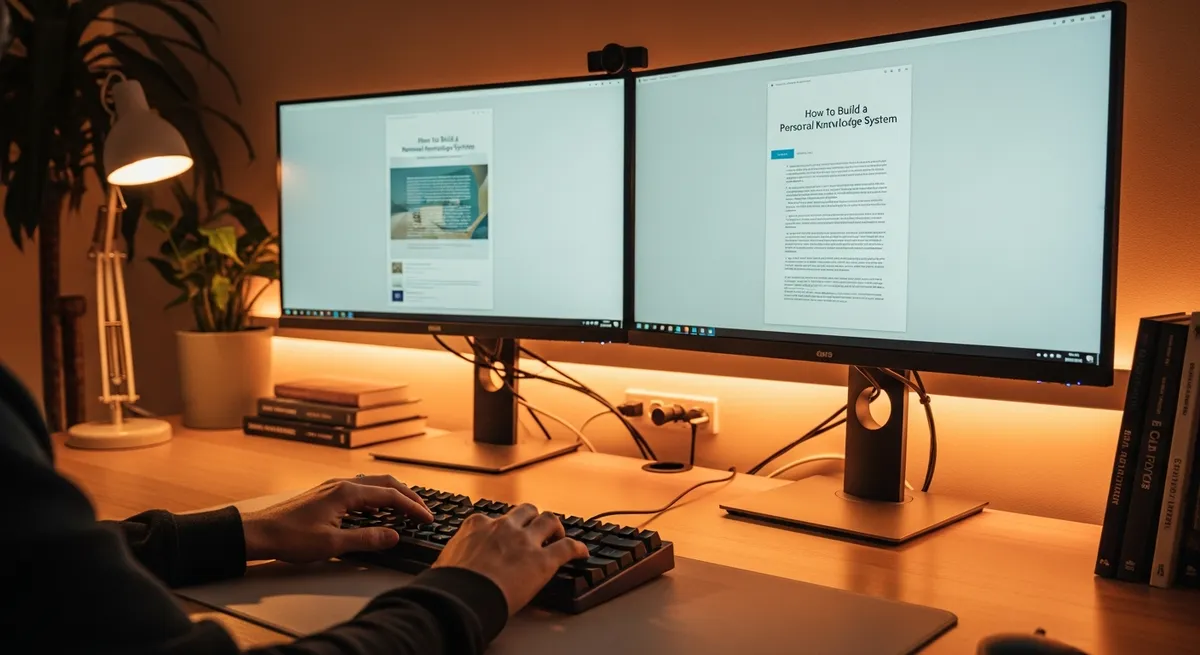
I am hunched over my desk at three o’clock in the morning, glowing like a radioactive swamp creature in the blue light of a monitor that should have been turned off hours ago, blinking at a browser window that holds forty-two distinct tabs. (My wife, Sarah, frequently remarks that this behavior is a desperate plea for psychological intervention, but I prefer to categorize it as deep investigation.) I am staring at a blank page because I cannot remember a brilliant idea I had while eating a turkey sandwich at noon. It is gone. The idea has evaporated into the ether. It is as if my brain decided to perform a factory reset without my permission.
We are all living in a state of mental bankruptcy. We consume more data in a single afternoon than our ancestors did in an entire decade. (I assume our ancestors spent most of their time looking at clouds and worrying about dysentery, which sounds oddly peaceful compared to my current inbox.) But we do not have a place to put any of it. My neighbor, Bob, is a perfect example of this modern tragedy. Bob is a contractor who can build a house with his eyes closed, yet he loses his temper every Tuesday because he cannot find the digital invoice for a pallet of lumber. It is in his email. Or his cloud drive. Or perhaps it is just a ghost in the machine. Bob has all the information he needs, yet he is effectively paralyzed because he cannot access it when the pressure is on.
The High Cost Of A Fragmented Mind
My friend Gary is even worse. Gary is obsessed with productivity. He buys every new application that promises to turn his life into a streamlined masterpiece of efficiency. (Gary once spent four hours picking a specific shade of forest green for his digital calendar, which is a level of psychological dysfunction I cannot even begin to respect.) Gary has purchased every productivity tool on the market, but if you ask him where he keeps his notes on the home renovation project he started in 2019, he begins to perspire. He is spending over ten hours every single week playing hide-and-seek with the contents of his own skull. (It is a tragedy in three acts, and Gary is playing every role.) It is a disaster. He is a high-functioning executive who cannot find his own car keys half the time because his mental RAM is completely occupied by junk data.
A study from the University of California, Irvine, led by Gloria Mark, found that it takes an average of twenty-three minutes and fifteen seconds to get back to a task after an interruption. (I am personally interrupted by my own wandering thoughts every six minutes, which means I am technically living in a permanent state of cognitive debt.) We think we are being busy. We are not. We are just moving piles of digital trash from one corner of our minds to the other. According to a study from the University of California, San Diego in 2009, the average person consumes about 34 gigabytes of information every day. That is roughly 100,000 words. Imagine having a full-length novel shouted at you every single morning while you are trying to brush your teeth. You are spending over ten hours a week playing hide-and-seek with your own brain, and that is a conservative estimate.
The Biological Tax Of The Unfinished Task
This mental clutter creates a constant, low-level hum of anxiety that never truly dissipates. (It is like having a refrigerator that makes a weird noise in the background of your entire life.) I have stood in front of a filing cabinet that I bought for two hundred dollars, feeling like an absolute fraud because I could not find my own tax returns. (The filing cabinet eventually tipped over and nearly broke my toe, which felt like a very pointed metaphor from the universe regarding my lack of organization.) This is what psychologists call cognitive load. Your brain is not designed to store things; it is designed to process them. When you force it to remember a grocery list, a meeting time, and a random fact about the Roman Empire, you are reducing its processing power for the things that actually matter.
We often think that being busy is the same as being productive. (It is a comforting lie we tell ourselves to feel important.) That is simply not the case. Most of the information we consume today is designed to be ephemeral. Social media algorithms do not care about your long-term wisdom. These algorithms only prioritize what is trending at this exact second. If you want to build something that lasts, you have to stop being a consumer and start being a curator. You must construct a fortification against the noise that threatens to drown out your original thoughts. I started doing this three years ago after a disastrous dinner with a history professor who quoted a book I had read only the week before. I could not recall a single specific detail from the text. I was embarrassed. I felt like a hollow shell of a person.
Stop Collecting And Start Curating
I once lost a three-thousand-word essay because I wrote the password for an encrypted drive on the back of a dry cleaning receipt that I eventually discarded. (I then lost the receipt because I am a person who lacks the basic survival skills of a functional adult.) That was a five-thousand-dollar mistake. I am not being dramatic. I checked the math. The time I spent rewriting that piece was time I could not bill to other clients. It was a painful lesson in why we need a system that does not rely on our own flawed grey matter. A person who does not have a method for arranging their ideas is not a thinker; they are merely an individual with a noisy, overpopulated lobby inside their skull.
A research paper from a prominent technology company published years ago showing that the average office worker spends hours every week just looking for files they already created. It is a pitfall. We think more information is the solution. It is not. The solution is curation. You have to build a wall against the noise. You must stop being a mindless consumer of data and start being a librarian of your own experiences. (My librarian in elementary school, Mrs. Higgins, would be horrified by the state of my desktop icons, and frankly, I am too.) You must treat your information like a garden. If you do not weed it, the thorns will eventually take over the entire plot.
Build Your Own Digital Basement
You do not need thirty-seven applications. You need one place where things go to live. A digital basement, if you will. (Just try to keep the spiders out of this one.) I have started using a single, simple database for every thought that crosses my mind. This is a sophisticated way of saying that your notes should point to each other. If I have a note about "Coffee Habits" and a note about "Productivity," they should be linked in a way that makes sense. This mimics how the brain actually works, creating a web of associations rather than a linear list. (It also makes me feel like a detective in a movie, which is a nice bonus.)
The National Center for Biotechnology Information has explored the Zeigarnik Effect, which suggests that our brains remember uncompleted tasks better than completed ones. This creates a mental loop that drains your energy. A proper system allows you to put a thought down and know, with absolute certainty, that you will see it again when it is relevant. It is like having a team of tiny librarians living in your hard drive, ready to hand you the right file at the exact moment you need it. This is where you summarize the big ideas in your own words, rather than just copying and pasting. If you cannot explain a concept to a ten-year-old child, you do not truly understand it yet.
Finally, the Vault is where the polished ideas live. My dentist, Dr. Aris, who is terrifyingly organized, does this with his patient files and his hobby of restoring old watches. (He has a different set of tweezers for every day of the week, which I find both impressive and slightly alarming.) He told me that a system is only as good as its weakest link, and he is absolutely right. We are like squirrels who bury nuts and then forget where the tree was located. But do not get carried away with perfection. Your system should reflect the strange, winding path of your own curiosity. If it looks like a textbook, you are doing it wrong. It should look like a map of your soul. (A messy, slightly confused soul, perhaps, but yours nonetheless.)
How To Get Started Without Burning Your House Down
The first step is to pick a tool and stick with it for ninety days. It does not matter if it is a physical notebook, a plain text file, or a high-tech application. Every day, find one thing you learned and write it down. I once spent sixty dollars on a leather-bound journal that I was too intimidated to actually write in because I did not want to ruin the pages with my mediocre handwriting. (It is currently being used as a coaster for my gin and tonic, which is a much better use of its expensive leather.) I have seen systems with so many categories that it takes longer to file a note than it does to write it. This is the bureaucracy of the mind, and it must be crushed. If the system feels like work, you will stop doing it. (I stop doing anything that feels like work after 4 PM, which is why my lawn looks like a set from a post-apocalyptic movie.)
Finally, schedule a weekly review. This is how you stop feeling like a victim of the internet and start feeling like the master of your own intellectual domain. It is a slow process, but the payoff is legendary. I no longer panic when I have a deadline looming over me. I do not stare at a blank page and pray for inspiration to strike. I just go to my Vault and see what I have been collecting for the last few months. It is like having a conversation with a smarter version of myself. (And that guy is much more articulate than I am after two glasses of Merlot.) But for the love of all that is holy, start today. Your future self is waiting for you to get your act together, and they are tired of searching for that Roman Empire quote you mentioned once. (Seriously, it was a good quote.)
Frequently Asked Questions ❓
Do I need expensive software to start a system? 🤔
You absolutely do not need to spend a fortune. I have seen people do more with a simple folder of text files than others do with a hundred-dollar-a-year subscription. The tool is far less important than the habit. If you are consistent, even a stack of index cards can become a powerful external brain. (Though I do not recommend index cards if you own a cat, as they will quickly become floor decorations.)
How much time should I spend on this every day? ⏱️
Fifteen minutes is more than enough time if you are consistent about it. The goal is to make it a seamless part of your workflow rather than an extra chore you have to perform. If you spend hours a day organizing, you are procrastinating on your actual work. Think of it as a quick cleanup at the end of the day rather than a deep spring cleaning of your entire brain. (My actual spring cleaning usually involves me finding things I forgot I owned and then feeling guilty about them.)
What is the biggest mistake beginners make? 🔴
People create hundreds of empty folders and then feel overwhelmed by the vacuum they have created. It is much better to let the structure grow organically as you add content. Start with one big pile and only create categories when the pile becomes too large to manage. Do not build a library before you have any books. (That is how you end up with a very expensive, very empty house.)
Can I just use a physical notebook instead of digital tools? 🟢
Physical notebooks are fantastic for deep thinking, but they fall short when it comes to searching and linking. If you love paper, you can use a hybrid system where you write by hand and then scan the important parts into a digital vault. I personally find that the act of writing by hand helps me process information better, even if I eventually store it on a computer. Just make sure you have a way to find those handwritten notes later without tearing your house apart.
Is a knowledge system only for writers and academics? 🤔
This is a tool for anyone who has to make decisions or solve problems in their daily life. Whether you are a plumber, a parent, or a programmer, you are constantly encountering information that could be useful later. Having a place to put that information makes you more efficient and less stressed. Everyone benefits from a clearer mind and a more organized way of looking at the world. (Even my dentist, who I suspect organizes his socks by thread count.)
References
Disclaimer: This article is for informational purposes only and does not constitute professional organizational or psychological advice. Consult a qualified professional before making major changes to your work systems or lifestyle based on this content.