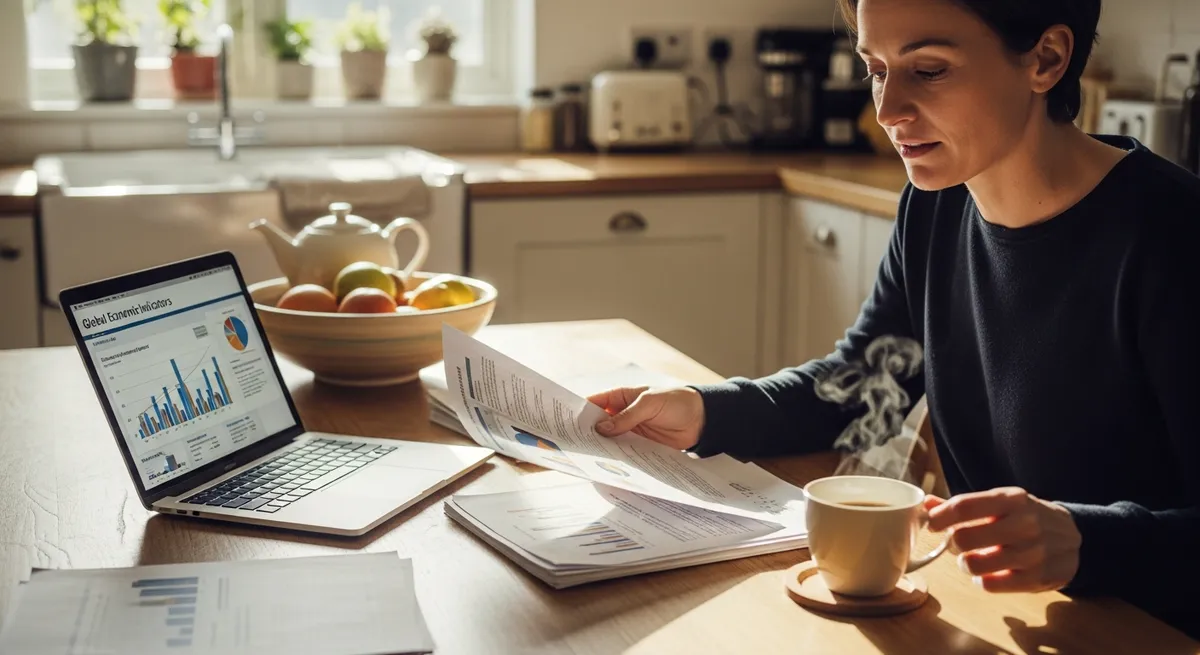
I am currently glaring at a grocery receipt that looks like a ransom note from a very greedy kidnapper. (The ink is fading, much like my hope for a balanced budget.) I should have skipped the imported pimento-stuffed olives, but I have the self-control of a puppy in a slipper factory. My neighbor Bob - a man who once tried to fix a leak with a glue gun - asked why his retirement account looks like a deflated balloon. I told him global economic indicators are the culprit. He looked at me with total confusion. (He looked as if I had just recited 14th-century liturgical poetry in a dead language.)
Developing an understanding of this complex machinery is not a task reserved solely for individuals who wear bespoke Italian suits and occupy glass towers in Manhattan. It is a necessity for the rest of us. We are the ones who actually have to pay for things. I have made spectacular, life-altering mistakes with my finances because I chose to ignore the broader picture. (I once liquidated a promising stock portfolio because the CEO had a haircut that I found fundamentally untrustworthy, which is a financial strategy I do not recommend to anyone with a mortgage.) If you intend to keep your head above the rising tide, you must observe the metrics that the rest of the world is watching with bated breath.
The Gross Domestic Product Is A Remarkably Blunt Instrument
The GDP is intended to quantify the total value of our national output, yet it remains a blunt instrument that lacks even a hint of subtle nuance. (It is equivalent to assessing the success of a marriage by calculating the collective weight of the living room furniture.) While it is a useful metric for general trends, it is a blunt instrument that lacks any sense of real refinement. According to the Bureau of Economic Analysis, the real GDP of the United States is projected to grow at an annual rate of 2.1 percent in the first quarter of 2026. This sounds like a victory lap for a titan of industry, but it certainly did not feel like a triumph when I was paying for those pimento-stuffed olives. Not even close.
The primary defect is that GDP quantifies frantic activity rather than genuine human well-being. If a multi-car pile-up occurs on the interstate, the GDP technically rises because of the ambulance fees, the mechanical repairs, and the subsequent lawyers who arrive like hungry wolves. (I find this logic deeply offensive to my moral compass, but the cold machinery of mathematics does not care about my feelings.) Growth does not always permeate the lower levels; frequently it just pools at the summit like grease on a low-quality pepperoni pizza. But you must still monitor it with a hawk-like intensity. If the GDP begins to waver or stagnate, the global markets become extremely agitated. When the world gets nervous, your bank account begins to exhibit signs of physical distress.
The Consumer Price Index Is Your Unfiltered Reality Check
Now we must address the Consumer Price Index, or CPI, which is the official governmental method of confirming you are not delusional for noticing that a carton of eggs now costs as much as a small ruby. This is the official government method of informing you that you are not losing your mind when you notice that a basic loaf of bread now costs as much as a modest used vehicle. The Bureau of Labor Statistics reported that the Consumer Price Index for all Urban Consumers is expected to rise 2.4 percent over the twelve months ending in January 2026. I read that specific number and began to laugh in a way that can only be described as hysterical. (My cat, Barnaby, observed this outburst with genuine concern and retreated behind the sofa.) Only 2.4 percent? I would very much like to have a spirited conversation with whoever is shopping for the Bureau of Labor Statistics.
I harbored the delusion that I was being clever by hedging against the escalating cost of protein three years ago. My plan involved bulk-buying a massive crate of grain-less dog biscuits under the delusion that they would appreciate in value like fine art. (I am not joking; I was two glasses of a very bold Zinfandel deep and the internet seemed very convincing at the time.) Instead, I discovered that when the CPI ascends, the very first luxury people abandon is artisanal, grain-less dog biscuits. By the time the Bureau of Labor Statistics actually publishes their findings, you have already endured the financial sting at the gas pump for several weeks. It is essentially a meteorological report that informs you it was raining yesterday after your shoes are already ruined.
How To Utilize These Metrics Without Transitioning Into A Doomsday Prepper
So, what are you supposed to do with this pile of data? You do not possess the need to construct a subterranean bunker or secrete bars of gold beneath your floorboards. (Although, given my recent investment history, the gold might actually be a safer bet than the dog biscuits.) I suggest you investigate the FRED database, which is the Federal Reserve Economic Data tool provided by the fine people in St. Louis. It is available at no cost, it is remarkably intuitive to navigate, and it ensures you appear exceptionally intelligent at pretentious dinner parties.
I utilized this tool last year to steer myself away from an ill-advised maritime purchase involving a leaky cabin cruiser. (The vessel was christened "The Fiscal Cliff", which really should have served as my primary warning sign.) Do not allow these massive global figures to dictate your internal sense of tranquility. Use the indicators as a compass, not a map. A compass indicates the general direction of North, but it fails to warn you about the murky swamp directly in your path that is currently ruining your expensive shoes. I have spent a lot of time in economic swamps, and the smell of stagnant capital is difficult to wash off. Stay focused on the long term and do not let every daily fluctuation cause you to panic.
The Role Of The Federal Reserve And Global Interconnection
We do not live on a secluded island. Unless you actually reside on a private island, in which case I am intensely jealous and would like an invitation. Everything in our modern world is closely connected. If a factory in a distant nation shutters its doors because of a localized crisis, the price of your favorite sneakers will inevitably climb. It is a ruthless domino effect. (I once suffered a significant financial loss on a shipping company because I did not comprehend how much a single canal could be paralyzed by one oversized cargo vessel.) The global economy is messy, interconnected, and relentlessly loud. Even the International Monetary Fund suggests global growth will remain steady but slow at 3.1 percent for 2026.
You must keep a vigilant eye on the interest rates established by the Federal Reserve. They serve as the thermostat for the entire national economy. When things become too hot and inflation begins to boil over, they turn the heat down by making it significantly more difficult to borrow money. This directly impacts your mortgage. It affects the interest on your credit card. It determines whether or not my accountant, Susan, calls me to scream about my discretionary spending. (Susan is a lovely human being, but her voice can reach a high-frequency pitch that only dogs can detect when she analyzes my tax returns.) If you choose to ignore the actions of the Federal Reserve, you are essentially flying a plane through a thick fog with your eyes closed.
Myth vs. Fact
Myth: A growing GDP means everyone is getting wealthier and the economy is healthy for everyone.
Fact: GDP only tracks the total value of production; it does not account for income inequality or the rising cost of basic living expenses.
Key Takeaways
The Unavoidable Truth About Your Future Spending
The realm of Global Economic Indicators is chaotic, paradoxical, and frequently feels entirely disconnected from the lives we actually inhabit. (The experience is akin to deciphering the assembly instructions for a Swedish bookshelf while you are already holding a mallet and several mysterious leftover screws.) However, ignoring these economic signals is a luxury that you simply cannot afford in this climate. When the GDP falters and the CPI climbs, the margin for error in your personal household budget contracts until it is practically invisible. You do not require a doctorate in economics to survive, but you do require the eyes of a keen observer.
Monitor the statistics, but place more trust in your actual bank balance than the sensational headlines on the evening news. It is a turbulent journey, and the only certainty is that those olives will likely be even more expensive by the summer of 2026. In the final analysis, your objective is to remain financially agile. If the data suggests a metaphorical storm is approaching, you secure the hatches and brace for the impact. If the metrics hint at clear skies, you might finally justify the purchase of that slightly more expensive bottle of Cabernet. (I usually buy the wine regardless, which is why my accountant Susan sounds so stressed on the telephone.) Stay informed, stay skeptical, and always remember that even the experts are frequently just guessing with a higher degree of confidence than the rest of us. We are all merely attempting to reach the next payday without the wheels completely detaching from the wagon.
Frequently Asked Questions
What is the most important indicator for a regular person to watch?
The Consumer Price Index is typically the most significant metric because it monitors the actual purchasing power of your hard-earned income. It quantifies exactly how much more you are required to pay for the fundamental necessities of life, from electricity to eggs. (I pay more attention to this than I do to my own physical health, which is a separate issue entirely.)
Why can the stock market fall when the economy is actually growing?
You can witness a situation where the economy is growing while the stock market tumbles if the Federal Reserve is aggressively hiking rates to dampen activity. The Fed acts like the parent who turns off the music and turns on the lights just as the party is getting interesting. Investors often look six months into the future, so they might sell stocks today if they think a slowdown is coming tomorrow.
Why do my groceries feel more expensive than the official inflation rate?
The official CPI is a weighted average that accounts for items like televisions and used vehicles, which might be decreasing in price while your grocery bill is skyrocketing. (I do not eat many televisions, so this average feels particularly useless when I am at the checkout counter.) Your personal consumption patterns likely do not align with the hypothetical basket of goods utilized by the Bureau of Labor Statistics. This fundamental discrepancy is why your wallet experiences a distinct form of agony that the official charts fail to capture.
What happens to my savings when inflation is high?
Inflation slowly consumes the value of cash idling in a basic savings account if the interest rate fails to keep pace with the rate of inflation. (Your money is basically sitting in a room with a very hungry, very invisible goat.) If inflation sits at four percent while your bank pays a measly one percent, you are effectively losing three percent of your purchasing power every single year. This is the core reason why individuals relocate their capital into tangible assets like stocks or real estate during periods of high inflation.
Should I worry about the global economy or just the local one?
We inhabit a profoundly interconnected world where a minor tremor in a global index can eventually topple your neighborhood lemonade stand. A drought in a distant hemisphere can inflate your local grocery prices, and a debt crisis in Europe can cause your retirement fund to take a sudden dip. (I once tried to help my nephew with his lemonade stand margins, but the cost of organic lemons was a geopolitical nightmare that neither of us was prepared for.) You cannot afford to ignore the global stage because it eventually finds its way to your front door.
References
Disclaimer: This article is for informational purposes only and does not constitute financial or professional advice. The economic landscape is inherently volatile and carries significant risk. Consult a certified financial professional before making any investment or major financial decisions based on global economic metrics.