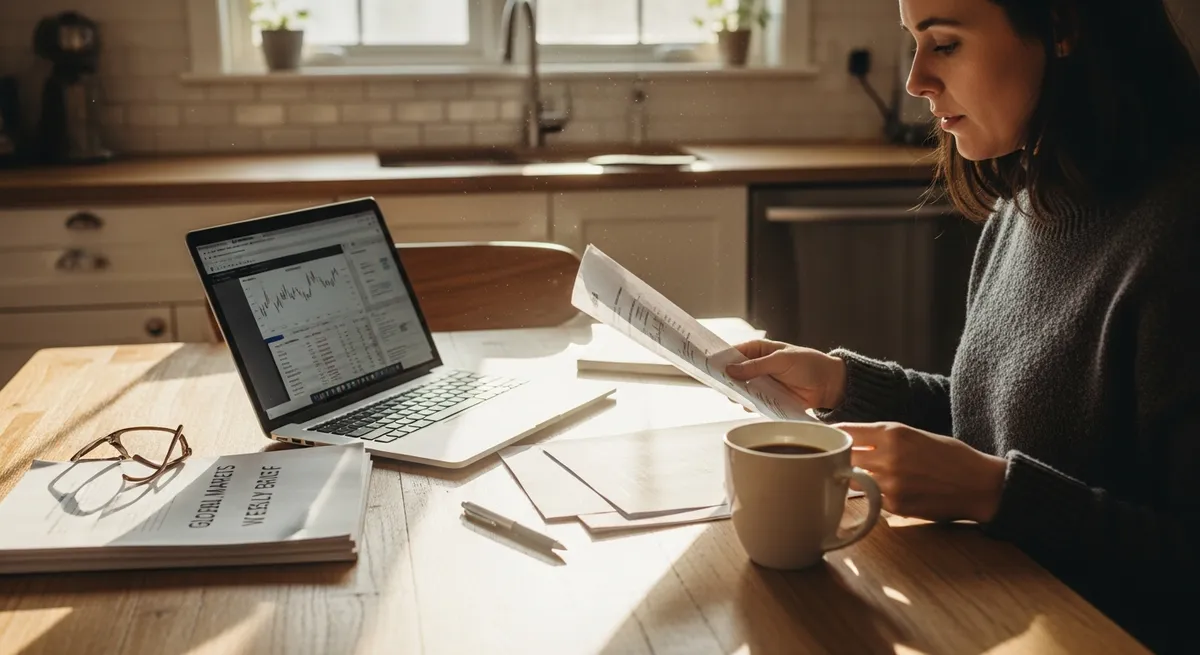
I am currently positioned at my battered oak dining table opposite my neighbor Gary, a gentleman who handles his finances with the jittery, frantic energy of a squirrel witnessing a lightning strike. (Gary once attempted to mitigate his personal inflation risk by purchasing forty cases of canned peaches.) Gary is white-knuckling a generic tablet and gesturing at a jagged sequence of red lines while quivering with the raw, unrefined terror usually saved for a botched root canal or an unexpected encounter with the tax authorities. It is a spectacle. Truly. I am watching a grown man lose his composure over a single decimal point. (I would offer him a drink, but he is currently using both hands to hold his head together.)
In the previous month, the US Bureau of Labor Statistics observed that the Consumer Price Index climbed by 0.2 percent on a seasonally adjusted basis, a figure that appears like a minor clerical oversight until you observe that your morning caffeine fix now requires a small loan I. That is the data point driving Gary to the absolute brink of sanity. One fifth of one percent. I told Gary to breathe. He did not breathe. He simply pointed at the current price of eggs again. (I recently attempted to concoct my own espresso at home, but the resulting sludge tastes primarily of warm soil and the bitter realization of my own ineptitude.) It is a grim situation in the house of Gary. He has started tracking the price of milk with a spreadsheet that looks like a NASA launch sequence. (Gary is very committed to his own misery.)
My friend Sarah, who manages a small local bakery, tells me that the price of flour has become her primary antagonist. (She speaks about wheat the way a captain speaks about a white whale.) She cannot raise her prices every week without losing her regulars, so she just absorbs the cost. This is the reality that the numbers do not capture. It is a slow, grinding pressure on the people who actually make things. I once made an expensive mistake in the late 1990s by investing heavily in a company that manufactured pagers. (Pagers. Can you imagine?) I ignored the obvious trend because I was obsessed with the immediate data. I learned that day that the data is a mirror, not a crystal ball. It shows you what already happened. It rarely tells you where you are going next.
The Great Inflation Monster Is Just A Slow Leak 🟢
The majority of individuals I encounter at social gatherings imagine that inflation is a carnivorous beast lurking beneath their bedsheets, but the reality is that it is merely a microscopic, persistent leak in a massive tractor tire. (I usually consume enough Chardonnay to stop caring about their household monsters.) We are presently witnessing the Federal Reserve attempt to deal with a high-wire composed of interest rates without plummeting face-first into a cavernous economic abyss. It is a frantic, sweaty, and entirely uncoordinated display that leaves every member of the audience feeling profoundly seasick. Gary is included in this group. Especially Gary. (He has started wearing a reflective vest indoors for reasons he refuses to explain.)
According to the Federal Reserve Bank of St. Louis, the genuine concern is not the 0.2 percent increase, but the long-term trajectory of consumer expectations IV. (I do not possess consumer expectations; I possess consumer demands, which are mostly for higher quality wine.) If individuals believe prices will escalate, they purchase more immediately. This causes prices to escalate. It is a self-fulfilling prophecy of the most irritating variety. I explained this to Gary. He responded by inquiring if I possessed any spare batteries for his flashlight. He is a lost cause. He is currently convinced that the dollar will be replaced by a system of bartering based on shiny rocks. (I told him I would not trade my wine for his rocks, no matter how shiny they are.)
My brother-in-law, a contractor named Dave, recently told me that the cost of a single two-by-four board fluctuates more than his blood pressure. (Dave is a very angry man, so that is saying something.) He spends half his morning at the lumber yard just staring at the price tags and sighing. This is the psychological toll of a fluctuating economy. It is not just the money; it is the constant mental gymnastics required to decide if you are being overcharged. I checked the historical records from the 1970s recently. (It was a dark era for both fashion and finance.) One might assume that those self-appointed wizards on the internet possess some secret knowledge that remains hidden from the rest of us. In fact, the more I scrutinize the historical records, the more I suspect that even the most exalted institutions are frequently just offering sophisticated guesses based on ancient history II. According to a 2026 report by the International Monetary Fund, global inflation is expected to fall to 5.8 percent in the coming year, but that does not help Dave buy his lumber today.
Why Your Personal Economy Is Not A Headline 🤔
The problem with looking at the Consumer Price Index is that it assumes you are an average person. (I have never met an average person, and I certainly hope I am not one.) Your personal inflation rate depends entirely on whether you are buying a house, a car, or forty cases of peaches. If you already own your home and your car, the 0.2 percent jump is mostly academic. It is noise. It is the static on the radio between songs you actually like. I once spent three years worrying about a market dip that never actually arrived. (I lost more sleep than money, which is a different kind of poverty.) We tend to overestimate the impact of the news and underestimate the impact of our own behavior.
Actually, the more I examine the historical data, the more I realize that even the most prestigious institutions are frequently just offering educated guesses based on outdated information. They are looking through the rearview mirror while trying to drive a bus. I saw a report from the Federal Reserve Board that suggested the path to a soft landing is still narrow. (A "soft landing" is economist-speak for "we hope we do not crash the plane.") It is a comforting thought, but it does not stop Gary from hiding under his desk. I told him that the economy is like a giant ship. It takes a long time to turn. You cannot expect it to zip around like a jet ski just because one report came out on a Tuesday morning.
My dentist, a man who frankly scares me, recently tried to explain his new billing structure to me. (I was in the chair with three tubes in my mouth, so I could not exactly argue.) He blamed the cost of gloves and masks. He was not lying. The supply chain is still a tangled mess of holiday lights that nobody wants to fix. This is why the Fed is so cautious. If they move too fast, they break the labor market. If they move too slowly, the price of eggs goes to the moon. It is a terrible job. I would not do it for any amount of payment. (Okay, maybe for a very large amount of payment.)
How To Not Lose Your Mind While Gary Panics ⏱️
If you can manage to inspect the data without the heavy weight of emotional baggage, you will observe that the sky has been "collapsing" for over a century, yet here we are and the coffee remains hot, even if it costs a literal fortune. As we proceed, try to envision economic bulletins as a sluggish, muddy stream rather than a sequence of terrifying tidal waves. The shifts that genuinely alter your life take seasons or decades to manifest, not a mere forty-five minutes on a random afternoon. Not even close. (I tried telling Gary this, but he was too busy cataloging his AA batteries.)
Myth vs. Fact
Myth: High inflation means the economy is about to collapse entirely.
Fact: The US economy has survived much higher inflation rates, such as the 14.8 percent peak in 1980, without ending civilization.
If you maintain your composure, keep your investment costs minimal, and refuse to lose your mind when Gary begins drafting blueprints for a concrete survival shelter, you will likely remain quite comfortable. (Bunkers are damp and Gary is a terrible conversationalist.) The noise is just noise. Turn down the volume. Eat a peach. (Gary has plenty to spare, and I suspect he is tired of looking at them.) The world is not ending. It is just getting slightly more expensive to live in it. (Which is annoying, but it beats the alternative.)
Common Questions for the Economically Anxious ❓
Why does the stock market trip over its own shoelaces even when the headlines appear perfectly reasonable?
The market prioritizes what it anticipated over what actually occurred, meaning if investors were promised a gourmet steak and were served a lukewarm hamburger, they will liquidate their holdings out of sheer, petty spite III. It is a complex psychological guessing game where every participant is desperately trying to deduce what every other participant thinks they are thinking. (It is essentially the eleventh grade all over again, but with significantly more expensive suits and slightly more manageable social anxiety.) Do not attempt to make it make sense. It will only give you a headache.
Should I retreat to the safety of a savings account when the market begins to tremble?
Fleeing to cash during a market downturn usually implies that you are making your temporary losses permanent while simultaneously missing the inevitable moment when things improve. High yield savings vehicles are excellent for your emergency reserves, but they almost never outpace the rate at which life becomes more expensive over a ten-year horizon. (You need your money to grow, not just sit there and look pretty.) You must discover a method to remain secure without allowing your capital to wither away from sheer boredom.
Which specific figure in those weekly market summaries actually deserves your attention?
The interest rate target established by the Federal Reserve is the primary titan because it determines the price of every single dollar borrowed in this nation. Skimming a brief summary once every seven days is more than sufficient for a normal human being who does not wish to be devoured by the static. (I personally check my accounts only when I am feeling particularly brave or particularly wealthy.) Inspecting your portfolio more often than that typically results in premature gray hair and the overwhelming urge to do something catastrophic with your retirement savings. The objective is to remain cognizant of the world without being haunted by every fluctuating decimal point on a glass screen.
Does a rise in inflation guarantee that we are headed toward a certain economic contraction?
Rising prices and economic growth are distant cousins rather than identical twins, and the economy can frequently endure elevated costs for years without shrinking into a dried-up prune. The Fed tinkers with interest rates for the specific purpose of cooling the heat without accidentally putting half of the population out of work. It is a clunky and arduous process that does not always culminate in a total disaster. (Sometimes the plane just bumps along the runway for a while.)
Is my savings account losing value right now?
Technically, the answer is yes. If your interest rate is lower than the inflation rate, your purchasing power is shrinking over time. (It is like a wool sweater that gets slightly smaller every time you wash it.) This is why people buy stocks or real estate. Or peaches, if you are Gary. You have to keep your money moving faster than the prices are rising.
How can I protect my purchasing power?
Diversification is the only tool that actually works. Do not put all your eggs in one basket, especially if eggs are expensive. Spread your investments across different sectors and asset classes. This way, when one area is struggling, another might be thriving. (It is like having a backup plan for your backup plan.)
References
Disclaimer: This article is for informational purposes only and does not constitute professional financial advice. Economics is a messy, complicated field and I am merely a person with a scarred table and a very nervous neighbor. Please consult a qualified financial advisor before you make any major life decisions based on what you read here.