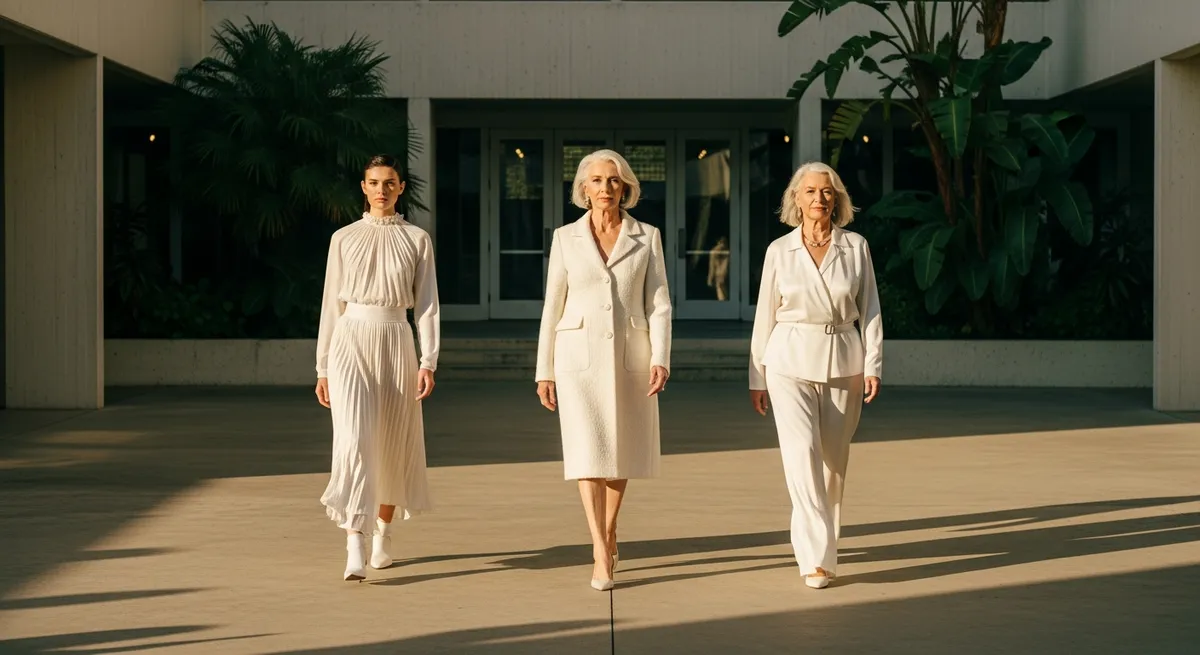
You might find yourself in a Madison Avenue boutique watching a woman try on a wool coat that costs more than a used sedan, while the model in the ad next to you looks like she hasn't even finished her freshman year of college. She looked to be about sixty-two, give or take. You could see that specific, quiet brand of confidence that only shows up after you've spent decades running a boardroom, or a household, or maybe both at once.
But her face just dropped the second she caught a glimpse of the ad campaign plastered on the wall next to her. The girl in the photo? She was barely twenty years old. She had the hollowed-out eyes of someone who survived on nicotine and green juice, wearing the same coat with a blank stare that didn't say "luxury" - it said "nap time." The disconnect was loud. It was a moment where the person with the money realized the brand wasn't actually talking to her. Age-diverse runways are finally starting to close that widening gap.
This shift is less about a sudden wave of kindness from designers and more about the cold reality of who actually has the money to pay at the register. Fashion houses spent years selling a dream of youth to a demographic that had long since moved past it. But the change currently underway is less about creative directors being kind and more about the financial reality of who pays for the items. The industry is waking up to a basic fact: the woman who can afford a five-thousand-dollar bag wants to see a face she actually recognizes in the mirror. You are looking for a face that suggests a history, not just a blank canvas. You deserve to see your own strength mirrored in the wardrobe choices you make. And frankly, a teenager who hasn't even had a mortgage yet can't sell that story to you.
The Math of the Invisible Woman
Look at the actual data and you'll see that freezing older women out of the frame never made a lick of sense. It was a strange, self-sabotaging habit the industry just couldn't seem to kick. Even with all the talk about inclusivity, the average age of a runway model still sits around 21.1 This disconnect feels increasingly out of date. (And let's be real, it basically was.) Most of those women were likely famous names from the nineties brought back for a "vintage" moment, not a real shift in policy.
But the money tells a different story. Women over fifty in the United States control about $15 trillion in wealth. That's more than the entire GDP of most countries. By the time the 2026 market projections are fully realized, this demographic will be the primary driver of high-end consumption. AARP, the massive interest group for people over fifty based in Washington D.C., has pointed out for years that this demographic is the healthiest and wealthiest in history.2 They aren't sitting on porches in rocking chairs. They're traveling, working, and buying clothes that cost as much as a small boat. When you ignore that much buying power, you aren't being "edgy." You're just being bad at business. The industry is finally starting to realize that youth is a dream, but age is where the cash lives.
I have watched this exact scene unfold in showrooms from Milan all the way to New York. Designers used to spend all their time chasing a fantasy version of some twenty-two-year-old socialite. But here's the kicker: it's the socialite's mother who's actually dropping the cash on those silk trousers. When you are 45 and need a suit that signals power, seeing it on a 19-year-old with a blank stare doesn't tell you anything about how it works in your world. It doesn't tell you how the fabric will move on a body that has lived a life. In fact, it tells you nothing at all. Brands are speaking directly to the woman who has the career, the house, and the desire to treat herself to something high-end.
The New Icon of the Runway
Then came a notable guest on the catwalk. If you haven't stumbled across her yet, you really need to go look her up. She is seventy years old. She's a retired doctor out of Shanghai who spent her whole life treating patients, not practicing a catwalk strut. She also happened to own a closet bursting with high-end labels and a popular social media platform feed that grabbed the attention of casting directors. Even Miu Miu, which is usually linked to a younger and quirkier vibe, featured Qin Huilan on their Fall-Winter 2024 runway.5 Huilan is a 70-year-old doctor from Shanghai, not a pro model.5 Her runway walk went viral, but it also pointed to a growing consensus in the industry.
The label is part of a massive luxury powerhouse based out of Milan. It involved brands like Chanel and Miu Miu putting these women right at the center of the story. For a long time, they were seen as the 'little sister' brand, leaning into a younger, slightly weirder vibe. But casting this seventy-year-old doctor was a stroke of absolute genius. It told the world that style doesn't have an expiration date. (About time, right?) These ads are telling you that you are still very much invited to the party. If a retired professional can be the face of one of the coolest brands on the planet, then your closet is still your playground. You don't have to retreat into beige polyester just because you've seen a few decades.
This shift isn't just happening with the usual high-fashion names. It's not just the high-fashion avant-garde doing this anymore. You see it in the catalogs and the social media feeds of brands that used to be obsessed with the "next big thing." Suddenly, the 'it' factor involves a few wrinkles and a massive amount of attitude. It's a huge relief compared to the airbrushed, plastic perfection we've been choking on for decades. Because, let's face it: nobody actually looks like a twenty-year-old model in real life. Heck, not even the twenty-year-old model looks like that once the studio lights go down. You deserve something real.
Why Your Wallet is the Most Powerful Tool
Why is this happening now? Is it because fashion executives suddenly developed a conscience? Probably not, honestly. It's because the market changed. The "grey dollar" - or the "silver economy," as some firms call it - is growing faster than any other segment. McKinsey & Company, a global management consulting firm that tracks luxury spending, noted that the growth in luxury consumption is being driven by older, established clients who stayed loyal during economic dips.3 While Gen Z is busy "thrifting," the over-fifty crowd is buying the brand-new collections. Money talks, as they say. And right now, that money is speaking with a very mature, very sophisticated accent.
You have way more influence than you probably realize. Every single time you swipe your card for a brand that actually shows older models, you are casting a vote. You're sending a signal to the entire industry that you deserve to be seen. And when you walk past a brand that only hires teenagers, you're sending a message their accountants simply can't ignore. I have seen brands go belly-up just because they refused to move with the times. They got stuck in a 1995 mindset, and their customers eventually just outgrew them. Look, don't give them your hard-earned money if they won't even bother to look you in the eye.
It's also about the "mother-daughter" dynamic. A lot of luxury houses are finally figuring out that if they can win over a woman in her fifties, they usually catch her daughter's eye too. It is a multi-generational play, plain and simple. If you look incredible in a specific designer's coat, your daughter is definitely going to take notes. She's going to want that brand too. By putting you in the frame, they aren't just snagging one customer; they're actually building a legacy. It is smart, it is calculated, and it is finally working out in your favor. You are the bridge to the next generation of buyers.
The End of the Token Gesture
To see how far the industry has moved, you only have to look back a few years. During the Fall 2018 season, only 13 models over the age of 50 were cast across the four major fashion capitals.6 That is 13 people in a global industry over an entire month. It was a rare event that usually meant a legacy supermodel was making a quick comeback. The signal was clear: once you hit 30, your time on the catwalk was done. But that's changing. As we look toward the 2026 fashion seasons, we're starting to see runways where twenty percent or more of the cast is over forty. That is a genuine shift in the environment.
The Council of Fashion Designers of America, an organization based in New York that supports American designers, has been pushing for more diversity of all kinds, including age.4 When Stephanie Cavalli, who is 50, opened the Chanel show, it sent a clear signal that the most prestigious spots are no longer just for the newest faces.4 They've realized that the "standard" model size and age was actually a barrier to sales. If you can't even picture yourself in the clothes, why would you ever buy them? It's really that simple. By putting older women in the shows, they're removing that barrier. They're making the dream accessible again. And honestly, it makes the shows much more interesting to watch.
Fast forward to the Spring-Summer 2024 show at Balmain. In that single show, 35 percent of the models were over 35.3 This means 20 out of 57 models were in an age bracket once considered retired.3 One designer managed nearly double the age diversity in one afternoon than the whole industry did over four weeks just six years ago. This change is massive in scale, and it's happening because designers are finally listening to the people who buy the clothes. Olivier Rousteing, who leads the creative team at Balmain, has been very open about this shift. He has said that fashion's obsession with youth is a dangerous limit that ignores the beauty of women who have lived lives.9 His shows are about a broader definition of power.
The Psychology of Looking at a Peer
A lot of women describe feeling like they become invisible once they hit 40. You still have the same drive and love for design, but the world starts to look right past you. This is very true in fashion, where the focus has always been on the next new thing. Seeing older models on the catwalk is a real cure for that feeling. It's a reminder that you are still part of the cultural conversation. Matthieu Blazy, the creative lead at Chanel, has argued that older models bring a new dimension to the clothes.8 When an older model wears a suit, she shows you how that fabric actually moves through a real life.
Many shoppers feel that after a certain age, they are only expected to buy functional pieces that hide the body. Seeing a 70-year-old on a Miu Miu runway shows you that you are still allowed to play. It tells you that fashion is a tool for self-expression, not just a uniform for kids. It turns the future into something to be celebrated rather than feared. The men who can afford a three-thousand-dollar linen suit are usually the ones with silver hair and some experience under their belt. For men, the silver fox look has always had more cultural room than the female equivalent, but youth has still dominated the runway.
The World Health Organization, headquartered in Geneva, has done a ton of research on 'ageism' and how it messes with our mental health. They've found that being constantly excluded from media and advertising makes older people feel less valued by society.5 Fashion has been a major offender here for decades. By opening up the runways, the industry is doing more than just selling coats. It's helping to rewrite the cultural script about what it means to get older. It is no longer just about the body; it's about the person wearing the clothes. When you know the woman on the runway is a surgeon, it changes how you view the outfit. These clothes become part of a story you actually want to join.
Own Your Look: Your Style, Your Rules
Do Older Faces Actually Sell More Clothes? Fashion is a business, and businesses respond to what actually works. Janelle Okwodu, a critic at Vogue, has pointed out that most models' career peaks only last a few seasons.10 They are building a brand identity that feels like a long-term relationship rather than a fleeting trend. You might wonder if this is all just a temporary marketing stunt. It's a myth that has limited growth and alienated the best customers for years. By embracing age-diverse runways, brands are finally admitting that style has no expiration date. They are acknowledging that the woman you will become is just as stylish as the one you were.
If you want to invest in pieces that feel authentic, look to brands that put women with life experience at the center. Looking ahead, the Fall-Winter 2026 season is set to prove that age diversity is a prestige signal rather than just a moral one. What hasn't changed are the fundamentals underneath. You still want quality and style, and you still want to be seen. The real difference now is that the industry is finally looking back. Your next step is to support the brands that reflect the world you want to live in. Your wallet is the loudest voice in the room, and believe me, the fashion world is finally all ears.
Key Points to Remember
Common Questions About the Shift
Is the Age Limit for Models Actually Changing?
Yes, it is changing significantly. While the average age is still young, major houses like Chanel are now casting models in their 50s and 70s for top spots. The industry is moving away from the idea that a career ends at 30, recognizing that older faces resonate with luxury buyers who have the money to buy high-end collections.1,3,4
Why Are Brands Suddenly Using 70-Year-Old Models?
Why Are Brands Suddenly Using 70-Year-Old Models? It's mostly about authenticity and spending power. While some spots are for viral impact, the data shows a real systemic shift. In 2018, there were only 13 models over 50 across all fashion weeks, but by 2024, a single Balmain show featured 20 models over 35.3,6 This shows that age diversity is becoming a standard part of casting.
Does this mean 'youth culture' is officially dead in the fashion world?
No, youth is always going to be part of fashion's DNA. But it is no longer the only part of the story. The industry is shifting toward a 'multi-generational' model where different ages share the same stage. This lets brands appeal to both the young trend-setter and her mother - or even her grandmother - at the exact same time.
What can I actually do to support more age diversity in fashion?
You have to vote with your wallet. When you spot a brand using older models and representing your demographic, that is exactly where you should spend your money. On the flip side, if a brand keeps ignoring women over forty, don't reward them with your business. Social media engagement also helps - share and like the images of older models to show these brands that there is a massive demand for them.
How does age diversity in luxury fashion affect younger consumers?
It actually helps them by removing the fear of aging and showing that style is a lifelong journey. When younger buyers see seventy-year-olds on the runway, it proves the brand's items are a long-term investment, not just a fast-fashion trend. It builds brand loyalty that can last for several decades rather than just a few seasons.