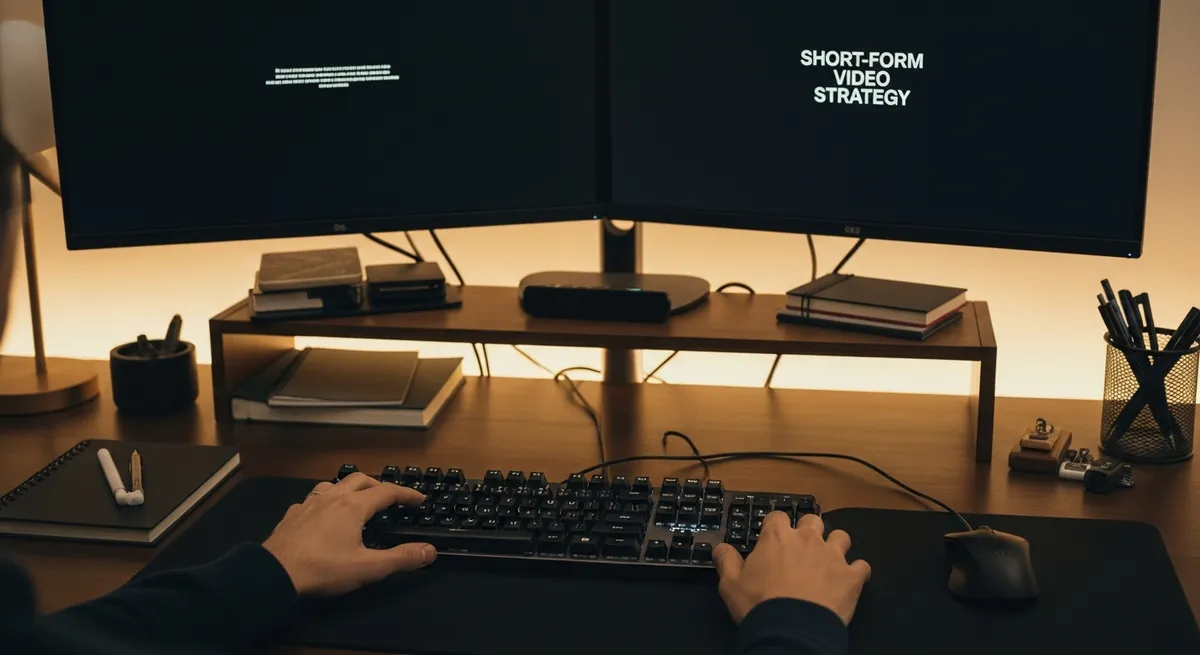
I was hunkered down in my study last Tuesday, clutching a mug of espresso that had long since lost its heat while I glared at a ring light I purchased during a midnight wave of professional insecurity. (I paid two hundred dollars for this piece of plastic and it makes me look like a prisoner in a suspiciously bright bunker.) I had just spent four grueling hours attempting to slice a thirty-second clip for the major vertical video apps, and the outcome was a total disaster. It was over-produced. It was stiff. It was, quite frankly, humiliating. (My nephew Leo - who is seventeen and speaks primarily in memes - informed me that I looked like a disgraced politician attempting to explain a massive tax hike to a group of disinterested teenagers.)
We frequently assume that a larger budget results in a higher degree of success. It is a falsehood we embrace to feel as though we possess authority over the chaos. (Control is an illusion I lost somewhere around the time I tried to assemble a Swedish bookshelf in the dark.) The reality is that the most effective plan is usually the most disorganized one. Pew Research Center notes that about seventy percent of adults in the United States report using social media, and an enormous amount of that attention is currently consumed by vertical, short-form media.I (I am a card-carrying member of that depressing group, usually around three in the morning when I should be fast asleep.) If you are not producing media that looks like it belongs on these apps, you are basically screaming into a cavern that is not even paying attention. You are wasting your valuable time. I know this because I have squandered months of my own life on high-resolution failures.
🔴 The Professionalism Paradox
If you appear too polished, you look like a stranger who does not belong. You resemble the person who carries a leather portfolio to a gathering on the sand. (I committed that social sin in 2008; I have yet to receive a return invitation to the coast.) Users want to see your messy kitchen. They want to see the dog barking in the background. They want to see that you are a human being who occasionally spills coffee on their shirt. We dedicate three whole weeks to the post-production phase. We hire expensive contractors. We color-grade the footage until everyone looks like they have a mild case of jaundice. By the time the file is exported, the cultural moment has passed, the app has tweaked its math, and our target market is busy watching a teenager sample cold pickles. (I actually viewed the pickle segment twice; it possessed a strange magnetic quality.)
Consider my acquaintance, Sarah. Sarah is a high-powered attorney who decided she needed a digital presence. She spent five thousand dollars on a professional camera crew to film her talking about estate law. They brought in reflectors. They brought in a makeup artist who used enough powder to coat a donut. The resulting video was beautiful. It was majestic. It looked like a trailer for a movie that would win an Oscar for being incredibly boring. It received twelve views. Eleven of those were likely automated bots from a server farm in a cold climate. (The twelfth was her mother, who still does not understand how to turn the volume up.) Meanwhile, a rival lawyer recorded a video while sitting in his car during a rainstorm. He used his phone. He had a smudge on the lens. He got forty thousand views because he looked like a person instead of a brand. This is the professionalism paradox in its most brutal form.
⏱️ The Psychology of the Three-Second Window
How do we rectify this situation? We must understand that the modern attention span is shorter than a goldfish on a caffeine bender. A 2023 study from the National Institutes of Health suggests that the constant barrage of digital media is fundamentally altering how we process information.II (I am certain my own attention span has shrunk to the size of a raisin.) This requires your footage to appear as though a genuine human recorded it on a standard mobile device in an actual living space. It needs to possess the general atmosphere - a concept I loathe defining because I have crossed the forty-year threshold - of a casual chat between acquaintances. This is the magic of the medium. It is an equalizer. It does not care about your degree or your corner office. It cares about whether you are interesting in the first two seconds.
You should focus on three specific elements: the hook, the value, and the payoff. The hook must occur before the person watching can swipe their thumb upward. If you do not grab them immediately, you are invisible. (I have been invisible at many parties, so I am intimately familiar with the feeling.) The value is the reason they stay. Are you teaching them something? Are you making them laugh? Are you showing them a broken stapler that actually represents the fragility of the human condition? (I might be overthinking the stapler, but you get the point.) The payoff is the reward. Give them the answer. Show them the result. Do not make them wait for it like they are standing in line at the DMV.
🟢 The Grammar of the Absurd
You must grasp the inherent logic of the platform before you can hope to communicate effectively. It is not about the resolution of your camera. It is about the speed of your delivery. It is about being comfortable with being imperfect. My neighbor Bob - who sells artisanal birdhouses and has the technical skills of a baked potato - has more followers than I do. Why? Because he just holds his phone up and talks. He does not use a ring light. He does not use a script. (He does, however, have a very charismatic golden retriever named Barnaby, who is doing most of the heavy lifting in terms of brand appeal.)
Bob is a genius of the accidental. He once filmed a video while he had a piece of spinach stuck in his teeth. I told him he should delete it. He laughed at me. That video became his most successful post of the month. People commented on the spinach. They felt a connection to his fallibility. (I spend half my life checking for spinach in my teeth, and Bob just leans into it.) The transformation occurs when you reduce the obstacles to participation. Because the interaction felt genuine, people trusted him. They bought the birdhouses. They did not want a slick commercial for birdhouses; they wanted to buy a wooden box from a guy who eats leafy greens and loves his dog. People do not want to be the target of a sales pitch; they want to be included in a shared moment.
❓ How to Fail Upward in the Digital Era
When you speak directly to the lens, without the aid of a teleprompter, you are constructing a connection. You are declaring that you are a person of substance with a useful perspective. This is a terrifying prospect for those of us who grew up in the era of curated resumes and polished headshots. Grab your mobile device and locate a window that offers sufficient natural light. (Natural light is the only thing that is actually free in this world, which is a rare miracle in this economy.) Do not overthink the background. If there is a pile of laundry behind you, just leave it there. It proves you are not a robot. (Unless the laundry is sentient, which is a different problem for a different article.)
Did You Know?
A study from the University of Texas at Austin found that consumers often perceive highly polished advertisements as less trustworthy than user-generated content.IV People crave the raw over the refined. (I crave a nap and a sandwich, but that is a different story entirely.) This distrust of polish is a biological defense mechanism against being sold something we do not need.
I learned this lesson the hard way. I once spent three days trying to film a perfect video about financial planning. I wore a tie. I used a tripod. I actually attempted to digitally erase the lines on my brow during the editing process. (This was a complete deception; my forehead is essentially a relief map of every poor choice I have made since the nineties.) The video was a total failure. Forty-eight hours later, I uploaded a jittery clip of myself lamenting a broken stapler, and it reached thousands. The audience connected with the stapler footage because they also possess faulty office supplies. They wish to see that you are in the trenches with them. They want to know that your life is also a series of minor inconveniences and small victories. That is the point. The digital world does not want your perfection. It wants your presence.
Lastly, maintain a regular presence without becoming a nuisance. (My feline companion, Steve, is currently staring at me with a look of profound disappointment because I have not fed him in twenty minutes.) Endeavor to post three times every seven days. If you approach this task like a tedious obligation, it will manifest as such. If you treat it like a conversation at a bistro after two glasses of Merlot, it will be the most successful outreach of your career. Do not allow the apprehension of appearing foolish to hinder your progress. I have appeared ridiculous for two decades, and I have earned a substantial living through that lack of dignity. (And if you happen upon my rant about printer toner, please do not judge my character too severely; I was having a very difficult morning.)
Key Takeaways
Frequently Asked Questions
How long should my short-form videos actually be?
While most applications permit up to ten minutes of footage, the ideal duration for engagement typically falls between fifteen and sixty seconds. You must convey your message with speed before the observer grows bored and navigates toward a clip of a cat playing a musical instrument. If you cannot articulate your point within sixty seconds, you should likely divide the content into two distinct segments. (Brevity is the soul of wit, and also the only way to survive an infinite scroll.)
Do I really need to use trending music?
Popular audio tracks can assist your footage in reaching a broader demographic because the platform software prioritizes segments using trendy sounds. Nevertheless, you should only adopt trends that actually align with your core message. Forcing a trend into an inappropriate context is like an elderly relative attempting to use urban slang; it is distressing for all parties involved. (I once tried to use a dance trend to explain interest rates, and I still wake up in a cold sweat thinking about it.)
What if I am too shy to be on camera?
You do not strictly need to display your face to achieve a successful outcome. You can film your hands working on a project, use a voiceover, or show your surroundings while you talk. However, showing your face builds trust much faster. (People like to see the eyes of the person who is giving them advice, even if those eyes are slightly bloodshot from lack of sleep.)
What kind of equipment is absolutely necessary?
A window offering indirect solar light is frequently superior to a thousand dollars of professional studio equipment. The objective is to appear like a human being in a living space, rather than a journalist on a professional set. If the sun has set, a basic circular light can assist, but do not allow a deficit of gear to stop you from capturing footage today. The U.S. Bureau of Labor Statistics suggests that the media communication world is expanding at a rate that requires us to be our own camera crew and editor.III (We live in the future, even if the future involves a lot of broken staplers.)
How often should I check my analytics?
Reviewing your statistics once every seven days is entirely sufficient to determine what is effective and what is failing. If you monitor them every sixty minutes, you will lose your sanity and begin producing media for the software instead of for humans. Prioritize the comments and the interactions over the raw viewing numbers, as those metrics indicate a genuine relationship. (A thousand views from people who do not care is worth less than ten views from people who actually want to talk to you.)
References
Disclaimer: This article is for informational purposes only and does not constitute professional marketing or financial advice. The social media landscape shifts with alarming speed, and you should consult with a professional advisor before making substantial investments based on these observations.