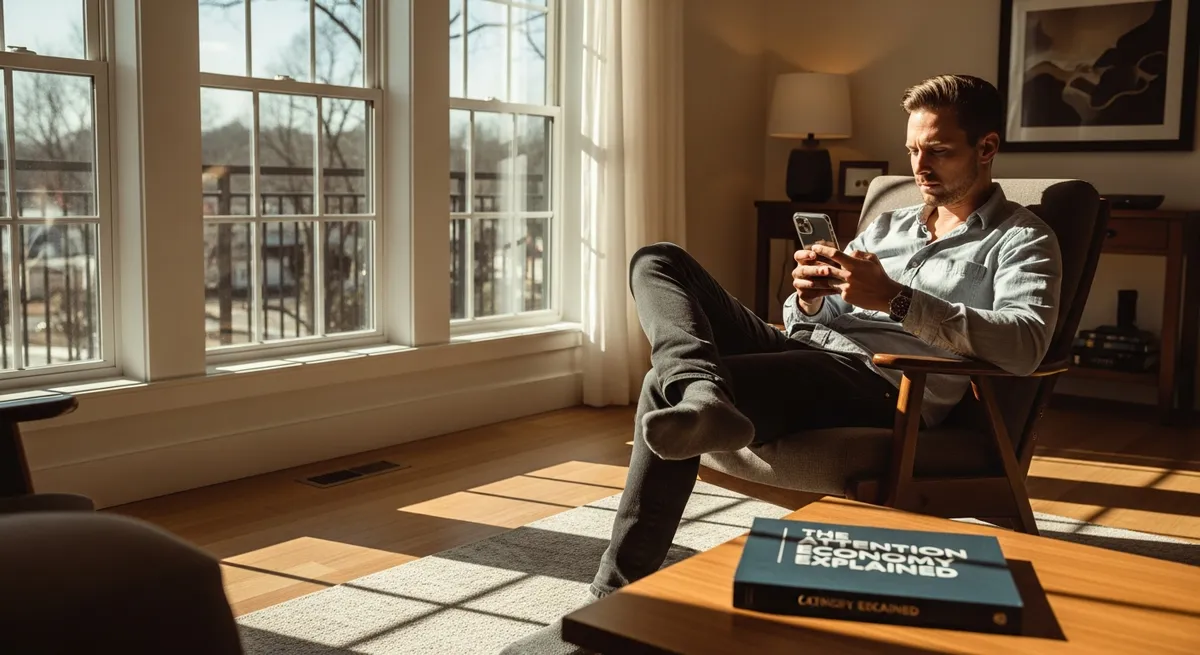
I was sitting in my living room at exactly fourteen minutes past two in the morning, hopelessly entranced by a video of a man in Ohio scrubbing a vintage Persian rug on a concrete driveway. I do not live in the Midwest, nor do I own a rug that requires such aggressive sudsing. (My spouse, Sarah, calls this my blue light stupor, and her accuracy is as irritating as her smugness.) My original goal was to investigate the meteorological forecast for the coming day, yet I remained stationary, observing pressurized water transform soot-colored wool into immaculate ivory while my mobile power supply plummeted to a terrifying three percent. My mobile device was on the verge of expiration. I was also expiring, from a spiritual perspective. It is no coincidence that I remained awake; it is a calculated commercial strategy crafted by the most talented software architects on this planet to guarantee that my retinas remain affixed to a glowing slab of glass until my intellect dissolves into absolute, irredeemable sludge. (I am a mature man who pays a mortgage, yet I am being systematically humiliated by a mathematical sequence.) It is a pathetic, brightly illuminated disaster.
The magnitude of this predicament is not merely a figment of my imagination or a result of my late-night habits. According to the Pew Research Center, approximately thirty-one percent of adults in the United States acknowledge being connected to the internet almost incessantly.I I encountered that statistic and felt a sudden chill. (It is possible that it was merely the ventilation system, but the emotional impact was quite real.) This means that nearly one out of every three individuals you encounter on a public walkway is essentially connected to a digital lifeline. Not long ago, I attended a small dinner gathering where I observed that my relative Linda, who is a remarkably skilled dental surgeon, was covertly peering into her lap at regular intervals. She appeared to be anticipating a divine transmission from a celestial authority. She was most certainly not doing that. She was actually investigating a promotion for orthopedic neck supports. This incessant condition of fragmented attention serves as the dominant legal tender of our age, and the prevailing valuation is proving ruinous for our shared psychological stability. We are surrendering our finite existence. Quite literally.
The Casino In Your Pocket 🔴
One must not be deceived into believing that this is simply a failure of individual discipline. That would be akin to criticizing a goldfish for wandering into a fishing net. These digital environments are constructed using tenets of behavioral science that were initially refined within the windowless subterranean levels of Nevada gambling establishments. (I once spent a weekend in Las Vegas and surrendered four hundred dollars in a mere twenty minutes, so I possess a deep understanding of how that particular net functions.) My acquaintance Larry, who spends his Saturdays refurbishing antique mechanical components, confessed to me that he can no longer remain seated for a thirty-minute documentary without grasping for his device. He describes a sensation of restlessness. That restlessness is the result of dopamine. It is a neurological reward that occurs every time you witness a crimson alert symbol or a new sign of approval on a photograph of your unremarkable homemade bread. It is intentional. It is clinical. And it is performing exactly as intended upon every one of us.
The consequences of this incessant stimulation are quantifiable and, to be perfectly honest, quite disheartening. A 2024 analysis published in the Journal of Medicine indicated that intensive use of social media platforms is correlated with a marked rise in sleep fragmentation and psychological unease.V I do not require a scientific publication to confirm this reality. I experience it every time I emerge from sleep at six in the morning feeling as though I have been trampled by a fleet of delivery vehicles carrying nothing but short-form videos and brief status updates. (I am not engaging in hyperbole; I am merely being an astute observer of my own decline.) We reside in a civilization where the state of being bored has been effectively criminalized. If a thirty-second void appears in our daily routine, such as standing in line for a lift or waiting for a physician, we immediately saturate that void with digital refuse. We have discarded the ability to simply occupy a physical space. It is disturbing. It is also remarkably fatiguing.
Consider my neighbor, Bob. Bob is a retired civil engineer who once spent his days calculating the structural integrity of bridges. (He is a man who understands precision, or at least he used to.) Last month, Bob spent three hours researching high-end lawn care equipment because an algorithm suggested he might enjoy a video of a robotic mower. Bob does not even have a lawn; he lives in a high-rise apartment with a small balcony. Yet, the system convinced him that he was an enthusiast of turf maintenance for three solid hours. This is not a lack of intelligence. It is the result of a system that has spent billions of dollars learning how to exploit Bob's specific curiosity. The uncertainty of what the next scroll will bring is what keeps us engaged. Will it be a photograph of your high school adversary looking noticeably more aged and exhausted than yourself? You do not know, and that specific ambiguity is precisely what compels you to continue engaging with the interface. (I once refreshed a journalistic application forty-two times within a single hour while awaiting a bus that I ultimately failed to board because I was too preoccupied with the refreshing process.)
The Data Broker And The Ghost Of Productivity 🤔
You are not the primary consumer in this particular arrangement; rather, you are the resource being gathered in a vast, clandestine harvest of information. Contemplate the astronomical level of labor that is invested in ensuring you remain on a specific digital page for an additional five seconds. Software designers employ split-testing methodologies to ascertain which particular hue of cobalt increases the probability of your interaction with a hyperlink. They scrutinize the duration for which your cursor remains stationary over a visual before you continue to click. They possess more thorough knowledge regarding your behavioral patterns than your own biological mother. (My mother remains convinced that I have an aversion to coriander, despite the fact that I have consumed it in her presence for three decades.)
The Bureau of Labor Statistics has observed a consistent growth in the duration of time that adults allocate to recreational pursuits involving electronic displays, which frequently occurs at the cost of rest or physical movement.II This is not merely a passing fad; it is a methodical redistribution of human vitality into a digital abyss. I once conversed with a software developer who wore a high-necked sweater in the middle of July, which should have served as my preliminary warning. He explained that features such as automated playback and endless scrolling are engineered to eliminate the organic termination points that previously existed in traditional media. In the preceding era, one would complete a newspaper or a broadcast would conclude, and one would proceed to another activity. At present, the conclusion of one digital recording is merely the prologue to the next. It is a mechanical belt of interruption that never ceases its motion. (I am convinced it would continue spinning even if the sun went out.)
I once remarked to my dental professional that I was considering the purchase of new footwear crafted from leather. By the time I returned to my vehicle, my digital feed was comprised of ninety percent advertisements for boots. It appeared less like a random occurrence and more like a covert surveillance operation. (The Federal Trade Commission has been investigating these information-handling procedures, but the technological advancement moves at a pace that far exceeds the bureaucratic response.)III This focus on monetization results in a desperate competition to produce the most sensational content possible. If the objective is to secure an interaction, then the most outrageous, divisive, and visceral content will invariably prevail. Intellectual moderation is uninteresting. Every interaction is a piece of information that is appended to your digital identity, which is subsequently traded to information wholesalers who understand your political inclinations, your physical ailments, and your economic standing.
This data can be utilized to sway your choices in manners that are exceedingly fine and difficult to perceive. You may believe you are exercising an autonomous preference regarding which coffee purveyor to patronize or which political representative to endorse, but you are being redirected by a mechanism that has expended enormous sums of capital learning how to coerce your individual consciousness. (It is like being a character in a novel where the author keeps changing the plot without telling you.)
Did You Know?
The average person touches their phone over 2,600 times per day according to research from dscout. That is nearly a million times a year. Your thumb is basically an Olympic athlete at this point, which is the only part of your body that can claim such a title while you are sitting on the couch eating chips.
Practical Ways To Reclaim Your Sovereignty From The Algorithm ⏱️
So, what can an ordinary individual do when confronted with this psychological barrage? The preliminary action is to acknowledge that you are currently engaged in a conflict. You cannot emerge victorious in a struggle if you are unaware that you are being targeted. I began by deactivating every individual notification on my device with the exception of telephone calls and direct messages. The world did not cease to function. If a digital service is provided without cost, you must bear in mind that you are the commodity. You ought to regard it with the same level of skepticism you would apply to a nameless individual offering you a complimentary meal in a dark passageway. (I would not eat that meal, and you should not either.)
It has been demonstrated that the human brain is significantly less captivated by a dull, monochromatic display than by a vivid, multicolored one. A popular social application appears remarkably somber in shades of grey, which is precisely the intended effect. It causes the digital environment to resemble a tedious corporate memorandum rather than a festive event. Suddenly, the compulsion to scroll for three consecutive hours evaporates. I also strongly suggest the implementation of Analog Sundays, where the device is placed into a literal wooden container in the kitchen for a period of twelve hours. You will experience a phantom sensation in your pocket where the device typically resides. You will instinctively reach for it to verify the time and realize that you are not wearing a timepiece. But eventually, your cognitive functions begin to stabilize. (I perused a volume regarding arboriculture last week, and it was entirely devoid of intrusive advertisements.)
Finally, we must insist on more effective oversight from our governing bodies. Personal resolve is insufficient to rival the combined engineering expertise of major technological hubs. The Federal Trade Commission and various other departments must enforce more rigorous regulations regarding data harvesting and the methods by which algorithms can influence susceptible groups. We require clarity regarding the manner in which our attention is being traded. Until that occurs, the most effective protection is a strong amount of doubt. Whenever you find yourself gazing at a recording of a woodland creature consuming fruit at three in the morning, interrogate yourself: Who is generating profit from my fatigue at this very moment? Usually, the individual in question is already far more affluent than you are. (And it is highly probable that their floor coverings are far superior to my own.)
But unlike those resources, our time is finite and non-renewable. Once a minute is exhausted observing a carpet being purified, it is lost for all time. Resisting the digital pull is a method of asserting that your existence is more than a collection of data points on a corporate ledger. It necessitates persistent alertness and a readiness to be bored, which is actually the state in which many of our most significant concepts are conceived. So, the next time you experience that familiar impulse to examine your device for no particular reason, attempt to withstand it for merely five minutes. Sit in the quietness. It may feel distressing initially, but that irritation is merely your brain regaining the ability to function as a human being. (Plus, the visual fidelity of the physical world is vastly superior to any electronic display I have ever encountered.)
Quick Takeaways
Frequently Asked Questions ❓
Is the attention economy actually harmful to my brain?
Investigation from the National Institutes of Health indicates that disproportionate time spent in front of screens can modify the neural reward architecture, resulting in reduced concentration and heightened impulsivity.IV It is not necessarily a permanent alteration, but it does change the way you interpret data and experience gratification. Implementing consistent intervals of rest is vital for preserving your mental well-being.
Why do I feel anxious when I am away from my phone?
This phenomenon is frequently termed nomophobia, or the apprehension of being deprived of a mobile communication device. It is a secondary effect of the incessant dopamine surges we obtain from digital alerts and social approval. Your brain has become accustomed to a constant flow of excitement, and the lack of it mimics the sensations of withdrawal. (I felt this when I forgot my device in a taxicab, and I nearly wept.)
Can I still use social media without being exploited?
It is quite challenging to circumvent exploitation entirely because the commercial framework is integrated into the very design of these systems. However, you can diminish the consequences by utilizing software that blocks advertisements, restricting the time you spend on these services, and being deliberate about your interactions. Knowledge of the underlying mechanisms is your primary shield against being misled.
What is the most effective way to reduce my screen time?
Establishing physical constraints, such as prohibiting the device from entering the sleeping area, is frequently more successful than relying solely on personal willpower. You should also seek out non-digital substitutes for routine tasks, such as employing a traditional alarm clock or a physical journal. Establishing technology-free zones within your residence can assist in dissolving the pattern of constant surveillance.
Are some platforms worse than others for my attention span?
Services that focus on brief, rapid-fire video presentations are generally the most draining on your ability to focus. These applications utilize automated playback and highly tailored sequences to maintain a state of nonstop consumption. Engaging with longer forms of content, such as audio broadcasts or written essays, typically demands more prolonged concentration and is less likely to induce addictive behavior.
References
Disclaimer: This article is for informational purposes only and does not constitute professional psychological or medical advice. The techniques mentioned are suggestions based on general observations of digital habits and may not apply to everyone. Please consult with a qualified professional if you feel that your digital behaviors are negatively impacting your mental health or general well-being.