I am currently sitting at a kitchen table that is cluttered with half-eaten sourdough toast and four different charging cables while I try to explain to my editor why the meeting invite did not go through. (My cat, a feline named Barnaby who possesses the spatial awareness of a bowling ball, has also decided that my laptop is the warmest bed in the house, which makes typing this quite a physical challenge.) This is the chaotic, unwashed reality of remote work today. We were all promised a future of nomadic freedom and quiet home offices, yet many of us spend our Tuesday mornings shouting "Can you hear me now?" at a pixelated image of a colleague named Gary. It is a magnificent, unmitigated disaster. (I am convinced Gary is actually a sophisticated AI designed specifically to test my patience.) It is also, according to the Bureau of Labor Statistics, a permanent fixture of the American workforce. Over twenty-seven percent of employees engaged in some form of telework as of 2023. I checked. That number is not moving. Gary, however, is still on mute. I am not surprised.
The Myth of the Seamless Virtual Office
When I first started writing for national magazines twenty years ago, collaboration meant sitting in a room that smelled faintly of old coffee and toner while we argued about commas. (It was glorious and I miss the physical presence of other irritable humans.) Now, I am trying to manage a project with a contractor named Dave. Dave thinks that a flurry of fourteen separate text messages at three in the morning constitutes a project update. It does not work. It is not even close to being helpful. According to a 2023 report from the Census Bureau, the number of people primarily working from home has tripled since 2019, jumping from roughly nine million to nearly twenty-eight million. This rapid shift has left us all fumbling with tools that we do not fully understand. We are trying to recreate the spontaneous energy of an office through a screen that frequently freezes when we are mid-sneeze. (It is a very specific type of digital humiliation that I would not wish on my worst enemy.)
The Expensive Gadget Pitfall
I have spent thousands of dollars on noise-canceling headphones that I still do not know how to charge properly, all in a desperate attempt to feel professional while wearing fleece pajama bottoms. (The struggle is very real, even if my digital background suggests I am in a minimalist loft in Soho rather than a basement in the suburbs.) My neighbor Arthur, who has a strange obsession with his leaf blower, is the primary reason for this investment. But no amount of technology can fix a lack of intentionality. If your team does not have a clear protocol for when to email and when to call, you are just shouting into a digital void. A 2024 study from the Journal of Business Research suggests that digital exhaustion is directly tied to "tool overload." I feel that overload in my bones. (And I see it reflected in my credit card statement every single month.) I have four different apps for messaging and none of them can tell me where I left my keys.
The Psychology of the Unread Red Badge
Consider the psychological weight of the "unread" badge. It sits there on your dock, a tiny red circle of judgment, reminding you that you are failing at least five different people. (I am currently failing six, but who is counting?) We have created a world where the office is not a physical place, but a haunting presence in our pockets. The issue is the sheer volume of digital noise. We have traded the occasional physical tap on the shoulder for a relentless, digital barrage of pings that arrive with the subtlety of a fire alarm in a library. I recently spoke with a neighbor named Bob who manages a team of developers, and he confessed that he spends six hours a day just responding to chat messages. He looked like he had not seen the sun since the Obama administration. (I suggested he go outside, but he was too busy checking his notifications.) We have become obsessed with the theater of being busy rather than doing the work. When we rely on remote collaboration tools that prioritize speed over substance, we lose the ability to think clearly. We are essentially running a marathon in a hamster wheel.
The Financial Absurdity of the Digital Synch
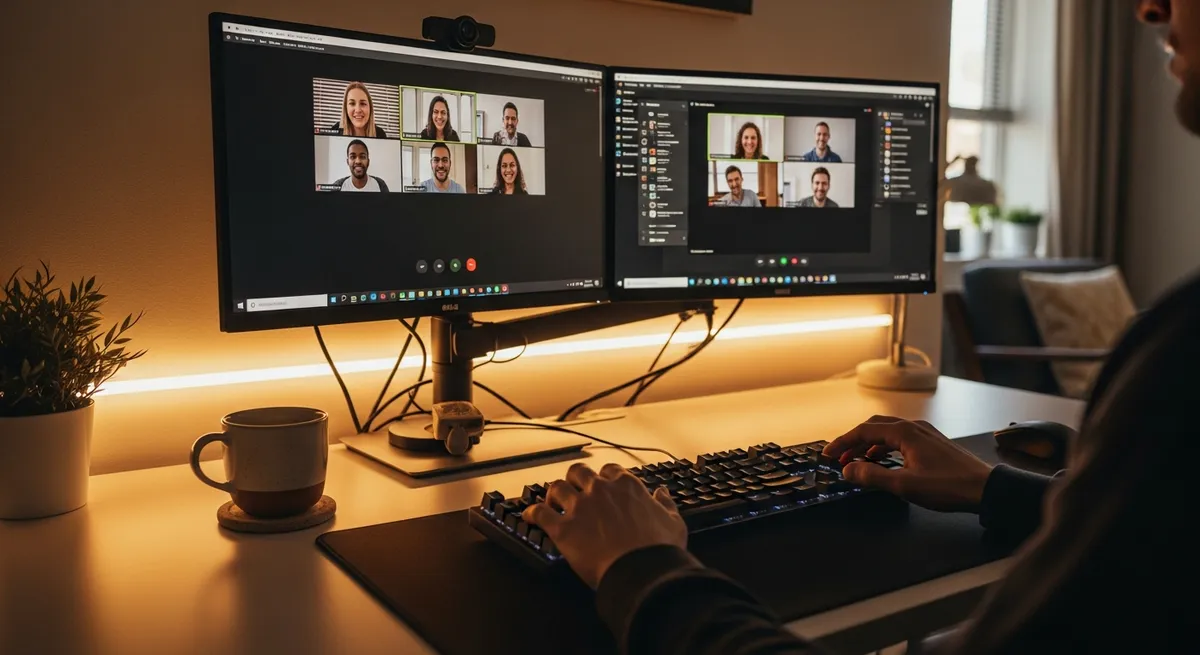
I have a buddy named Mark who calculates the cost of every meeting by the hourly rate of the people in the room. He once realized a forty-minute talk about the office holiday party cost the company four thousand dollars. (They ended up getting pizza, which cost eighty dollars.) This is the fiscal reality of our digital age. Video calls are the most overrated invention of the twenty-first century. I am convinced they are essentially a way to watch yourself age in real-time while trying to look interested in a spreadsheet. They require a level of intense eye contact that would be considered aggressive in any other context. If I stared at you that hard in a coffee shop, you would call the police. (I have tried it; the results were mixed.) We must admit that our current methods are not working. There is a massive difference between being connected and being collaborative. One is a technical state; the other is a human one. We keep clicking the little green icons like our lives depend on it, but we are not actually getting anything done.
How To Actually Talk To Each Other Without Losing Your Mind
We need to stop pretending that a shared document is the same thing as a conversation. It is not. Real collaboration requires a structure that is both rigid and forgiving. (Like a good pair of shapewear, I suppose, though I have less experience with those than I do with bad software.) My friend Sarah, who manages a team of thirty engineers from her basement in Ohio, swears by the "no-meeting Thursday" rule. She says it saved her sanity. I tried to implement that with Dave. He sent me a photo of his lunch at 10 AM on a Thursday instead. We are all learning. Some of us are learning slower than others. (Dave is currently in the remedial class.) When you have clear rules, the anxiety of the unknown starts to fade. I tell my contractors that if they need me, they can leave a message in the project portal, and I will check it at 4:00 PM. By 4:00 PM, Dave has usually figured out the answer himself, which is a wonderful side effect of my unavailability. (I call it "strategic neglect," and it is the only thing keeping me alive.)
Pro Tip
Establish a single "source of truth" for your projects. If you are using three different apps to track one task, you are not collaborating. You are just creating a digital scavenger hunt that nobody wants to play.
The Human Cost of the Pixelated Life
At the end of the day, we are social animals who have been forced into little glass boxes. We need to choose our tools carefully and set our boundaries firmly. (And perhaps buy a better charger for those headphones.) If we do not, the coordination costs will continue to eat into the time we saved by not commuting. I am optimistic that we will eventually get this right. We are currently in the "awkward teenager" phase of remote collaboration, where everything is clumsy and slightly embarrassing. But as we grow more comfortable with these platforms, we will learn to use them for their intended purpose - to help us work better, not just faster. Finally, do not forget the human element. Remote work can be incredibly lonely. I have started having very long conversations with the guy who brings my groceries about the weather in Ohio. (He is a lovely man named Derek who thinks I am slightly unhinged.) Schedule a "no-agenda" coffee chat once a week. Talk about movies. When you know that Gary is actually a decent guy who likes 1970s jazz, you are less likely to get annoyed when his internet fails during a presentation. Trust is the oil that keeps the machine running. Without it, your expensive software is just a very fancy way to be miserable together. I am going to close my laptop now. The cat has won. Arthur is starting his leaf blower. I am going to have a glass of wine and pretend I am in that Soho loft. (In reality, I am just going to stare at a wall and enjoy the silence.)
Frequently Asked Questions
How do I choose the right tools for my team?
You should start by identifying the specific friction points in your current process rather than looking at what is popular. (If everyone else is jumping off a digital cliff, you do not have to follow them.) If your team is struggling with version control on documents, look for a centralized cloud editor. If you are drowning in small questions, a structured chat platform might be better. Always prioritize tools that work well together to avoid creating data silos. (Silos are for corn, not for communication.)
What is the biggest mistake teams make when working remotely?
The most common error is trying to replicate the traditional office environment exactly in a digital space. This leads to excessive video meetings and "micromanagement by notification" which destroys focus. (Nothing kills a creative spark faster than a "just checking in" ping at noon.) Instead, teams should lean into the flexibility of remote work by emphasizing asynchronous communication and clear project outcomes over hours spent online.
How can I reduce video call fatigue?
You can start by making video an optional feature for most internal calls or by designating certain days as "meeting-free." When you do have video calls, try to keep them under thirty minutes and provide a clear agenda beforehand. (If there is no agenda, there is no meeting.) Many times, a well-written summary or a quick voice note can replace a thirty-minute face-to-face interaction entirely.
Is remote work actually productive?
According to research from the National Bureau of Economic Research, productivity can stay stable or even increase in remote settings when managed correctly. The key factor is whether employees are given the autonomy and the right tools to manage their own schedules. (Autonomy is a powerful drug.) Without proper structure, however, the coordination costs can eat into the time saved by not commuting.
How do I maintain team culture without an office?
You must be intentional about creating social opportunities that do not feel like forced fun. (Nobody wants a mandatory virtual happy hour.) This could include interest-based chat channels, occasional in-person retreats, or regular informal check-ins. Culture is built through shared experiences and mutual trust, which can happen through a screen as long as the interactions are genuine and frequent.
Disclaimer: This article is for informational purposes only and does not constitute professional career or management advice. Always consult with a human resources professional or organizational specialist before making major changes to your workplace structure. The experiences shared are personal anecdotes and may not reflect the specific needs of every organization.